
Asked to picture a short walk, older adults imagined four seconds. It took them six
Picture yourself walking across the room and back. A new study timed that picture in 85 adults in their seventies, then timed the real walk.
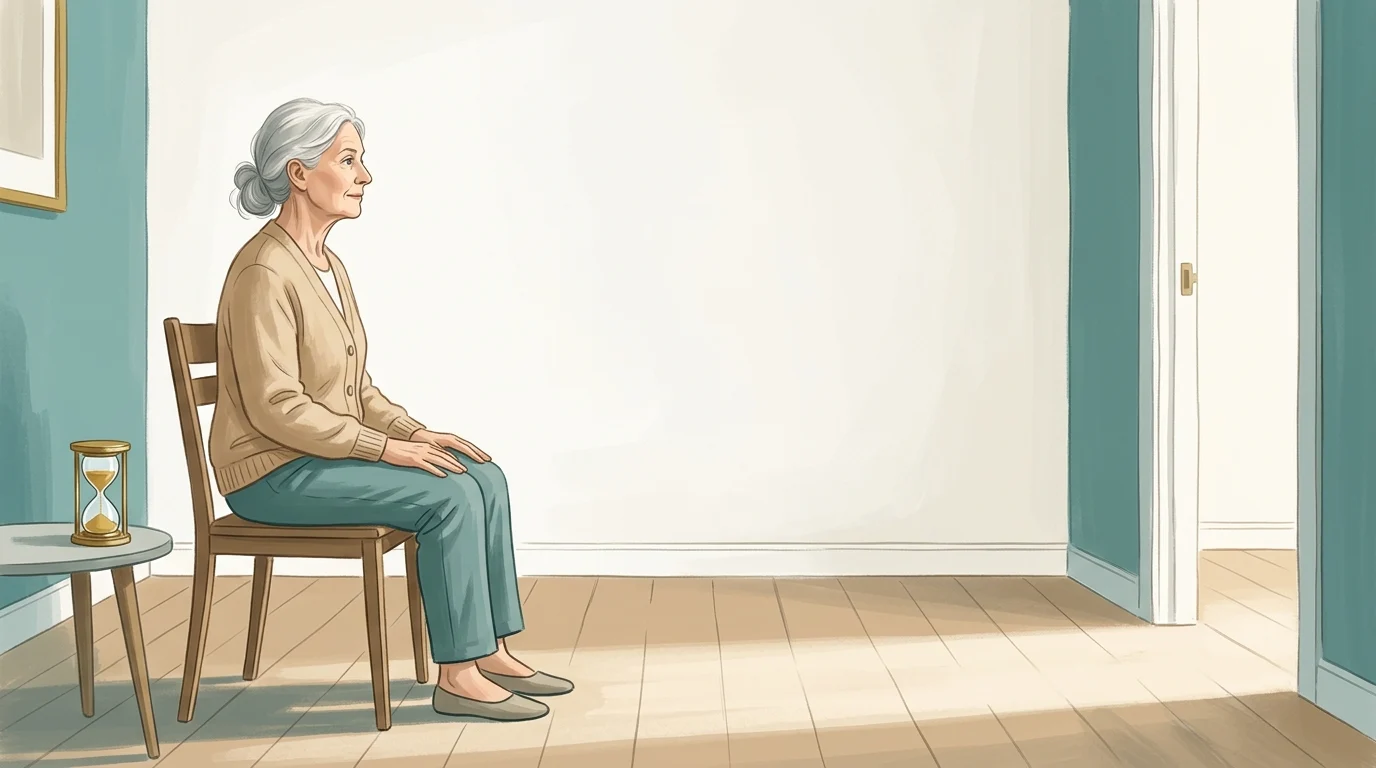
Sit in a chair and picture yourself standing up, walking to a mark a few steps away, turning, walking back and sitting down again. How long did that take in your head? For 85 people in their seventies tested in Japan, the answer was about four seconds. Walking it for real took them about six (Physiotherapy Theory and Practice, 2026).
What the study measured
The test is the Timed Up and Go, one of the most ordinary measures in geriatric care: stand from a chair, walk a short distance, turn, come back, sit. Its imagined version asks for the same course done only in the mind, with a stopwatch running while the person pictures it from start to finish. The difference between the two times is what researchers call the estimation error.
The new paper, from a rehabilitation team at Kameda Medical Center in Chiba and published online on 28 September, wasn't designed to ask whether older people misjudge themselves. It was a reliability study. Of 98 adults recruited, 85 were included; their average age was 76.1, 86% were women, all lived at home, and all had normal cognitive function. The question was whether the imagined test gives a stable reading.
Two examiners timing the same attempt at the same moment agreed almost perfectly. The same person repeating the imagined test within one sitting agreed only moderately: from one attempt to the next, a person's estimation error could drift by up to about 2.3 seconds through ordinary variation alone, which is more than the average gap itself. Since the stopwatches agreed so closely, that points to most of the wobble sitting in the imagining rather than in the timing.
So two findings sit side by side. On average, the picture ran about two seconds ahead of the body, a third less time than the walk actually took. And the picture did not hold still.
Why the gap interests fall researchers
The overestimation has a history. In 2013 a team in Tokyo showed 494 older adults a horizontal bar seven metres away, asked them to judge the highest bar they could step over, and then had them try; about one in nine of those aged 60 to 74, and about one in three of those over 74, could not clear the height they had chosen, while every young adult in the comparison group cleared theirs. Among people who had fallen in the previous year, 28% had overestimated, against 16% of those who hadn't (BMC Geriatrics, 2013). In 2020 a smaller study of 31 older adults found that those rated at higher fall risk walked narrow paths more slowly, yet pictured themselves walking them faster, so the gap between picture and walk was wider in that group (Brain Sciences, 2020).
None of this shows that the gap causes falls. These are associations, in fairly small groups, and the authors of the new paper are clear that the imagined test needs more study before clinics lean on it. What the three studies share is a plainer observation: the inner picture of how we move doesn't automatically update when the body changes.
A learning problem
Moshe Feldenkrais built the Feldenkrais Method® on the idea that we act according to the image we hold of ourselves, and that this image is learned, partial, and often out of date. Seen that way, a four second picture of a six second walk is not a failing. It is a map that stopped receiving updates. Maps get redrawn the way they were drawn in the first place, by moving slowly enough to notice what is actually happening. In Awareness Through Movement® lessons we often do a movement once in imagination, then once with the body, then compare. What I see again and again in my classes is surprise at what the picture left out: the weight travelling forward before standing, the eyes leading a turn. That surprise is the update arriving.
What to take from it
If you're curious, the experiment is easy to borrow, as long as you treat it as a noticing and not a test. Sitting in a chair you trust, picture standing up and walking to the door. Notice less how long it took and more what was missing from the picture. Did you feel your feet press into the floor, your weight move forward over them, your eyes find the doorway before your body turned? Then do it for real, slowly, going only where it feels easy, pleasant, and comfortable, and see which parts the picture skipped. Those blank places are where attention can go. If you'd like a gentle way into that kind of attention, this explainer on movement efficiency looks at how to sense what a movement costs you, rather than only how far or how fast it goes.
If you have had a fall, or walking has started to feel less certain, that's worth raising with your doctor or a physiotherapist, who can look at your balance properly; gentle awareness work sits alongside what they give you rather than replacing it. The Feldypedia entries on how the sense of where your body is changes with age and on balance and the fear of falling go further into both.
Six seconds in the body, four in the mind. Next time you get up from a chair, it might be worth asking whose walk you were picturing: the one you have now, or one from a few years ago?
Let Feldy guide you, eyes closed
A calm voice walks you through gentle moves so your attention stays in your body, not on the screen.
Try Feldy Free for 7 daysNo credit card needed.
Sources
- Intra-session reliability of the Imagined Timed Up and Go Test: intra- and simultaneous inter-rater analyses in community-dwelling older adults— Physiotherapy Theory and Practice, 2026
- Age-related self-overestimation of step-over ability in healthy older adults and its relationship to fall risk— BMC Geriatrics, 2013
- Increased Time Difference between Imagined and Physical Walking in Older Adults at a High Risk of Falling— Brain Sciences, 2020
Movement Pulse is informational, not medical advice. See our editorial policy.
Move better with Feldy
See the programMovement Pulse Weekly
The week's best research, in your inbox Tuesday.
Movement science, gentle-practice ideas, and a practitioner's read on what's new. Free.
More from Movement Pulse
Why twenty two years of research on imagining movement for back pain still says maybe
Large effects, very low certainty, and a direction that has not changed since 2004. What the arc of imagined movement research actually adds up to.
Aug 29, 2026
The body awareness that fades with age is not the body awareness that predicts function
Four studies across eleven years have quietly taken apart the idea that interoception is one ability sliding down one curve.
Aug 22, 2026
The part of you that learns new movement may not be aging the way you think
Two preregistered experiments compared young and older adults on the same reaching task. The age difference turned up somewhere most people would not expect.
Aug 1, 2026Ready to start moving better?
Gentle, guided lessons for your body. Try your first one free, no credit card required.