
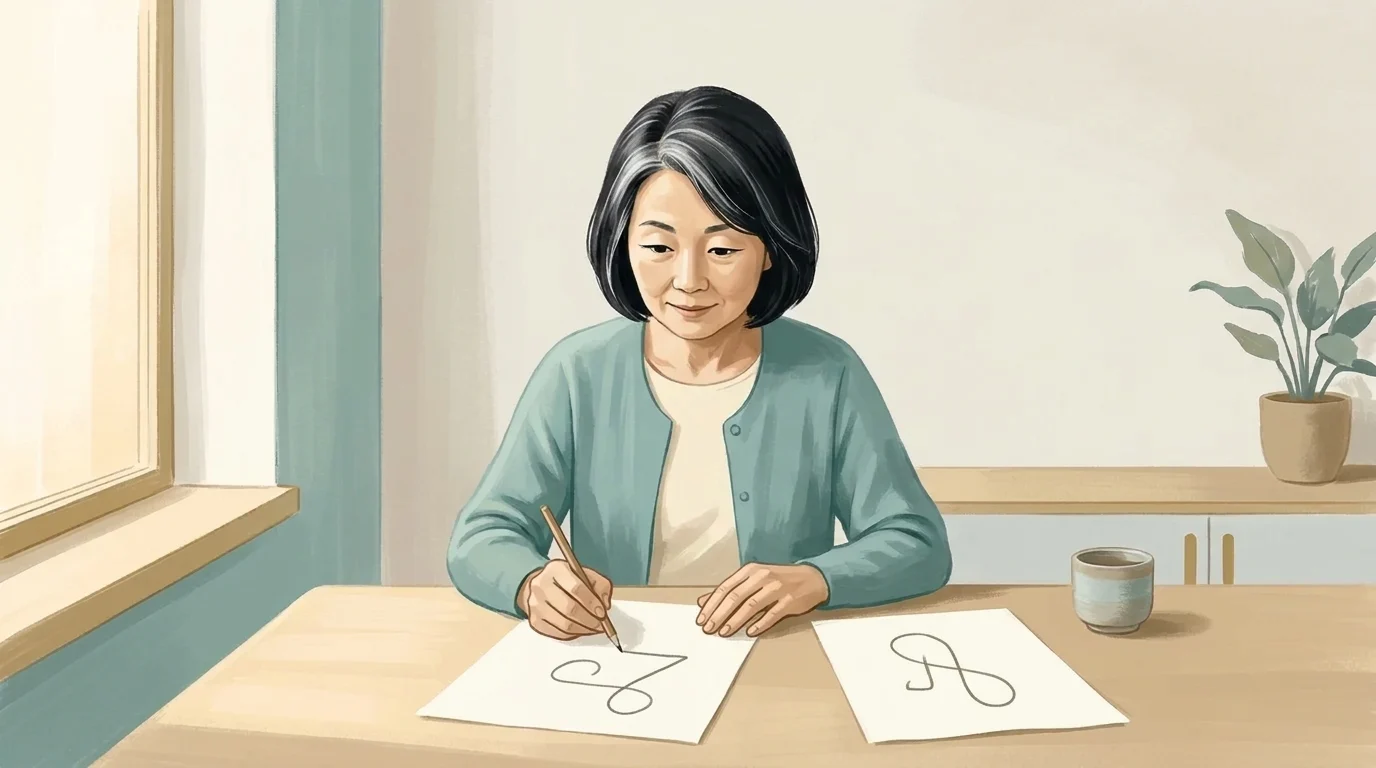
Practising a new movement sideways and upside down helped about as much as repeating it
Across 11 experiments, Yale volunteers practised unfamiliar symbols turned sideways or upside down. Their upright copies improved about as much as with plain repetition.
Eleven experiments. Around 650 volunteers. And one odd instruction: learn to write a symbol you have never seen, but practise it turned on its side, then upside down, then on its other side.
When people went back and copied the symbol upright, they had improved about as much as if they had simply practised the upright version itself (Nature Human Behaviour, 2026).
What the Yale team tested
The paper, by Zekun Sun, Zhiran Xie and Samuel McDougle at Yale University, was published on 19 October. According to the plans the team registered in advance, each round went the same way. Copy an unfamiliar handwritten character once. Practise it three times, rotated by 90, 180 and 270 degrees. Then copy it upright again. The score combined how closely each copy matched the model and how long it took to draw.
Rotating a shape changes far more than its look. As the authors describe it, the rotated versions called on substantially different movements underneath while keeping the same overall path. Different muscles, same path.
Then the team spent most of the paper asking whether something simpler could explain the result. Watching a program draw the symbol helped far less than drawing it rotated. Tracing other, unrelated symbols didn't account for it either, so it was not just a warm up for the hand. The benefit did not depend on having the model on screen, on continuous feedback about the path, or on picturing the movement in the mind. Following a moving dot along the rotated path was enough. The direction mattered, too: when the dot ran backwards, from the end of the symbol to its start, the practice carried over less. And in one experiment the gain crossed from one hand to the other.
Experiments 5 to 8 were registered in advance, and all the data and code are public (OSF, 2026); that's also where the count of about 650 people across the eleven experiments, after exclusions, comes from. The work was funded by the US National Institute of Neurological Disorders and Stroke.
Your signature, in chalk
Here's an everyday way to picture what the paper describes. Your signature is recognisably yours whether you write it small with a pen, large in chalk on a board using your whole arm, or slowly in wet sand with the tip of a shoe. The muscles are different each time, and so are the joints, the scale and the speed. Yet the shape stays yours. Movement scientists call this motor equivalence, and it has usually been treated as something skilled writers have after years of practice.
What this study adds is timing. The shape of a signature, it suggests, is not only what is left over after long practice: some version of it seems to be built in the first minutes of learning, and practising the shape with different muscles feeds the same store. The authors put it more cautiously, that the motor system "probably deploys abstractions in the earliest stages of skill acquisition."
Where the signature stops
The tasks were short, on screen, and used symbols nobody had written before. The gains were measured within the same brief practice round, so nothing here says how long they last. The volunteers were not people living with pain, stiffness, or a neurological condition. And handwriting is a hand skill: whether getting up from the floor or turning to look over a shoulder is learned the same way is a reasonable guess, not a finding.
How a lesson would approach it
In the Feldenkrais Method®, an Awareness Through Movement® lesson rarely leaves a pattern in one position. We might turn the head lying on the back, then lying on the side, then sitting, then with only the eyes moving, then imagine it on the other side. People sometimes ask why not just practise the version they need. This study offers one possible answer: each variation asks different muscles to draw the same shape, and the shape seems to be what the nervous system keeps. What I see again and again in my classes is that the movement someone came for feels clearer at the end of a lesson that spent most of its time on its relatives.
What to take from it
If a movement has become hard, the usual instinct is to drill that exact movement. This study, narrow as it is, hints that its relatives count too: the same reach done lying down, smaller, slower, with the other arm, or in another direction. The useful variation is the one where you go only where it feels easy, pleasant, and comfortable, so there is room to notice what changes. Methods differ on exactly this point; a side by side look at the Alexander Technique vs Feldenkrais shows one starting from the everyday activity itself and the other from varied explorations that are meant to carry over. Two Feldypedia entries go further, one on how coordination changes with age and one on how the Feldenkrais Method works.
Next time you sign your name, try it once slowly on a slant, or with the other hand. It will probably still look like yours, though you have never practised it that way. So where was that shape being kept?
Let Feldy guide you, eyes closed
A calm voice walks you through gentle moves so your attention stays in your body, not on the screen.
Try Feldy Free for 7 daysNo credit card needed.
Sources
- Motor abstraction training generalizes to the refinement of specific movement patterns— Nature Human Behaviour, 2026
- Motor abstraction training generalizes to the refinement of specific movement patterns (PubMed record)— PubMed, 2026
- Motor Abstraction Training: data, code and registered study plans— Open Science Framework, 2026
Movement Pulse is informational, not medical advice. See our editorial policy.
Move better with Feldy
See the programMovement Pulse Weekly
The week's best research, in your inbox Tuesday.
Movement science, gentle-practice ideas, and a practitioner's read on what's new. Free.
More from Movement Pulse
The part of you that learns new movement may not be aging the way you think
Two preregistered experiments compared young and older adults on the same reaching task. The age difference turned up somewhere most people would not expect.
Aug 1, 2026
Why gentle practice is what your body keeps
A July 2026 trial found that pain during practice cut how much of a new movement people still had a day later. Comfortable practice is what settles overnight.
Jul 19, 2026
The science of learning to move, split in two
A new Nature Human Behaviour paper says the study of how we learn to move split into lab and life, and makes the case for putting it back together.
Jul 8, 2026Ready to start moving better?
Gentle, guided lessons for your body. Try your first one free, no credit card required.