
A Gentle Hip Mobility Workout, the Feldenkrais® Way
A slow, attentive hip routine you do lying down. No reps to grind and no pushing, just small easy movements that ask your hips how they like to move.
Before you begin. This is gentle self care, not medical advice. Hip pain that sits on one side and lingers, follows a fall or injury, or wakes you at night deserves a diagnosis before you work on it at home. If you have a hip replacement, advanced osteoporosis, or pain that is sharp or travels down the leg, please check with your doctor or physical therapist first, and stop anything that hurts.
The lesson
About 8-12 minutes. Move slowly, do less than you can, and stay well below any pain. Rest whenever you need to.
Prefer to listen than read?
Feldy voices gentle lessons like this for knees and hips, so you can close your eyes and follow along.
- 1
Settling onto the floor. Lie on your back, knees bent, feet standing a little apart. Give the floor a few breaths to carry you.
- 2
A first look. Notice how your pelvis rests. Does one side press into the floor more clearly than the other?
- 3
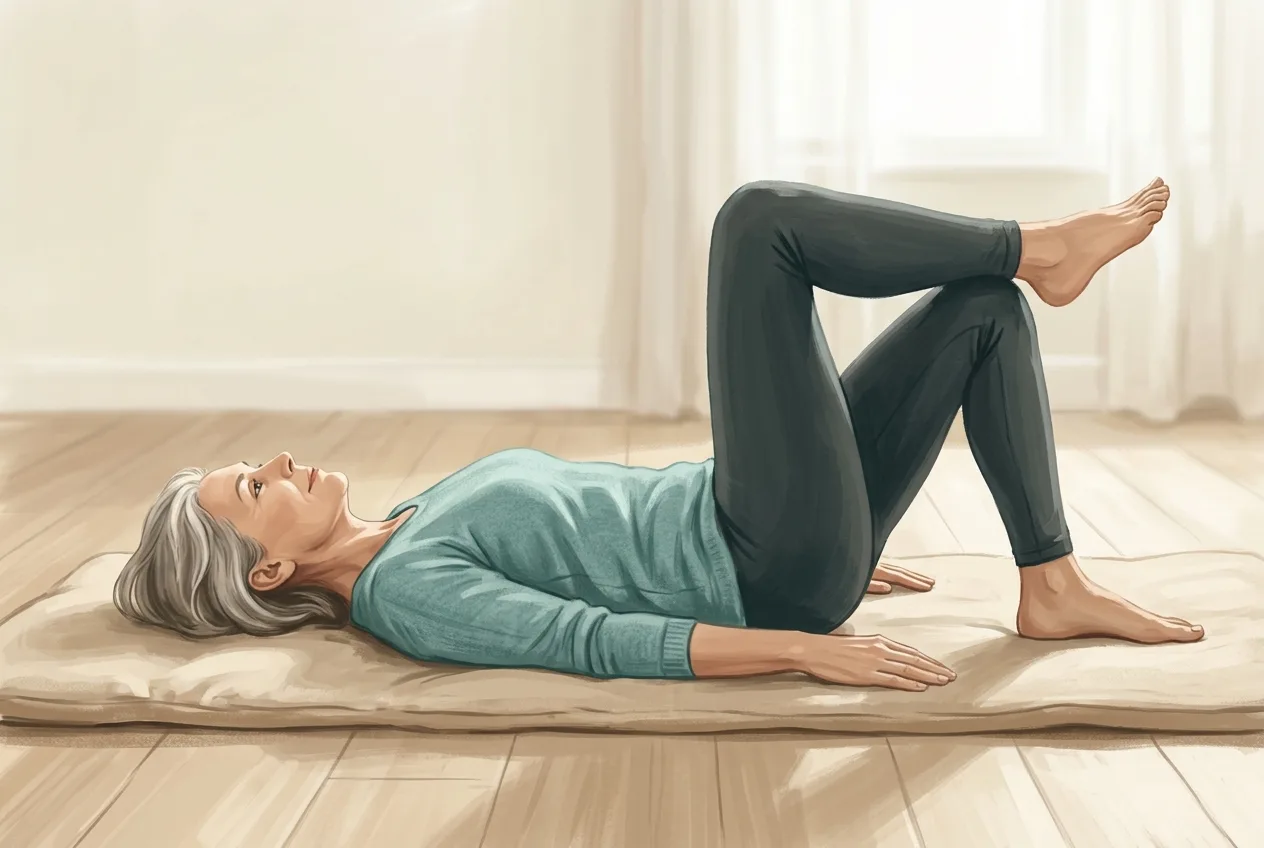
A knee pointing up. Lift one foot so that knee points to the ceiling. Let the knee draw a slow, small circle in the air.
- 4
The other way around. Circle the other way a few times. Where does the circle feel round, and where does it lose its shape?
- 5
A rest. Set the foot down and rest with both feet standing. Smaller circles next time if the hip complains.
- 6
The other hip. Lift the other foot and let that knee draw its own slow circles, each way. Is this circle a different shape?
- 7
Resting and noticing. Set the foot down, slide your legs long, and rest. How do your hips meet the floor now, compared with the start?
Let Feldy guide you, eyes closed
You just read these steps. In the Feldy program, a calm voice guides you through each gentle move, so your attention can stay in your body instead of on the screen.
Try Feldy Free for 7 daysNo credit card needed.
This hip mobility workout is done the Feldenkrais® way: slow, attentive hip movements, lying down, with curiosity doing the work that effort usually claims. If the word workout makes you picture lunges, bands, and gritted teeth, set that picture aside. Here a workout simply means a short, repeatable practice, a sequence your hips can return to every day without dreading it. The lesson above walks you through it: easy knee sways, slow hip circles, and small movements of the pelvis, none of them forced, all of them well inside comfort.
Stiff hips are common company. Osteoarthritis, one frequent reason joints lose their easy range, affected about 528 million people worldwide in 2019, with the knee most affected and then the hip (WHO, 2023). Yet a good share of everyday hip stiffness is not the joint itself but the muscles around it holding on, a quiet guarding that builds through long sitting, old aches, and habit. Guarding responds to a different invitation than a stretch does.
Why this hip mobility workout stays gentle
The hip is a deep ball and socket joint surrounded by some of the strongest muscles in the body. When those muscles sense threat, from pain or from a hard yank toward end range, they grip. An aggressive stretch can read as exactly that kind of threat. That is why hips that get stretched hard often feel tight again by evening.
Slow, small movement sends the opposite message. Easy, comfortable circles and sways give the nervous system time to feel that nothing bad is happening, and the grip tends to soften on its own. Our Feldypedia guide to hip stiffness and limited mobility explains this guarding pattern in more depth, and the Feldenkrais method builds its whole approach on it: attention, not effort, is the active ingredient.
Lying down matters too. On your back, your hips are off duty. They no longer have to hold you upright, so they can afford to explore. That is why every movement in this routine happens on the floor or a firm bed.
When to try a hip mobility workout like this
Good moments are the ones when your hips already have your attention: after a long stretch of sitting, before a walk, in the evening when the joints feel dry and reluctant, or first thing in the morning before the hips have warmed to the idea of moving. Because nothing here is strenuous, you can repeat the routine daily, and short daily visits are exactly how this kind of practice does its work. If you enjoy this sequence, the slower companion set in our hip mobility stretches lesson explores the same territory with a stretching focus, and our somatic exercises for hips make a kind next step. The Feldy program for knee or hip pain carries the same approach into a full library of guided audio lessons.
A note on where this sits. If you already see a physiotherapist or another clinician for your hip, this practice works alongside that care, not in place of it. Whether to involve a clinician at all is your call. If you would like this same slow work guided out loud, our 7 day free trial gives you one short lesson a day.
Who should skip it for now
Please put this routine on pause if your hip pain is severe, arrived after a fall or another injury, or comes with swelling, locking, or a leg that gives way. One sided hip pain that lingers for weeks, wakes you at night, or brings numbness or weakness down the leg deserves a diagnosis before home movement, not after. People with a recent hip replacement or advanced osteoporosis should ask their doctor or physical therapist which movements are suitable first. For ordinary stiffness, staying slow, small, and below any pain keeps this practice kind.
Find where to start
A short lying down routine suits many people, but not everyone works well with the same method. Some hips want the quiet attention of Feldenkrais, others do better with the structure of yoga or Pilates.
Curious which movement method your hips would choose? A few short questions on the Movement Match quiz, about two minutes, and it names the method most likely to suit you.
Common Questions about the hip mobility workout (FAQ)
What is the best hip mobility workout for stiff hips?
For hips that feel stiff or guarded, a gentle routine of small movements usually serves better than a demanding one. Slow knee circles, easy knee sways, and tiny pelvic rocks, all lying down and well within comfort, let the hip move through its range without provoking it. The lesson above is exactly that kind of routine, and it is short enough to repeat daily.
How often should I do a hip mobility workout?
Little and often beats long and rare. A few quiet minutes most days, or whenever your hips feel tight after sitting, tends to help more than one long session a week. Because every movement stays small and pain free, there is no soreness to recover from, so daily practice is realistic.
How long until a hip mobility workout shows results?
Many people notice a small change in one session, because part of hip stiffness is muscular guarding that can soften quickly. Change that lasts usually builds over several weeks of regular practice. Steady, easy repetition matters more than how far you move on any single day.
How is this different from a gym style mobility workout?
A gym mobility session usually chases range: deep lunges, long holds, load. This routine works the other way. The movements stay small, slow, and comfortable, and your attention does most of the work, teaching a wary hip that motion is safe. Yoga and Pilates also build hip mobility, each with a different mechanism, a different way of working with the body.
What should I avoid in a hip mobility workout?
Avoid forcing range, bouncing at the end of a movement, and working through sharp or pinching pain. Skip deep loaded positions while a hip is irritated, and drop any movement that leaves the joint feeling worse afterward. If a movement feels like too much, make it smaller or simply imagine it. Effort you have to brace against is a signal to ease off.
Is a hip mobility workout safe if my hip hurts, and who should skip it?
Slow movement within comfort is generally gentle on a sore hip, and many people find it soothing. That said, set it aside for now when the pain is intense, began with a fall or another injury, or arrives together with swelling, locking, or a leg that gives way. If you have a hip replacement or advanced osteoporosis, ask your doctor or physical therapist which movements suit you before starting.
When should I see a professional about hip pain?
Hip pain that stays on one side for weeks, wakes you at night, follows an injury, or comes with numbness or weakness down the leg deserves a proper diagnosis. So does pain in the groin that makes weight bearing hard. A clinician can name the cause and suggest which movement suits it, and gentle lessons like this one can then sit alongside that care.
Kinder movement for knees and hips
See the programRelated resources
Hip Mobility Stretches: A Gentle Lying-Down Lesson
Hip mobility stretches that ease stiff, gripping hips through small, slow, comfortable movement, with a short lying-down lesson you can do today.
Feldenkrais® for Tight Hips: A Gentle Fit Check
A Guild Certified Feldenkrais practitioner on why hips that feel tight are often hips that feel guarded, and what slow awareness lessons can offer.
Snapping Hip Syndrome Exercises: A Gentle Lying-Down Lesson
Snapping hip syndrome exercises done the gentle way: small, slow movements of the hip and pelvis that invite smoother paths for the leg, without chasing the snap.
Ready to start moving better?
Gentle, guided lessons for your body. Try your first one free, no credit card required.