

How Do You Stretch the Psoas Muscle: Gentle Movement
A gentle way to ease tension in the psoas, the deep hip flexor linking spine to thigh. Slow, small movements that invite the muscle to let go rather than force a stretch.
The lesson
About 5-10 minutes. Move slowly, do less than you can, and stay well below any pain. Rest whenever you need to.
Prefer to listen than read?
Feldy voices gentle lessons like this for lower back pain, so you can close your eyes and follow along.
- 1
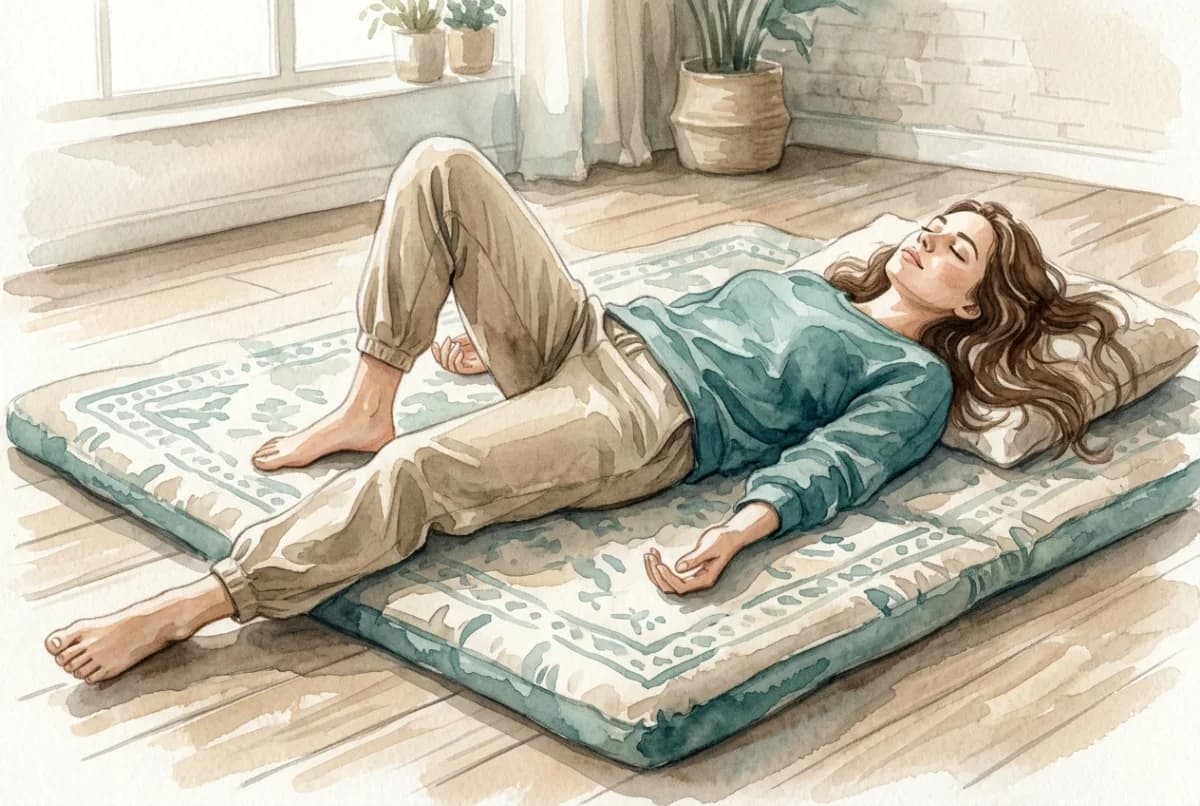
Arriving on the floor. Lie on your back with knees bent and feet standing. How much of the curve at your lower back floats away from the floor today?
- 2
The crease of one hip. Bring your attention to the front of one hip, where the thigh meets the torso. As you breathe, does that crease feel busy or quiet?
- 3
A leg growing long. Slowly slide one foot away until the leg lies long, then draw it back to standing, at the pace of a slow breath. A few gentle rounds, then rest.
- 4
A pause in the middle. Lie still for a few breaths with both feet standing. Let the hips be heavy.
- 5
A knee floating up. Let the other knee drift a little toward your chest and back down, only as far as is easy. Make it smaller or imagine it if the hip objects, then rest and let the sides trade roles.
- 6
Comparing the two hips. Return both feet to standing and be still. What, if anything, feels different between the two sides of your lower back and hips?
Let Feldy guide you, eyes closed
You just read these steps. In the Feldy program, a calm voice guides you through each gentle move, so your attention can stay in your body instead of on the screen.
Try Feldy Free for 7 daysNo credit card needed.
If you have been wondering how do you stretch psoas muscle without straining, the gentlest answer may surprise you: you mostly invite it to let go rather than pull on it. The psoas is a deep hip flexor that connects the lower spine to the top of the thigh bone, so when it holds tension you can feel it in the front of the hip, the lower back, or both. This page offers a slow, small approach drawn from the Feldenkrais Method®, which helps muscles release through attention and easy movement instead of force.
Hip flexor tightness is widespread, partly because so many of us sit for hours. The World Health Organization reports that low back pain is the single leading cause of disability worldwide, affecting 619 million people in 2020 (WHO, 2020), and the hip flexors often play a quiet role in how the lower back feels. Easing this area gently is a kind thing to do for your back.
How to release the psoas with gentle movement
The psoas does not respond well to being yanked into a deep stretch. Like any muscle held in a protective pattern, it tends to grip harder when forced. A softer path works better. When you move the leg slowly and let the front of the hip lengthen at its own pace, the nervous system gets the message that it can ease its grip. That release is what most people are really after when they ask how to stretch this muscle.
Because the psoas links spine to femur, the most comfortable movements involve the leg and the hip crease, not the back itself. When you slide a leg long or float a knee, the psoas lengthens and shortens naturally as part of an everyday action, which feels far kinder than holding a fixed lunge. You can read more about the principle behind this in our Feldypedia guide to the Feldenkrais Method.
It also helps to involve the breath. The psoas sits deep in the torso, close to the diaphragm, so an easy, unhurried exhale can quietly invite the whole front of the hip to settle. You are simply offering the muscle slow movement and calm breathing, and letting it respond in its own time.
Keeping it gentle and accurate
It helps to keep expectations grounded. The psoas is simply a hip flexor doing an ordinary job, not a storehouse of emotion or a switch you can flip. Releasing it gently can ease a feeling of tightness, and that is a worthwhile result on its own. If lower back or hip tension is persistent, comes with leg weakness or numbness, or follows an injury, please consult a doctor or physical therapist. This is gentle self-care, not a diagnosis. For a broader gentle approach to the lower back, see our lower back pain program.
Making the practice your own
Find a firm, comfortable surface and a few quiet minutes. There is no ideal range to reach and no count to hit. Keep each movement smaller and slower than feels necessary, let your breath stay easy, and rest between repetitions so you can notice what shifted. If a movement sharpens discomfort, make it smaller or pause for the day.
The same slow, curious quality runs through every lesson in the Feldy program, where the aim is more comfort and more options rather than a forced result. If you enjoy this gentle style, you may also like our somatic stretching exercises, which extends the same idea to the whole body. Over time, a relaxed hip flexor can leave your lower back feeling lighter and your stride a little freer.
Common Questions about releasing the psoas muscle (FAQ)
How do you stretch psoas muscle safely?
Gently and slowly, more by releasing than by pulling. The psoas is a deep hip flexor that links the lumbar spine to the top of the femur, so it responds well to small, unhurried movement and breath. Forcing a deep stretch can leave it more guarded, while inviting it to let go tends to work better.
What does the psoas actually do?
The psoas is a hip flexor. It runs from the vertebrae of the lower back to the top of the thigh bone and helps lift the leg and stabilize the spine. Because it links your back and your leg, tension there can be felt in the lower back, the front of the hip, or both.
Can a tight psoas cause lower back pain?
It can contribute to a feeling of tightness or pulling, since the muscle attaches to the lumbar spine. That said, lower back pain has many sources. Gentle movement may ease the sensation, but persistent pain deserves a professional assessment rather than self-diagnosis.
How often should I do this?
Once a day is plenty, kept short and gentle. The aim is steady, easy practice rather than a hard stretch. If a movement sharpens discomfort, make it smaller or rest that day.
Will I feel results right away?
Many people notice a little more ease in the same session, often a sense that one hip feels longer. A steadier change usually develops over weeks of unhurried practice, as the nervous system learns the area is safe to relax.
Should I see someone if it does not improve?
Yes. If hip or lower back tension lingers, worsens, or comes with weakness or numbness, please consult a doctor or physical therapist. This is gentle self-care, not a diagnosis or treatment for a specific condition.
A gentler way through back pain
See the programRelated resources
Can a Tight Psoas Cause Sciatica? A Careful Look
Can tight psoas cause sciatica? The answer is mostly indirect. The psoas is not the sciatic nerve, but its tension patterns can play a part. Here is the nuance, plus a gentle practice.
Gentle Exercises for the Back and Hips
Exercises for back and hips that link the pelvis, hip joints, and lower spine in one slow, easy floor and seated sequence, so a stiff hip stops loading the back.
The thing that stopped people finishing a pain education programme was not the schedule
Ready to start moving better?
Gentle, guided lessons for your body. Try your first one free, no credit card required.