

Stretches for Pregnancy Lower Back Pain
Gentle, pregnancy-safe stretches for pregnancy lower back pain, in side-lying, seated, and hands-and-knees positions. Soft and beginner-friendly, with safety first.
In short
Safe stretches for pregnancy lower back pain stay gentle and use pregnancy-friendly positions: a soft upward round and small hip arcs on hands and knees, easy seated breathing and arm reaches, and supported side-lying rest. Skip deep stretches and long spells flat on your back, and check with your OB or midwife first.

See how Feldy helps people with back pain move more comfortably
Gentle guided lessons you can do at home. Start with a free 7-day trial.
Before you begin. Gentle self-care, not medical advice. Pregnancy changes what is safe for your body, so please check with your OB or midwife before trying these movements, and stop if anything feels off.
The lesson
About 5-10 minutes. Move slowly, do less than you can, and stay well below any pain. Rest whenever you need to.
Prefer to listen than read?
Feldy voices gentle lessons like this for lower back pain, so you can close your eyes and follow along.
- 1
Hands and knees, supported. Come onto hands and knees on a mat, hands under shoulders and knees under hips, with a cushion under the knees if you like. Let your back rest in its natural shape.
- 2
A soft upward round. Let your lower back round upward a small amount, then return to an easy neutral, skipping any deep dip the other way. Keep it tiny, and rest when you have done a few.
- 3
Hips drawing an arc. Still on hands and knees, let your hips drift a little toward one side, back to the middle, then the other side. Small and smooth, then pause.
- 4
Sitting and breathing. Move to a firm chair and sit with your feet flat. Take a few slow breaths and notice how your back feels after the floor work.
- 5
One arm floating. Let one arm drift a small way out and up until a soft lengthening appears along that side, then return, staying well short of your full range. Change sides, or simply imagine it, then rest.
- 6
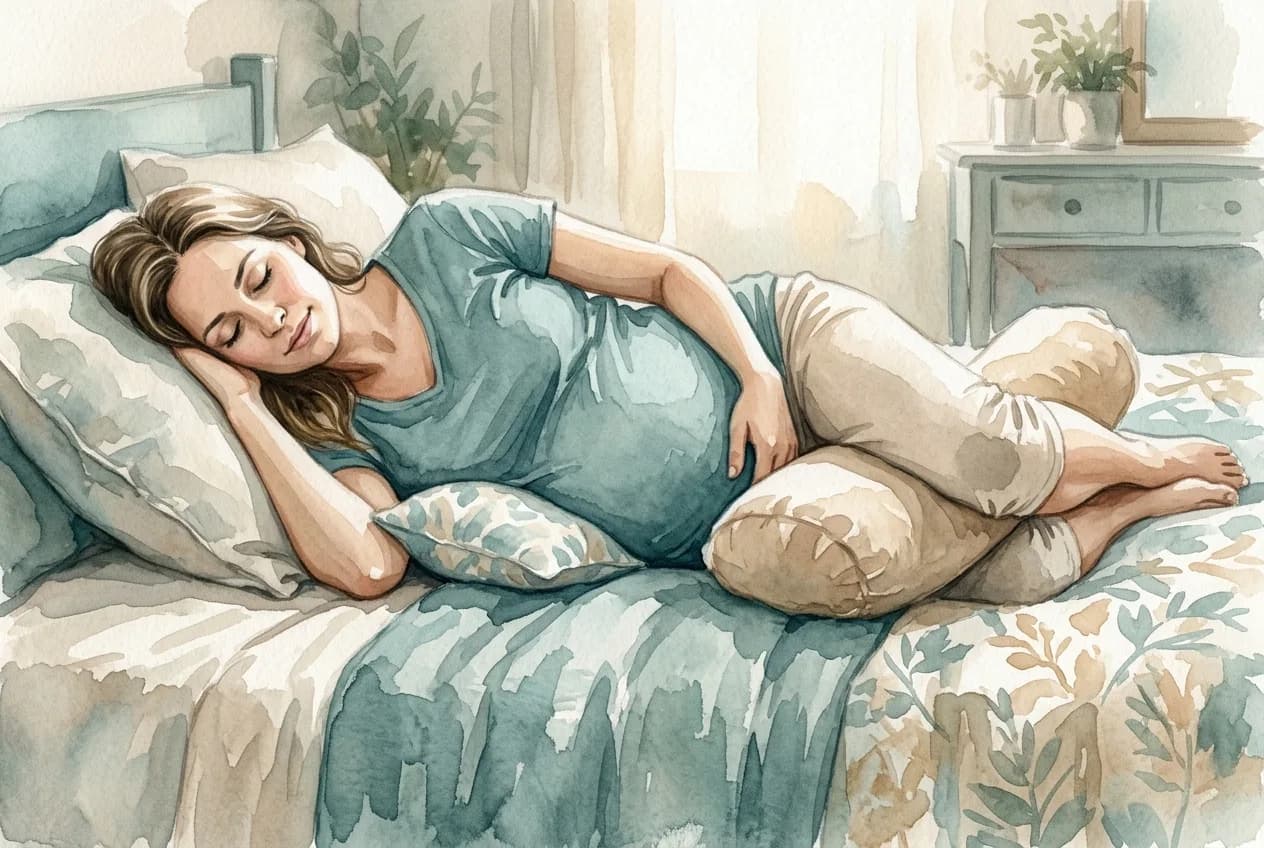
Side-lying and noticing. Lie on your side with a pillow between your knees and one under your bump, fully supported. What, if anything, feels different along your lower back compared with when you began?
Let Feldy guide you, eyes closed
You just read these steps. In the Feldy program, a calm voice guides you through each gentle move, so your attention can stay in your body instead of on the screen.
Try Feldy Free for 7 daysNo credit card needed.
If a growing bump has your lower back aching by the end of the day, these gentle stretches for pregnancy lower back pain offer a calm, supportive way to find a little more comfort. Before anything else, please check with your OB or midwife before you begin, since every pregnancy is different and they know yours. The movements here are meant as gentle comfort, never as a treatment, and they use positions that are kinder to a pregnant body. The slow, attentive quality comes from the Feldenkrais Method®, which favors small movement and easy attention over effort and force.
Back pain in pregnancy is extremely common. A Cochrane review reports that more than two thirds of pregnant women experience low-back pain and almost one fifth experience pelvic pain (Cochrane, 2015). A shifting center of gravity, added weight, and looser joints all play a part, which is why comfort measures matter so much.
What makes safe stretches for pregnancy lower back pain
Two ideas guide everything in the set above. The first is position. After the first trimester, lying flat on your back for prolonged periods can press on the vena cava, a large vein, and may leave you light-headed, so this set stays in side-lying, seated, and hands-and-knees positions instead. The second is gentleness. During pregnancy a hormone called relaxin softens your joints and ligaments to prepare for birth, which makes it surprisingly easy to overstretch. Staying well short of your end range protects those looser joints.
So you will not find deep twists, deep backbends, or big reaching stretches here. Instead the movements keep the spine quiet, let the hips and pelvis do small, easy work, and stay slow enough that you can feel each moment. You can read more about the underlying approach in our Feldypedia guide to the Feldenkrais Method. If sciatic-type sensations are also part of your picture, our gentle sciatica exercises take the same careful approach.
How to use this set during pregnancy
Find a firm, comfortable surface and keep a few pillows nearby for support. There is no range to reach and no count to hit. Make each movement smaller and slower than feels necessary, keep breathing easy, and rest whenever you like. Everything should feel comfortable. If a movement pulls, pinches, or simply does not feel right, make it smaller or skip it.
Please stop right away and contact your OB or midwife if you notice any pain, dizziness, vaginal bleeding, leaking fluid, or contractions. These are signals to pause and get professional advice rather than to push through. A prenatal physiotherapist can also tailor movement to your body if back pain is a regular companion. And if you would like the same slow, curious approach in fully guided audio lessons, the free 7 day trial is an easy way to begin.
The aim is simple: a little more comfort and a little more ease in how you move through your day, always within what feels good and always with your provider in the loop.
Common Questions about stretches for pregnancy lower back pain (FAQ)
Are these stretches for pregnancy lower back pain safe?
They are designed to be gentle and use pregnancy-friendly positions like side-lying, seated, and hands-and-knees. Even so, every pregnancy is different. Please talk with your OB or midwife before starting any new movement, and stop if anything feels wrong.
Why avoid lying flat on my back?
After the first trimester, lying flat on the back for long stretches can press on a large vein and may leave you feeling dizzy or short of breath. Side-lying, seated, hands-and-knees, and standing positions are more comfortable and are what this set uses.
Why should I not stretch deeply during pregnancy?
A hormone called relaxin loosens your joints and ligaments to prepare for birth, which means it is easier to overstretch without realizing. Keep every movement gentle and well short of your end range to protect those looser joints.
When should I stop and call my provider?
Stop right away and contact your OB or midwife if you notice any pain, dizziness, vaginal bleeding, fluid leaking, or contractions. These movements should always feel comfortable. Anything beyond that needs professional attention.
How common is back pain in pregnancy?
Very common. Reviews in journals such as the Cochrane Database report that a large majority of pregnant people, often cited as roughly half to two thirds, experience low back or pelvic pain at some point. Gentle movement is one comfort measure many find helpful.
Can these stretches fix the cause of my back pain?
No. They are a gentle comfort measure, not a treatment. Pregnancy back pain often comes from shifting weight, a changing center of gravity, and looser joints. Use this set for comfort alongside the guidance of your OB, midwife, or a prenatal physiotherapist.
A gentler way through back pain
See the programRelated resources
How to Lie Down With Lower Back Pain: Easier Positions
How to lie down with lower back pain using supported, neutral positions, plus how to get onto a bed or floor and back up by rolling rather than twisting.
Best Resting Position for Sciatica: Easing the Nerve
The best resting position for sciatica keeps the spine neutral and takes pressure off the nerve, with supported back-lying and side-lying setups plus tiny gentle movements between rests.
The thing that stopped people finishing a pain education programme was not the schedule
Ready to start moving better?
Gentle, guided lessons for your body. Try your first one free, no credit card required.