
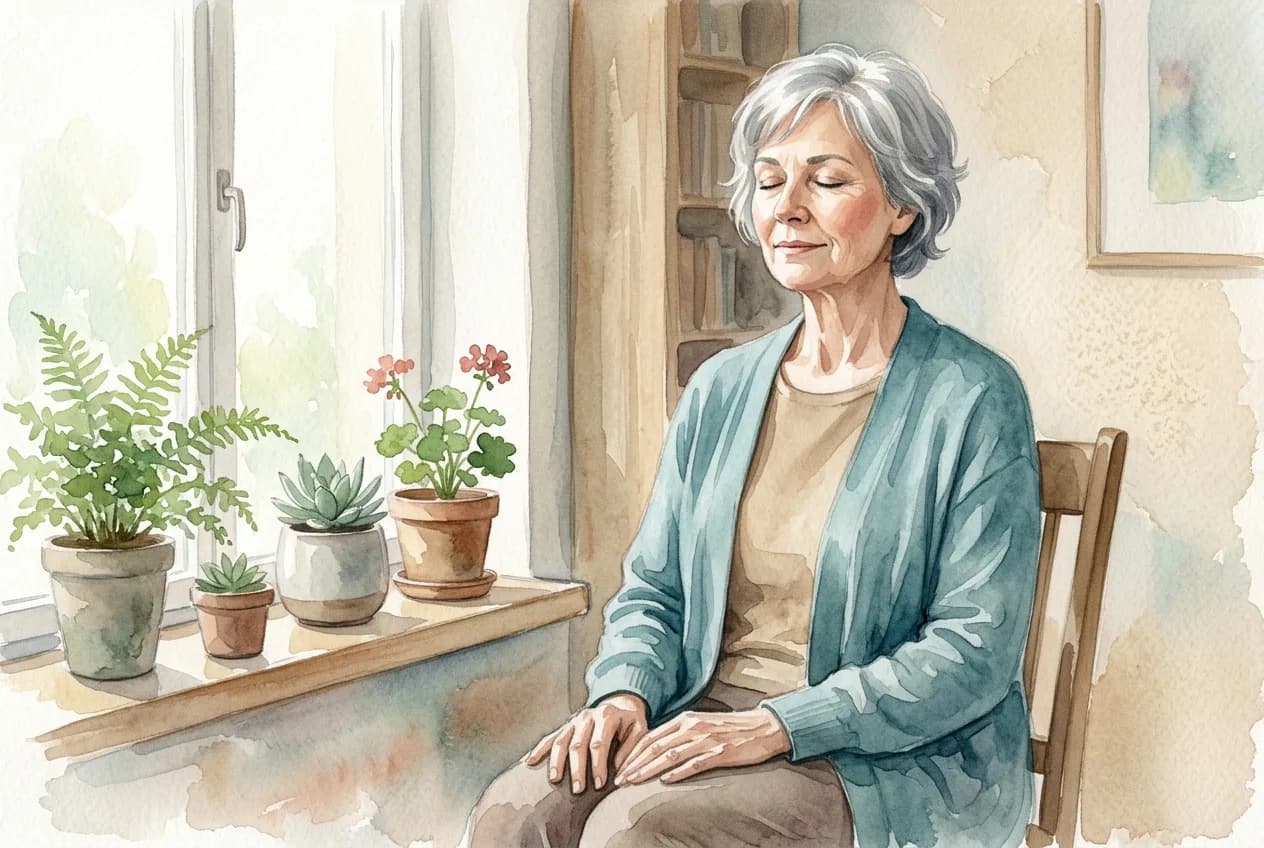
Cervical Proprioception Exercises: Gentle Movement to Try
Cervical proprioception exercises use slow, attentive movement to sharpen your sense of where your head and neck rest, so the neck feels steadier and moves with more ease.
In short
Cervical proprioception exercises train your inner sense of where your head and neck rest. The gentlest way in: sit comfortably, close your eyes, turn your nose a small amount to one side, return to where center feels to be, then open your eyes and check. Small, slow, and unhurried, with rests between rounds.

See how Feldy helps ease neck and shoulder tension
Gentle guided lessons you can do at home. Start with a free 7-day trial.
Before you begin. This is gentle self-care, not medical advice. If your neck symptoms followed an injury such as whiplash, or come with numbness, tingling, arm weakness, or strong dizziness, please check with a doctor or physical therapist before you begin. If closing your eyes leaves you unsteady, keep them open and make every movement smaller.
The lesson
About 5-10 minutes. Move slowly, do less than you can, and stay well below any pain. Rest whenever you need to.
Prefer to listen than read?
Feldy voices gentle lessons like this for neck and upper back, so you can close your eyes and follow along.
- 1
The weight of the head. Sit comfortably with your feet flat and hands in your lap, closing your eyes if that is easy. How heavy does your head feel balanced over your neck right now?
- 2
An inner sense of center. With eyes closed, ask where straight ahead is for your nose. There is nothing to arrange, only an inner sense to notice.
- 3
Turning and returning. Slowly turn your nose a small amount to one side, then bring it back to where center feels to be, and open your eyes to see where you landed. Rest a breath before trying again.
- 4
The other direction. Close the eyes and let the nose drift a little the other way, then float home to your felt center. Does one side feel clearer than the other?
- 5
A pause with eyes open. Sit easily and breathe for a few rounds. Let the neck be quiet.
- 6
Standing and sensing. Stand up slowly and take a few steps. What, if anything, feels different about where your head rests over your spine?
Let Feldy guide you, eyes closed
You just read these steps. In the Feldy program, a calm voice guides you through each gentle move, so your attention can stay in your body instead of on the screen.
Try Feldy Free for 7 daysNo credit card needed.
If your neck feels tense, stiff, or slightly unsure of where it is, cervical proprioception exercises can help it feel steadier and move with more ease. Proprioception is your inner sense of where a body part rests and how it is moving, and the neck is especially rich in it, because it feeds so directly into balance and the steadiness of your gaze. The Feldenkrais Method® works exactly here, through slow, attentive movement that sharpens that inner sense rather than forcing the neck into a position or chasing a stretch.
The neck is one of the most commonly troubled parts of the body. Neck pain is among the most widespread musculoskeletal conditions worldwide (WHO, 2022), and long hours leaning toward screens leave many people with a neck that quietly holds on. When the small muscles stay switched on for hours, the inner read on where the head rests can grow faint, and that haziness is part of why a neck can feel both tense and oddly hard to place.
Why cervical proprioception matters
Your head weighs about as much as a small bowling ball, balanced on a slender column of vertebrae packed with sensors. Those sensors tell your brain where your head is pointing, and that information helps steady your balance and your vision. When the neck is braced for long stretches, or after a strain, the signal can become muddier. The result is sometimes tension, sometimes a vague sense of being off, and often a neck that no longer trusts its own middle. Telling yourself to sit up straight rarely helps, because the nervous system has no fresh information to work with.
How gentle movement sharpens the sense of where you are
Cervical proprioception exercises interrupt that loop through awareness rather than effort. When you find your sense of center with the eyes closed, then check, the brain gathers new information about where the neck actually rests. Given that clearer picture, the holding can soften, balance can feel steadier, and movement can flow more easily, because the neck knows itself better. Nothing is being corrected. You are simply refreshing the map your nervous system reads from.
It is worth remembering that healthy posture is never still. No single fixed position is the one to lock into, so what you gain here is a broader set of choices, not one ideal shape to clutch. This way of working, attention before effort, is the thread inside every Feldy lesson, each one inviting the body toward easier movement without grasping for more range. The Feldypedia guide to the Feldenkrais Method covers it in more detail, the article on proprioception decline with age explains why this sense fades and how movement supports it, and when the neck and upper back are what you most want to care for, the neck and upper back program goes further.
Before you begin
Give yourself a calm few minutes and a chair you can sit in easily. Nothing here needs to be reached for, and there is no posture to land on. Keep the pace slow, do less than you are able, and pause as often as you like. If a movement brings on pain, make it smaller or set it aside, and if closing your eyes leaves you unsteady, keep them open and shrink the movements further. The short lesson below is one gentle way to refine your feel for where the neck sits, and it is there whenever your neck would welcome a little attention. For a related practice, see our lesson on Feldenkrais for neck tension and our forward head posture exercises.
Common Questions about cervical proprioception exercises (FAQ)
What are cervical proprioception exercises?
They are gentle movements that train your inner sense of where your head and neck are in space, known as cervical proprioception. Rather than stretching or strengthening, they ask you to notice and find positions with your eyes closed, then check, so the neck builds a clearer, more reliable map of itself. That map is part of how you balance and move smoothly.
Who might benefit from cervical proprioception exercises?
People with long standing neck tension, a head that drifts forward at a desk, or a sense of being slightly off balance often find this kind of sensing practice helpful. Because the neck feeds heavily into balance, sharpening its position sense can support steadiness as well as ease of movement. It is gentle enough for most people to explore.
How are these different from neck stretches or strengthening?
Stretches chase more range and strengthening chases more force. Proprioception practice instead refines awareness, the sense of where the neck rests and how it moves. The movements stay small and slow, and the work is in the noticing. Many people find that as awareness improves, both comfort and easy movement follow.
How often should I practice?
Short and frequent works well. A couple of brief rounds spread through the week is a gentle place to start, and many people enjoy a few minutes after long screen time or before bed. Little and often tends to build a clearer sense of the neck than one long session.
How soon might I notice a difference?
Some people feel the neck moving more freely and finding center more readily after a session or two. A steadier, clearer sense tends to grow across a few weeks of unhurried, regular practice. We all differ, and even small progress counts.
Are these safe if my neck is sensitive or I feel dizzy?
Small, slow movement that stays below any pain suits a sensitive neck well. If you feel dizzy, build up very gradually and keep the movements tiny, and pause if dizziness rises. If your symptoms followed an injury, or come with numbness, arm symptoms, or strong dizziness, check with a healthcare professional before you begin.
A softer neck, a freer upper back
See the programRelated resources
Deep Cervical Flexors Exercises: A Gentle Lying Lesson
A quiet lying down lesson for the small muscles at the front of the neck. No holds, no counting, just tiny slow nods and close attention.
Can Tight Neck Muscles Restrict Blood Flow to the Brain?
Can tight neck muscles restrict blood flow to the brain? Almost never. But neck tension does produce lightheadedness by other routes, and those are worth knowing.
Why neck pain trials keep working on the mid back, and what the pain score misses
Ready to start moving better?
Gentle, guided lessons for your body. Try your first one free, no credit card required.