
Deep Cervical Flexors Exercises: A Gentle Lying Lesson
A quiet lying down lesson for the small muscles at the front of the neck. No holds, no counting, just tiny slow nods and close attention.
Before you begin. This is gentle self care, not medical advice. See a doctor before starting if your neck pain comes with numbness, tingling or weakness in an arm or hand, if it followed a fall or a car accident, or if you notice dizziness or trouble swallowing. If any movement sharpens pain, stop.
The lesson
About 8-10 minutes. Move slowly, do less than you can, and stay well below any pain. Rest whenever you need to.
Prefer to listen than read?
Feldy voices gentle lessons like this for neck and upper back, so you can close your eyes and follow along.
- 1
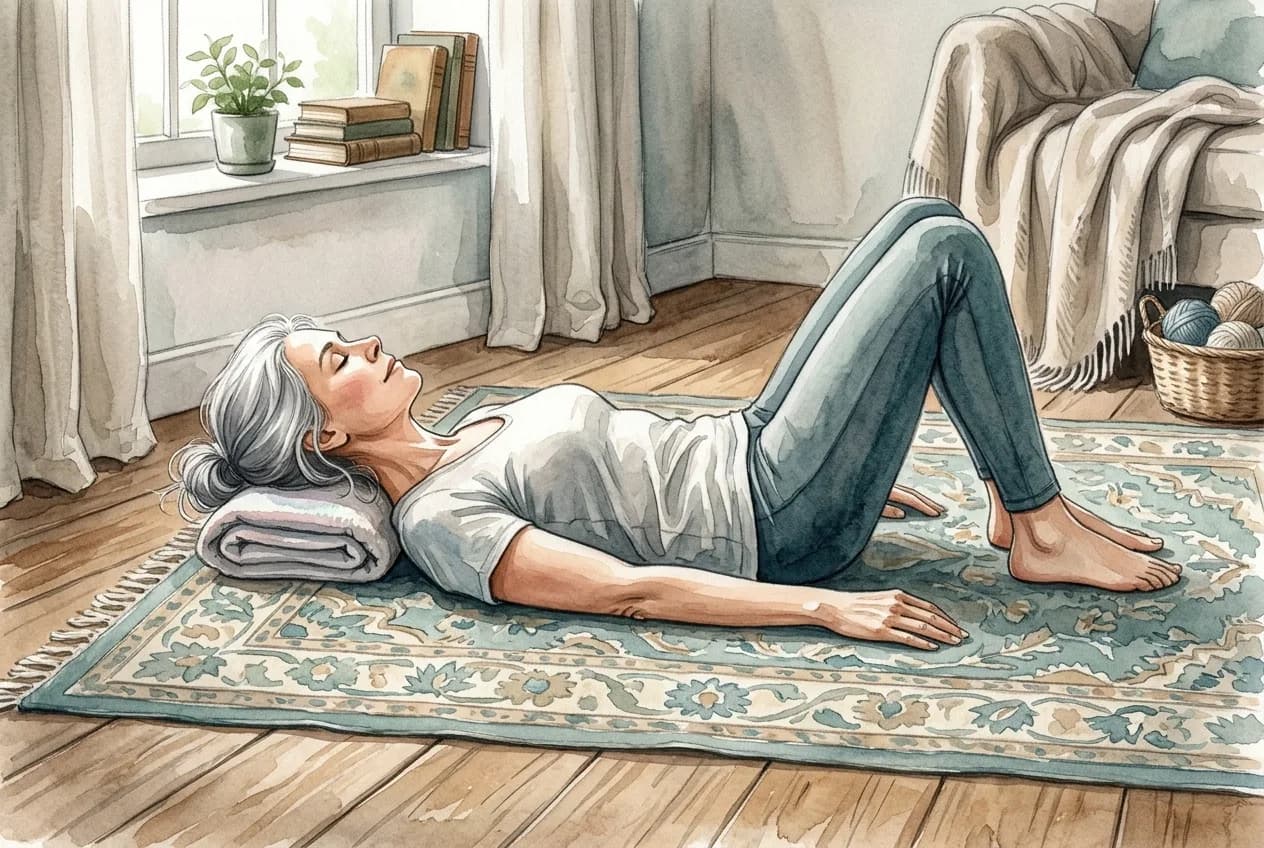
On your back. Lie on your back with your knees bent. A thin folded towel under your head if the floor feels hard.
- 2
The starting state. Sense where the back of your head presses down. Does the back of your neck feel long or short?
- 3
Beginning a yes. Move your chin a hair toward your throat, as if starting to say yes, then let it go. Smaller than seems worthwhile.
- 4
A rest, then more. Stop and rest. Then repeat the tiny nod a few times, slowly. Can your jaw stay soft while the chin travels?
- 5
The breath. Rest and let one breath out a little longer than usual. What does the front of your neck do as the air leaves?
- 6
The other way. Now move your chin a hair away from your throat, just as small, then return and rest. Only imagine it if anything complains.
- 7
The closing scan. Lie still and feel how your head meets the floor now. What, if anything, is different from the start?
Let Feldy guide you, eyes closed
You just read these steps. In the Feldy program, a calm voice guides you through each gentle move, so your attention can stay in your body instead of on the screen.
Try Feldy Free for 7 daysNo credit card needed.
Most deep cervical flexors exercises look the same wherever you find them: pull the chin back, hold for ten, repeat. The lesson on this page takes a different route. Instead of drilling holds, it invites tiny, slow nodding movements done lying down, small enough that you can feel the difference between the big muscles gripping and the deeper ones doing quiet work. The approach comes from the Feldenkrais Method®, a form of movement education that changes how you use yourself by paying close attention, not by adding effort.
What the deep cervical flexors actually are
The deep cervical flexors are a small group of muscles lying deep at the front of your neck, close against the spine. The main two are called longus colli and longus capitis. Unlike the muscles you can grab at the side of your neck, these sit behind the throat, out of reach of your fingers. Their job is quiet postural support: they steady the head from the front so the muscles at the back do not carry everything alone.
When the head spends hours forward of the shoulders, over a screen or a steering wheel, these deep muscles tend to go quiet. The bigger surface muscles take over, and that takeover is often what an aching, tired neck feels like by late afternoon. If you want the fuller story of these muscles, our companion guide explains what these muscles are in more depth, and our Feldypedia article on desk posture and chronic neck pain covers how the forward head builds up in the first place.
The forward head rarely travels alone. It usually keeps company with extra rounding of the upper back, and that rounding is common: an estimated 20 to 40 percent of older adults live with age related hyperkyphosis, the exaggerated forward curve of the upper spine, and while exercise has shown some benefit in the higher quality trials, the evidence overall is still thin (Katzman et al., 2014). So this is a widespread pattern, not a personal failing, and the claim for any exercise here is modest.
Why these deep cervical flexors exercises skip the holds
The conventional exercise for this area is the chin tuck, also called craniocervical flexion, usually done with deliberate effort and timed holds. Physiotherapists often prescribe it as a training programme, and if you already see a physiotherapist, this page sits alongside that work rather than replacing it. If you are curious about the classic drill, we have written about it in our gentler take on chin tucks for forward head posture.
The lesson above chooses a different doorway. Lying on your back hands the weight of your head to the floor, so the surface muscles have nothing left to brace against. From there, a nod of a millimetre or two is enough to feel something most people have never noticed: whether the throat and jaw join in when the head moves. Nobody can promise you this will make the deep muscles stronger, and this page does not. What the lesson offers is information. You learn what quiet work at the front of the neck feels like, and once you can feel it, you have somewhere to return to during an ordinary day.
How to get the most from the lesson
Slowness is the whole method. A slow nod gives your nervous system time to notice detail, and detail is what changes habits. Keep the movement so small that a person watching from across the room would miss it. If your breath pauses or your jaw tightens, treat that as useful news and make the movement smaller still, or simply imagine it. Imagined movement is a real practice here, not a consolation prize.
Where this leads, for many people, is a neck that spends less of the day braced. If ordinary exercise leaves you sore the next day, or if effort has never solved your neck, this quieter route may suit you. The lesson on this page is a taste of how Feldy works: short daily Awareness Through Movement® lessons you follow by voice at home, with a free 7 day trial to see whether the approach fits you. And to be straightforward about the science, Feldenkrais research is still limited and the trials are small, so promising is the accurate word, not proven.
Common Questions about deep cervical flexors exercises (FAQ)
What are the deep cervical flexors and why do they matter?
They are a small group of muscles lying deep at the front of the neck, close to the spine, mainly longus colli and longus capitis. Their job is quiet, steady support of the head, the kind you never feel from outside. When the head sits forward for hours they tend to go quiet, and the bigger surface muscles take over work that was never theirs, which is often felt as an aching, tired neck.
Who should skip deep cervical flexors exercises?
Check with a doctor first if your neck pain arrived with numbness, tingling or weakness in an arm or hand, if it began after a fall or a car accident, or if you have dizziness or trouble swallowing. Those signs need assessment before any self guided movement. For everyone else, the rule is simple: stay small, stay slow, and stop if a movement sharpens pain.
How often should I do these exercises?
A few quiet minutes most days works better than one long, determined session a week. Because these muscles do their job all day, every day, the useful thing is frequent gentle reminders rather than occasional effort. Once a day is a fine rhythm, and twice is plenty.
How long until I notice anything?
Some people feel the back of the neck resting differently by the end of the first lesson, mostly because the surface muscles were given a genuine pause. A steadier change in how the head sits through the day tends to take a few weeks of relaxed, regular practice. Comfort is a better guide than any calendar.
How is this different from a standard chin tuck routine?
A standard chin tuck routine asks you to draw the chin back with some effort, hold it for a count, and repeat in sets. This lesson removes the effort and the holds. The nod is tiny, slow, and done lying down, so you can feel the difference between gripping with the big surface muscles and letting the deeper ones do quiet work. Clinicians often prescribe the effortful version, and it sits alongside this rather than being replaced by it.
What should I avoid when working the deep cervical flexors?
Avoid force, speed, and big ranges. If you feel your throat clench, your jaw clamp, or your breath stop, the movement has become too large or too fast, so make it smaller. Avoid pushing into any pain, and avoid holding your chin in a fixed position for long counts, since gripping is exactly the habit this lesson is trying to interrupt.
Can I do these deep cervical flexors exercises sitting up?
Yes, once the lying version feels familiar. Sitting, the head is no longer supported, so the surface muscles have more reason to join in. Keep the nod even smaller than it was on the floor and let the back of the neck stay long. Lying down remains the easiest place to learn the feeling, and a quiet minute at a desk is a good way to revisit it during the day.
A softer neck, a freer upper back
See the programRelated resources
Neck Hump Exercises: A Gentle Lesson for the Upper Back
Neck hump exercises built as one slow, quiet lesson: tiny nods, easy head turns, and breath felt in the upper back, so the head can rest over the spine.
Posture Yoga, the Feldenkrais® Way: Sensing Before Shape
A seated lesson that borrows the ideas behind common posture poses, mountain, cat and cow, a small twist, and trades holding a shape for noticing how your head balances.
With neck pain, the shoulder blade shift you make yourself may outlast one done for you

Ready to start moving better?
Gentle, guided lessons for your body. Try your first one free, no credit card required.