
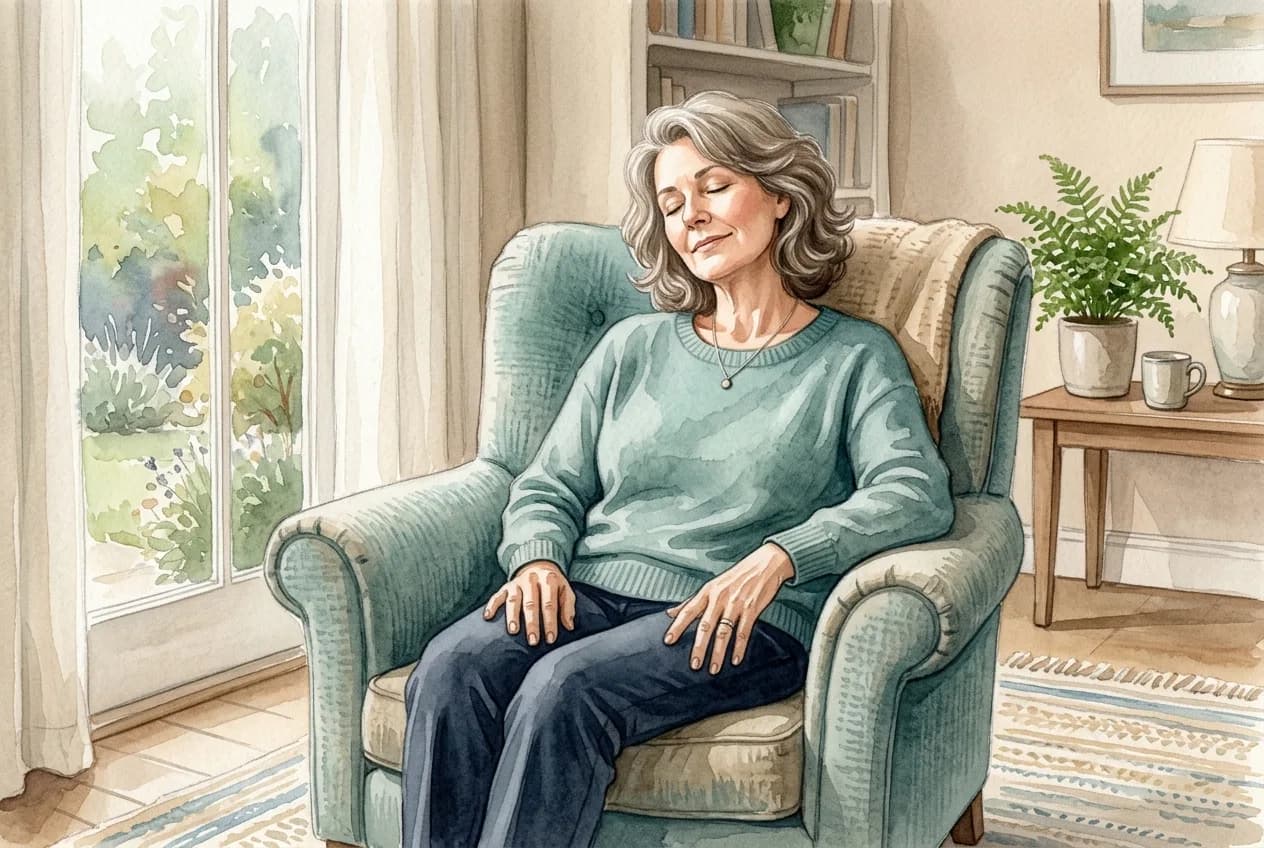
Neck Tension Headache Stretches: A Gentle Feldenkrais® Lesson
Neck tension headache stretches, done the gentle way: small, slow neck and jaw movements that invite a held, aching head to feel lighter and quieter.
Before you begin. This lesson is gentle self care, not medical advice. Keep every movement small, slow, and comfortably below any pain. See a doctor for a new, severe, or sudden headache unlike any you have had before, for a headache with fever, a stiff neck, vision changes, weakness, or numbness, or for a headache that follows a head injury. These quiet movements suit the ordinary held tension of a tension type headache, not a headache you are worried about.
The lesson
About 5 to 10 minutes. Move slowly, do less than you can, and stay well below any pain. Rest whenever you need to.
Prefer to listen than read?
Feldy voices gentle lessons like this for neck and upper back, so you can close your eyes and follow along.
- 1
Settling in. Sit or lie somewhere comfortable. Close your eyes if that is pleasant, and notice the weight of your head.
- 2
A soft jaw. Let your teeth part a little so the jaw hangs easy. Where does your neck seem busiest right now?
- 3
Small turns. Slowly turn your head a small way toward one side, then back through the middle. A few times, stopping in the middle whenever you like.
- 4
A pause. Let the turning go and rest for a few breaths. Smaller if anything stirs the headache, or only imagine it.
- 5
The other side. Turn a small way toward the other side a few times, just as slowly. Which side feels easier?
- 6
Resting again. Pause and let everything settle. Notice your neck, your jaw, and the space behind your eyes.
- 7
Comparing with the start. Take one easy breath and sense yourself as a whole. How does your head sit on your neck now, compared with the start?
Let Feldy guide you, eyes closed
You just read these steps. In the Feldy program, a calm voice guides you through each gentle move, so your attention can stay in your body instead of on the screen.
Try Feldy Free for 7 daysNo credit card needed.
Neck tension headache stretches of a quieter kind can help when a tension headache settles in, because the neck usually has something to say about it. The short lesson above offers small, slow, attentive movements for the neck and jaw, all of them kept comfortably below any pain. There is nothing to push into and nothing to hold. You move a little, notice a lot, and rest often. Many people find that when the neck receives this sort of unhurried attention, the whole head begins to feel less gripped.
This kind of headache is remarkably ordinary. The World Health Organization notes that episodic tension type headache, the everyday variety most of us recognize, is reported by more than 70 percent of some populations (WHO, 2025). And it rarely travels alone. It tends to arrive with company: shoulders drawn up a little, a jaw held closed a little too firmly, a subtle squint around the eyes and forehead. If you would like the fuller picture of that pattern, our Feldypedia page on tension headaches explores it gently.
Why these neck tension headache stretches stay small
The lesson on this page borrows from the Feldenkrais Method®, an approach built on curiosity rather than effort. In a Feldenkrais® lesson, a movement is kept small and slow on purpose, because a nervous system learns most easily when nothing feels urgent. A neck that has been quietly working all day does not need one more demand placed on it. It seems to respond better to a lighter question: could this be easier?
That is why you will find no pulling, no holding a position until it burns, and no counting to thirty. Instead you turn the head a little, nod a little, and pause often to sense what changed. In Feldenkrais® work the pauses matter as much as the movements. They give you a moment to notice the difference between how the neck felt before and how it feels now, and noticing is where the softening tends to begin.
Where neck tension headache stretches fit among other approaches
It helps to be clear about what a five minute lesson is and is not. Painkillers act through the body's chemistry, and firmer stretching acts on muscle length. Both are simply different mechanisms, and this lesson is not in competition with either. What gentle, attentive movement offers is a way to meet the holding itself, the habit of gripping around the neck, jaw, and eyes that a headache day so often carries.
Clinical care has its own place too, and this kind of practice sits alongside it rather than replacing it. If you enjoy this lesson, two neighbouring pages continue the thread: a broader guide on how to relieve a tension headache, and a floor lesson in Feldenkrais for neck tension. And if your neck asks for this kind of attention often, the Feldy program for neck and upper back turns it into a guided daily practice, with a free 7 day trial to begin.
Before you begin
A few quiet minutes and a comfortable chair, sofa, or patch of floor are all you need. Move at perhaps half the speed you first want to, and make each movement smaller than you think it needs to be. Rest whenever you like, and if anything stirs up pain, let that movement become tinier still or leave it out entirely. One caution deserves plain words: a sudden headache far worse than any you have known, or a headache with fever, a stiff neck, vision changes, weakness, numbness, or one following a head injury, is a reason to see a doctor promptly rather than a reason to practise. This lesson is for the familiar, ordinary tightness of a tension headache, nothing more.
Common Questions about neck tension headache stretches (FAQ)
Can gentle neck movements really help a tension headache?
For many people, yes, though everyone responds in their own way. The muscles around the neck, jaw, and scalp often take part in a tension headache, and slow, attentive movement gives them a chance to do less. Think of the lesson as an invitation the body may accept, rather than a guarantee.
Is it safe to do these stretches during a headache?
During an ordinary tension headache, small and slow movement within a comfortable range is generally fine, and resting often is built into the lesson. A headache that is sudden and unusually severe, or that arrives with fever, a stiff neck, vision changes, weakness, or numbness, or one that follows a knock to the head, needs a doctor first, not a movement lesson.
How often is it worth practising?
Little and often tends to suit a busy neck best. A few quiet minutes most days, or whenever you feel the familiar tightening begin, usually offers more than one long session a week.
How long until I feel a difference?
Some people notice their head resting more easily after a single quiet lesson. For headaches that visit regularly, change tends to build gradually over weeks of unhurried practice, so let your expectations stay soft.
How is this different from stretching hard or taking a painkiller?
A strong stretch works on muscle length, and a painkiller works through the body's chemistry. Both are simply different mechanisms, neither better nor worse. The movements here work through attention, letting your nervous system notice the holding and quiet it from the inside.
When should I see a professional about my headaches?
If your headaches are new, changing, becoming frequent, or getting in the way of your life, it is worth talking to a doctor. Gentle movement sits alongside clinical care rather than replacing it, and the two combine comfortably.
A softer neck, a freer upper back
See the programRelated resources
How to Relieve a Tension Headache: A Gentle Approach
How to relieve tension headache pressure by easing the neck, jaw, and shoulder tension behind it. A gentle, natural approach, plus the warning signs that need a doctor.
Feldenkrais® for Neck Tension: Gentle Lessons That Help
Feldenkrais for neck tension uses slow, attentive movement to ease the holding patterns behind a stiff neck. Here is how it works, plus a short lesson to try.
With neck pain, the shoulder blade shift you make yourself may outlast one done for you
Ready to start moving better?
Gentle, guided lessons for your body. Try your first one free, no credit card required.