
Posture Exercises for Kyphosis: Gentle Rounded-Back Movement
Posture exercises for kyphosis use slow, gentle movement to ease a rounded upper back and invite more comfortable length, without strain or force.
Before you begin. Gentle self-care, not a treatment. If you have or suspect osteoporosis or osteopenia, avoid forceful forward bending of the spine and check with your doctor or physical therapist before starting.
The lesson
About 5-10 minutes. Move slowly, do less than you can, and stay well below any pain. Rest whenever you need to.
Prefer to listen than read?
Feldy voices gentle lessons like this for neck and upper back, so you can close your eyes and follow along.
- 1
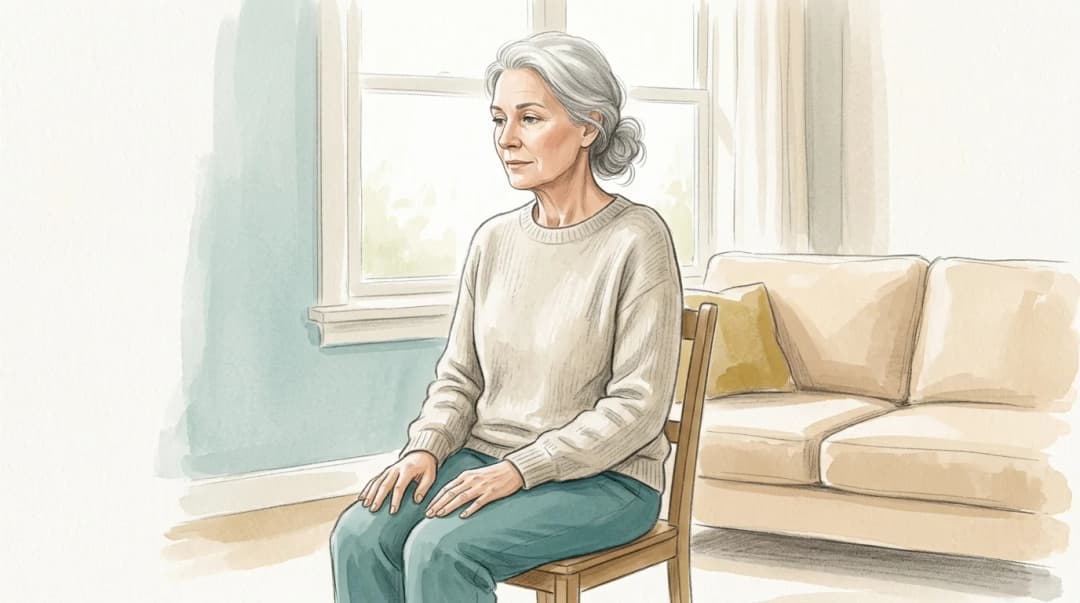
On a firm chair. Sit toward the front of a firm chair, both feet flat, hands on your thighs.
- 2
Upper back shape. Sense the shape of your upper back without changing it. Where does your head balance above it?
- 3
Blades drifting down. Let both shoulder blades slide a little down your back, toward your hips, then drift back up. Slowly, a few times.
- 4
Sitting quietly. Stop and rest for a few breaths with your hands in your lap. Smaller if anything pulls, or only imagine it.
- 5
Where it reaches. Slide the blades down again and notice your breastbone and the back of your neck. Do they take part?
- 6
One blade alone. Try sliding only the right blade down and up, then only the left. Which side moves more easily? Then rest.
- 7
The upper back, after. Sit still and sense your upper back and head once more. What, if anything, is different from when you started?
Let Feldy guide you, eyes closed
You just read these steps. In the Feldy program, a calm voice guides you through each gentle move, so your attention can stay in your body instead of on the screen.
Try Feldy Free for 7 daysNo credit card needed.
If your upper back has grown more rounded over the years and you would like to feel a little taller and more open, gentle posture exercises for kyphosis can help, as long as they stay slow, small, and comfortable. Kyphosis is the forward curve of the upper spine, and a degree of it is normal. This page offers a short, seated set that draws on the gentle-movement principles of the Feldenkrais Method® and related somatic approaches, which work by inviting easier movement rather than forcing the body into a shape.
A meaningful number of older adults live with increased thoracic curvature. Research summarized in geriatric literature suggests that roughly 20 to 40 percent of older adults show some degree of hyperkyphosis, and the proportion rises with age (Kado, 2009). The aim here is not to remodel the spine, which gentle movement cannot do, but to help the upper back, neck, and shoulders feel more comfortable and to give you more options in how you carry yourself.
A safety note before you begin
This matters, so please read it. Many people with a rounded upper back, especially older adults, also have osteoporosis or osteopenia, in which forceful or loaded forward-bending of the spine can raise the risk of injury. For that reason, keep every movement gentle, avoid deep or forced spinal flexion, and do not push into any end range. If you know or suspect you have low bone density, or if you have pain or an increasing curve, please check with your doctor or physical therapist before trying these movements. When in doubt, smaller and slower is always the safer choice.
How these posture exercises for kyphosis work
These movements do not try to hold you in a straighter position. Instead, they invite the upper back, ribs, and shoulder blades to explore a little more easy range, and they give the nervous system fresh information about where the head balances on the spine. When the body has more options, it often settles into a more comfortable, open carriage on its own. You can read more about this gentle, awareness-based approach in our Feldypedia guide to the Feldenkrais Method.
This is the heart of the Feldy program, where short lessons guide slow, curious movement that builds ease rather than forcing alignment. If a rounded upper back or ongoing neck and upper-back tension is part of your daily experience, the program for the neck and upper back offers a fuller, guided path.
Moving with curiosity, not force
As you work through the seated set above, treat each movement as a question rather than a task. Where does the breath move? Which side turns more easily? What feels a little more open after you rest? You are not holding a posture or bracing into place. You are offering the upper back gentle, low-pressure practice and letting it find more comfortable options. If you would like a companion practice for the same region, our guide to Feldenkrais for neck tension explores the connected territory of the neck and shoulders.
Keep everything well below any pain, avoid forcing your spine into deep bends, and let comfort be your guide. Easing how you move and feel is a worthwhile goal in itself, and it is one your upper back can keep practicing for years. When you feel ready to explore this with a guiding voice, Feldy free for seven days gives a rounded upper back a week of slow, careful lessons in which to notice what opens.
Common Questions about posture exercises for kyphosis (FAQ)
Can posture exercises for kyphosis straighten a rounded back?
Gentle movement can help the upper back feel more open and comfortable, and may improve how easily you carry yourself. It does not reverse structural changes to the spine. Think of it as easing how you move and feel, not as straightening bone. A doctor or physical therapist can advise on your specific situation.
Are these exercises safe if I have osteoporosis?
Caution is important here. Many people with kyphosis, especially older adults, also have osteoporosis or osteopenia, where forceful or loaded forward-bending of the spine can be risky. Keep movements gentle, avoid deep or forced spinal flexion, and check with your doctor or physical therapist before starting, particularly if low bone density is known or suspected.
How gentle should the movements be?
Very gentle. Every movement here should feel small, slow, and well below any pain or strain. If a movement feels like effort or pulls, make it smaller or skip it. More force does not bring faster results and can do harm.
How long until I notice a change?
Some people feel a little more open and at ease within one session. Lasting change in how you move and feel usually develops with regular, gentle practice over weeks. Be patient and let comfort guide you.
When should I see a professional?
See a doctor or physical therapist if your rounding is increasing, if you have pain, if you have or suspect osteoporosis or osteopenia, or before starting any new movement routine. Professional guidance is especially important for a structural change in the spine.
What is the difference between postural and structural kyphosis?
Postural kyphosis relates to habitual movement and positioning and tends to be more flexible. Structural kyphosis involves changes to the bones or discs themselves. Gentle movement may help comfort and ease in both, but it cannot remodel structure. A clinician can tell you which you have.
A softer neck, a freer upper back
See the programRelated resources
Posture Yoga, the Feldenkrais® Way: Sensing Before Shape
A seated lesson that borrows the ideas behind common posture poses, mountain, cat and cow, a small twist, and trades holding a shape for noticing how your head balances.
Hunched Over Posture: Why It Happens and What Helps
Hunched over posture is usually a habit of holding, not damage. Here is why it settles in, and the kind of attention that helps it change.
With neck pain, the shoulder blade shift you make yourself may outlast one done for you
Ready to start moving better?
Gentle, guided lessons for your body. Try your first one free, no credit card required.