
What Does Double Jointed Mean? The Answer
Nobody has two joints. Here is what people are really describing when they say double jointed, when it matters, and when it is simply an unusual party trick.
In short
Double jointed is everyday language, not a medical term, and it does not mean what it sounds like: nobody has extra joints. What people mean is that a joint travels further than the usual range, which clinicians call joint hypermobility. For many it causes no trouble at all; for some it comes with pain, instability, or fatigue.

Prefer to ease in gently?
See a few gentle exercises for hypermobility to try.
Before you begin. Hypermobility ranges from harmless extra range to conditions that need proper care. If you have bendy joints alongside frequent pain, joints that partly slip out of place, marked fatigue, unusually stretchy or fragile skin, or digestive or heart symptoms, ask your doctor about assessment for hypermobility spectrum disorder or hypermobile Ehlers Danlos syndrome. With hypermobile joints, the goal of movement is steadiness and control, not more flexibility.
What does double jointed mean, in the end? Not what the phrase implies. Nobody has two joints where other people have one, and there is no doubling of anything. It is everyday language for a joint that travels further than most, and the term clinicians use instead is joint hypermobility. Some degree of it is common: in one study using a strict Beighton cutoff, about 12.5% of university students met the threshold for generalised joint hypermobility (PeerJ, 2019).
The phrase usually turns up in a specific context: someone bends a thumb back to the forearm, hyperextends an elbow, or folds into a shape that makes everyone else wince. What is actually happening is that the ligaments and joint capsule around that joint allow more travel than average, and the bone surfaces may be shaped to permit it. If the elbow is your particular party trick, our comparison of double jointed elbows and typical ones looks at that joint up close.
Where the extra range comes from
Ligaments and joint capsules are made largely of collagen, and the properties of a person's collagen vary and are substantially inherited. That is why hypermobility often shows up across a family. Two other things contribute: the shape of the bone ends themselves, which differs between people, and habitual muscle tone, which sets how much a joint is held in check moment to moment.
That last point is the useful one. Bone shape and collagen are not going to change. How steadily you can hold and move through your range is a skill, and skills can be practised. Our Feldypedia article on hypermobility and joint instability goes into how the extra range and the wobbliness relate to each other. If steadiness is the skill worth practising, a sensible first step is our set of exercises for hypermobility, all kept slow and well inside your range.
When double jointed matters and when it does not
For a great many people it never becomes an issue. One trick thumb, one elbow that goes a bit further, and nothing else to report. The picture changes when the extra range travels with other things: joints that ache after ordinary use, a knee or shoulder that feels like it might not hold, a habit of knocking into doorframes, or a level of tiredness that does not match the day.
That cluster is what distinguishes plain flexibility from symptomatic hypermobility, and it is worth taking to a doctor rather than sitting with. Our comparison of hypermobile versus flexible is the clearest place to see that line drawn, and if you want to know how clinicians actually measure the trait, our guide to the Beighton scale walks through the nine points. Where a diagnosis is on the table, our comparison of EDS and hypermobility sets out how the terms differ.
Why the goal is steadiness, not more range
This is the part most often got backwards. Someone discovers they are unusually bendy, concludes they are naturally suited to stretching, and heads for the classes that reward the deepest shape. For a body that already has plenty of range, that adds to the thing there is no shortage of and neglects the thing there is.
A joint with lots of travel and little sense of where it is tends to feel unreliable. What helps is the opposite of stretching: slow, attentive movement in the middle of the range, where you build a clearer picture of where your limbs are and how they are supported. The Feldenkrais Method® works this way as a matter of course, which is why it suits hypermobile bodies, and it is the approach behind Feldy's lessons. Our explainer on exercises for hypermobility syndrome is the practical next step if that is where you are.
A note on language
If you have grown up being told you are double jointed, there is nothing wrong with using the phrase. It communicates perfectly well. The reason it is worth knowing the more accurate term is practical: searching for joint hypermobility brings you information written for adults with a body like yours, while searching for double jointed mostly brings you party tricks. The words you use shape what you find.
Stability without gripping
Now for stability that does not rely on gripping. The Feldy program builds a clearer sense of where the body rests, so steadiness grows from awareness, through Feldenkrais® lessons. Gentle, guided, and self-paced.
Start my free 7-day trialNo credit card needed.
Common Questions about what double jointed means (FAQ)
Is being double jointed the same as being hypermobile?
Broadly yes. Double jointed is the kitchen table version of joint hypermobility, which simply means a joint moves beyond the range considered typical. Clinicians avoid the phrase because it suggests an anatomical doubling that does not exist. What actually varies is the make up of your connective tissue and the shape of the joint surfaces.
Is being double jointed bad for you?
Not in itself. Plenty of people have one or two very mobile joints, never think about it, and live entirely unbothered. It becomes worth attention when the extra range comes with recurring pain, joints that feel unreliable or partly slip, clumsiness, or fatigue that outstrips the activity. That combination is what turns an interesting quirk into something worth discussing with a clinician.
What causes joints to be double jointed?
Mostly the properties of your connective tissue, the collagen rich material that makes up ligaments and joint capsules, which is largely inherited. The shape of the bone surfaces and habitual muscle tone play a part too, which is why the trait often runs in families and why some people can add range through years of training while others start with it.
Can you make yourself double jointed with stretching?
You can increase your range with persistent training, but that is a different thing from the inherited trait, and it is not a goal worth chasing. For anyone whose joints already travel a long way, more flexibility is generally the wrong direction. What tends to help is control through the range you already have, so the joint feels steady rather than merely bendy.
What kind of exercise suits double jointed people, and what should be avoided?
Slow, attentive movement that builds a clear sense of where your joints are in space tends to serve better than anything that chases range. Avoid hanging in end range positions, avoid deep passive stretching, avoid locking the elbows and knees fully straight when you stand or bear weight, and be wary of classes that reward the deepest shape in the room. Steadiness first, range second.
When should I see a professional about hypermobile joints?
Speak to a doctor if bendy joints come with recurring pain, dislocations or partial dislocations, marked fatigue, unusually stretchy or fragile skin, or symptoms involving digestion, heart rate, or blood pressure. Those combinations warrant assessment for a hypermobility spectrum disorder or hypermobile Ehlers Danlos syndrome. A physiotherapist experienced with hypermobility is the most useful movement professional to find.
Stability without gripping
See the programRelated resources
Hypermobility Exercises to Avoid (and Gentler Choices)
A calm guide to the hypermobility exercises to avoid, or approach with care, and the slower, steadier movement that tends to serve a loose-jointed body better.
Double Jointed Elbows vs Normal: Should You Worry?
Double jointed elbows bend past straight into hyperextension. A normal elbow stops near straight. What it means, whether to worry, and how to move well.
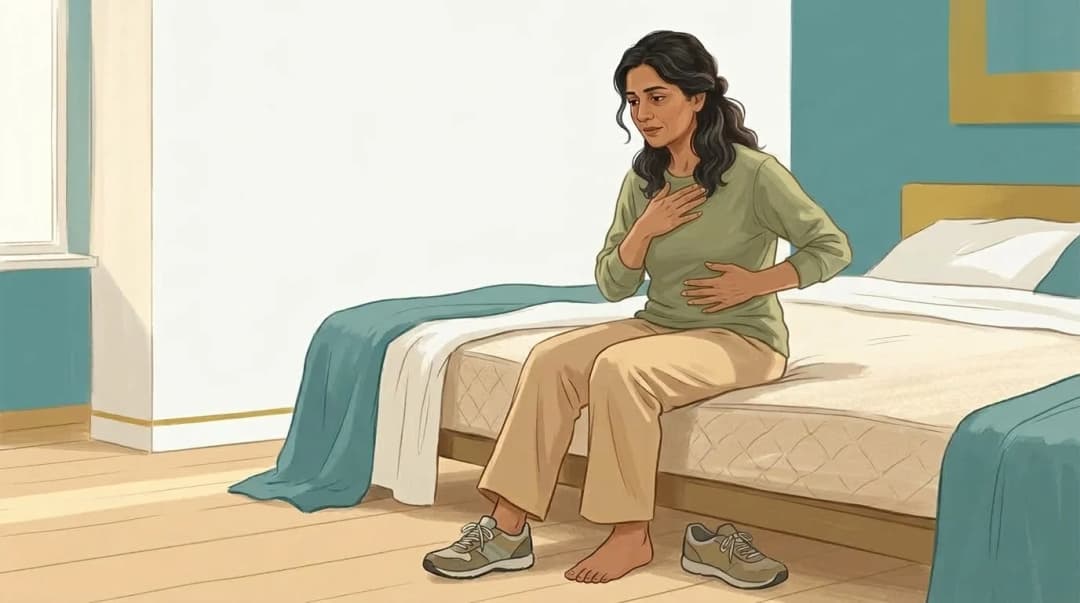
Getting out of breath may be the hypermobility symptom that quietly shrinks your day
Ready to start moving better?
Gentle, guided lessons for your body. Try your first one free, no credit card required.