
Stooped Posture When Walking: Why It Builds and What Helps
Why a stooped posture creeps in over years, why it shows most when you walk, and how the eyes, head, ribs and hips can share the work of standing taller.
In short
Stooped posture usually builds slowly, from years of sitting bent forward, a stiff upper back and hips, and caution about falling. It shows most when you walk, with eyes on the ground and shorter steps. Slow, curious movement can give you easier ways to stand and walk.

Prefer to ease in gently?
See a few gentle exercises for stiffness after 60 to try.
Before you begin. This page is movement education, not medical advice. A stoop that appears quickly, loss of height, sudden back pain, or new shuffling or trembling needs a doctor, since these can point to a spinal fracture from osteoporosis or a neurological condition. If you have osteoporosis, ask your clinician which bending movements suit you.
Stooped posture usually builds slowly, over years. Long hours of sitting bent forward, stiffness in the upper back and hips, and a growing caution on your feet all feed it. Then one day you catch yourself in a shop window and wonder when it started. The head sits ahead of the chest. The eyes rest on the pavement a few steps ahead. Most people notice it when they walk, or when someone they love points it out. I teach Feldenkrais®, and this is one of the questions I hear most.
People describe it in different words: stoop shouldered, stooping shoulders, walking stooped over. They all point at the same slow drift. A stoop is a shape, not a verdict. It is what a body does after many years of sitting folded, looking at things below eye level, and being careful on its feet. None of that is a mistake. It is learning. And what the body has learned, it can learn to do differently.
Why stooped posture shows up most when you walk
Sitting hides a stoop. The chair holds you, and the eyes can rest on a screen or a book. Walking is different. Every step is a small fall forward, caught by the next foot. To do that with ease, the body needs to know where the ground is and where the horizon is.
When the eyes drop to the ground, the head follows. The head is heavy. When it moves ahead of the chest, the upper back rounds to carry it. The weight of the body drifts forward over the toes. Steps shorten, because a short step feels safer when the weight is already ahead. The arms swing less. The whole walk becomes quieter and more cautious.
Looking down feels like the careful thing to do, and in one sense it is. You see the kerb and the loose paving stone. But the eyes are one of three main sources of balance information. The other two are the inner ear and the feeling of the feet on the ground. The eyes do that job most easily when they look out toward the horizon. A head carried forward also tires the back of the neck sooner. Tired muscles let the stoop deepen, and the eyes drop a little further. It is a loop, and it tightens slowly. Our Feldypedia article on how walking changes with age follows that loop into confidence and falls.
What tends to build a stooped posture over the years
Several things usually add up. Few people have only one.
Long hours of sitting bent forward come first. Desks, cars, sofas, phones. The hip joints spend most of the day folded, and the front of the hips gets used to that shorter length. When you stand, the hips do not quite reach upright, so the upper body leans forward to make up for it. The upper back, meanwhile, has rounded over a keyboard for decades. The guide to hunched over posture covers that sitting habit on its own.
Stiffness through the upper back and hips comes second. Ribs that move less with each breath, a middle back that has forgotten how to turn. When these parts move less, the head and the lower back have to make up the difference, and the head usually goes forward.
Caution comes third, and it deserves respect. A fall, or a near fall, or watching a friend fall, teaches the body to guard. Guarding means looking down, shortening the step, and holding the chest a little tighter. The response makes sense, but it stays on as a habit once the danger is gone.
Eyesight plays a quiet role. If near vision has changed and the ground looks less sharp, the head drops to see it more clearly. New glasses, especially bifocals or varifocals, can change where the eyes rest, and the neck follows.
Then there is bone. Doctors call a strong forward curve of the upper back hyperkyphosis. The kind that grows with age is estimated to affect 20% to 40% of older adults. Exercise shows some benefit for it, though the evidence base is limited (Katzman et al., 2014). Part of that curve can come from thinning bones in the spine, which is what osteoporosis means. A weakened vertebra can collapse a little at the front, sometimes with no clear injury and little pain, and the spine above it tips forward. A doctor can check your bone health if this is a concern. Parkinson's disease and some other neurological conditions also change how a person stands and walks. This is why a stoop that arrives quickly, or comes with loss of height, needs a doctor rather than a web page.
A stoop does become more common with age. That is a fact about bodies, time, and years of sitting. It says nothing about what you can still learn.
A short exploration: letting the eyes lead
Try this standing in a hallway, with a wall or a counter within reach. Stand as you usually do, and change nothing yet. Notice where your eyes are resting. Notice where the weight sits in your feet, nearer the heels or the toes. Notice how much of your chest moves as you breathe.
Now let your eyes drift slowly down toward the floor in front of you. Let the head follow the eyes, only as far as is easy. Then let the eyes travel slowly up toward the far wall, and let the head follow again. Repeat a few times, slowly, with the eyes leading. Pause. Does the weight in your feet shift as the eyes travel? Does the chest change?
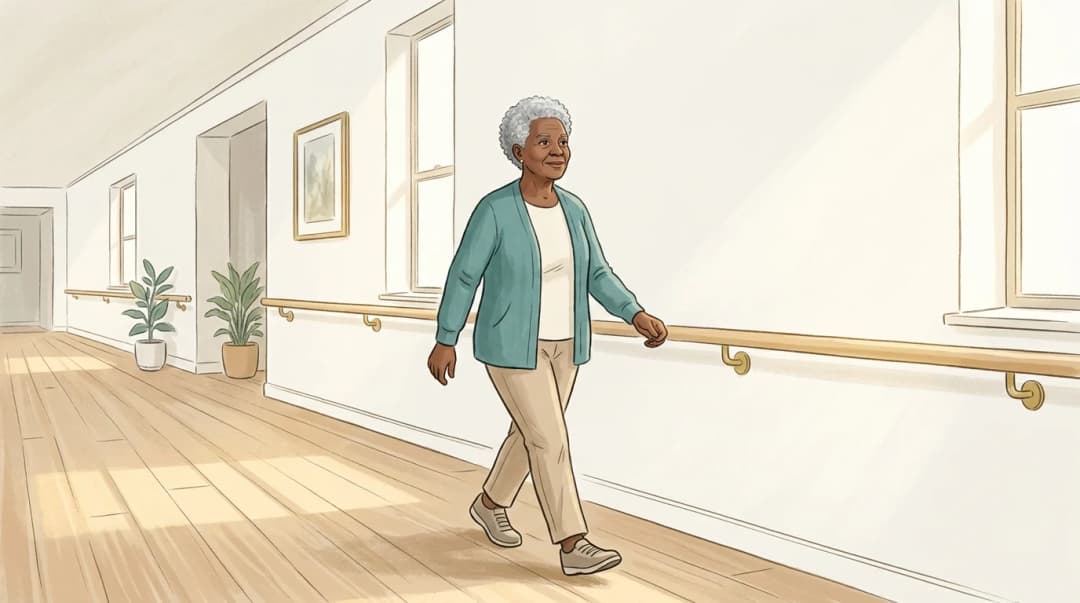
Next, rest your eyes on something at eye level across the room and begin to walk, slowly, a few steps. You do not have to lift your head. Let the eyes choose the horizon and see what the head and chest do on their own. Then walk a few steps the way you normally do, and compare. Is your step a different length? Do your arms swing differently? How do you feel on your feet?
That is the whole exploration. It takes about three minutes. Nothing is held, nothing is pulled back. You are giving the body a comparison, and the nervous system is very interested in comparisons.
How the hips and ribs help you stand taller without effort
Most advice about a stoop goes straight to the shoulders. Pull them back, lift the chest, tuck the chin. It lasts a minute, then the muscles tire and the shape returns, often with a sore neck. In my experience, lasting change more often comes from the parts underneath the shoulders.
The hips are the hinge. When the hip joints can open fully, the pelvis sits level over the feet and the spine can rise from it. The ribs are the next link. When they can move freely with each breath, many people find the chest lifts more easily from the inside, and the neck has less work to do holding the upper back upright. An Awareness Through Movement® lesson works on exactly these links. You might lie on your back and roll the pelvis slowly, feeling the movement travel up the spine. You might sit and let the breastbone follow the breath. You find where there is room, and the body uses it.
For a guided start, the gentle exercises for seniors lesson is a slow whole body sequence, lying down or in a chair. The posture exercises for seniors page takes the same ideas into sitting and standing. The lessons at Feldy are built this way: short audio guidance you follow at home. The stiff after 60 program page explains how they fit together.
Alongside clinical care and other methods
If you have osteoporosis, a neurological condition, or a stoop that worries you, a doctor and often a physiotherapist belong in the picture. A physiotherapist may check your gait and give you a strength and balance programme. Feldenkrais sits beside that work. It does not replace it, and it makes no medical decisions.
Other movement methods reach the same shape by different routes. Pilates builds the muscles along the spine and around the pelvis through precise, repeated movement. Yoga lengthens the front of the hips and the chest through held shapes. Tai chi trains an upright, flowing walk through slow standing forms. The Alexander Technique teaches you to notice how the head rests on the neck and to stop pulling it down. Feldenkrais is the smallest and slowest of these. It relies on sensing differences rather than building strength or holding a shape. Many people combine two of them.
Move easier again, whatever the calendar says
Now for the part that changes it. The Feldy program helps a body that has carried itself for decades find lighter, freer movement, through gentle Feldenkrais® lessons at home. Gentle, guided, and self-paced.
Start my free 7-day trialNo credit card needed.
Common Questions about stooped posture (FAQ)
Is gentle movement safe if I have a stooped posture, and who should hold back?
For most people, slow movement inside a comfortable range is safe, and often pleasant. Hold back until a doctor has looked if the stoop arrived over weeks rather than years. The same goes for new sharp back pain or a recent fall. If you have osteoporosis or low bone density, ask your clinician which bending movements suit you. Anything that sharpens pain is a signal to make the movement smaller or stop.
How often should I practise for a stoop?
A few minutes most days does more than one long session a week. Ten minutes lying down, or the three minute eyes and walking exploration on this page, is enough to begin. The body changes a habit through repetition it finds pleasant, so stop before you are tired. The rest of the day counts too. Every time you notice your eyes on the ground and let them lift to the horizon, that is practice.
How long until I notice a change in a stooped posture?
Many people feel something within a couple of weeks. Walking feels lighter, the neck is less tired by evening, or they catch their eyes lifting on their own. A visible change in how you stand, if it comes, takes longer, usually months, because the shape took years to settle. If part of the stoop comes from compressed vertebrae, that part will not straighten. The parts around it can still move more freely and feel different.
Why do I look at the ground when I walk?
Usually for a sensible reason. Looking down shows you the kerb and the uneven paving. After a fall or a scare, the body keeps doing it long after the danger has passed. Changes in eyesight, new glasses, and a stiff upper back that makes lifting the head tiring all add to it. The cost is that the eyes feed your balance system, and they do that most easily when they look out. Try resting your eyes on a point at eye level across the room as you walk, and see what the rest of you does.
How is Feldenkrais different from the Alexander Technique for a stoop?
They are cousins, and both care about how the head rests on the spine. The Alexander Technique is usually taught one to one, with a teacher's hands guiding you in sitting, standing and walking. It focuses on noticing and undoing the habit of pulling the head down. Feldenkrais uses slow movement lessons, often lying on the floor. They explore how the pelvis, ribs, head and eyes connect, and let a new way of standing appear through comparison. Many people like both. If you enjoy being guided by touch, Alexander may suit you. If you like to explore on your own at home, Feldenkrais may fit.
What is the best exercise for a stooped posture?
There is no single best one, and I would be cautious of any page that names it. What tends to help most is slow movement that includes the eyes and head, the hips and the ribs, stays comfortable, and happens often. Three places to begin. Let the eyes lead the head up and down while standing. Roll the pelvis slowly while lying on your back. Walk a few steps with the eyes on the horizon. The gentle exercises for seniors lesson on this site is a slow whole body lesson in the same spirit.
What should I avoid if I walk stooped over?
Avoid pulling your shoulders back and trying to hold them there. The neck tires within minutes and the body learns nothing it can keep. Avoid staring at your feet for the whole walk, and avoid hurrying on ground you do not trust. If your bone density is low or unknown, skip bending forward under load, such as sit ups, toe touches, and lifting heavy things while rounded. And avoid pushing through pain. A movement that hurts is asking to be smaller.
When should I see a professional about a stooped posture?
See a doctor if the stoop appeared over weeks or months rather than years. Lost height, sudden back pain, or new shuffling, trembling, or trouble starting to walk also need a visit. These can point to a spinal fracture from osteoporosis or to a neurological condition, and both are worth knowing about early. A physiotherapist is also a sensible companion if you have had falls or feel unsteady. Gentle movement lessons sit alongside that care, never instead of it.
Move easier again, whatever the calendar says
See the programRelated resources
Hunched Over Posture: Why It Happens and What Helps
Hunched over posture is usually a habit of holding, not damage. Here is why it settles in, and the kind of attention that helps it change.
Posture Exercises for Seniors: Gentle Daily Movement
Posture exercises for seniors that use slow, safe standing and seated movement to ease stiffness and help you stand and sit with more comfort.
Brisk walking eased frailty more than strolling, and the stroll still helped nearly half
Ready to start moving better?
Gentle, guided lessons for your body. Try your first one free, no credit card required.