
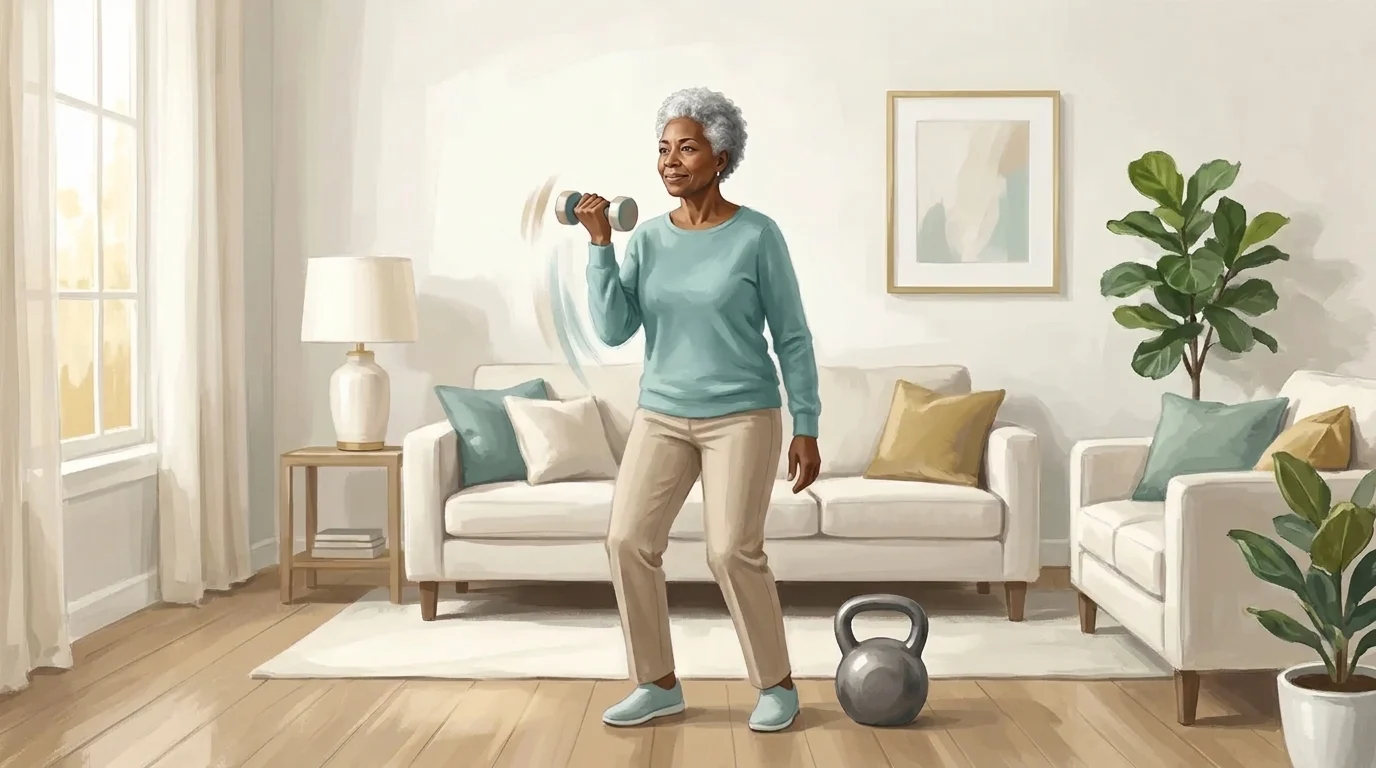
After menopause, women who lifted lighter weights fast had denser hips
Heavy weights may not be the only way in for bone. In 82 women past menopause, the hip change was small and needs more testing.
The usual advice for bones after menopause is to lift heavy. If the picture of a loaded barbell is the very thing keeping you from starting, there may be another way in. In a trial published this month, women who lifted lighter weights, quickly, ended eight months with slightly denser hips than women who didn't train, and women who lifted heavy weights slowly did not.
The trial followed 82 women in their fifties and sixties to the end (Caliskan and colleagues, Bone, 2026). Plenty of women come to strength work late, after years of putting their own needs aside, or after a bone scan that left them unsure which movements are safe. Heavy lifting still has its place in bone care. You may not have to start there.
Lighter and quicker reached the hip
Two groups trained twice a week under supervision, and a third group didn't train. The heavy group lifted heavier weights, slowly, and lowered them just as slowly. The quick group used half or less of the heaviest weight they could lift once. They pushed each lift up as fast as they could, then lowered it.
After eight months, only the quick group's hip density came out ahead of the women who didn't train. In a smaller group of women whose bone density was already on the low side, the quick lifts went with a hip change too, though a smaller group makes that less certain.
So if heavy weights feel out of reach, this suggests a lighter weight, moved with some speed, may also count for your hips. It's an option to talk over with your physiotherapist or trainer, and it would sit alongside what they've already given you, not in place of it.
Heavy lifts changed the shin instead
The slow heavy group's hip density didn't change. Their shin bone did. Its outer layer grew denser, its wall a little thinner and the shaft a little wider, and the authors say this may affect how well the shin resists bending. Heavy lifting did something to bone, then, just not at the hip, which is the place this trial was built to measure.
What the headline will miss
The hip change was small. Each lifting group was compared with the women who didn't train, not with each other. So it doesn't show that quick lifts are better than heavy ones for the hip. Bone changes slowly, and eight months is a short time for it.
Of the women who started, 82 of 109 finished, and the ones who dropped out may have differed from those who stayed. The women were healthy, and on average their bone density was only a little lower than a typical young woman's, so the trial says nothing yet about osteoporosis or a past fracture, where a fast, forceful lift is a different question.
Every session had a trainer in the room, so we don't know whether the same thing happens when women train on their own. A quick lift also brings a small jolt, so we can't tell whether the speed or the impact did the work. The spine was measured as well; the summary doesn't mention a change there. The authors say this kind of training needs more testing before it is used to prevent osteoporosis, and nothing here tested the Feldenkrais Method.
The Feldenkrais angle
In my experience, a quick movement isn't a strong movement made faster. It feels easy when the effort travels from the feet, through the pelvis and the back, into the arms, with nothing holding against it. When one part braces, speed tends to turn into strain. That's where the slow work of the Feldenkrais Method® comes in for me. In an Awareness Through Movement® lesson you go slowly, and only where it feels easy, pleasant and comfortable, so you can notice where you hold your breath or lock a knee. Slowness isn't the goal. It gives you time to notice how you move and find an easier path, one a quicker movement can use later, and in my experience coordination that has faded can often be learned again.
Before you change your routine
Fast, forceful movement isn't for every body. With osteoporosis, a past fracture or the joint changes that can come with menopause, it needs your clinician's view first. If you'd like to explore it, ask your physiotherapist or trainer whether some of your strength work could be lighter and quicker, with a weight you can keep coming back to.
Let Feldy guide you, eyes closed
A calm voice walks you through gentle moves so your attention stays in your body, not on the screen.
Try Feldy Free for 7 daysNo credit card needed.
Sources
Movement Pulse is informational, not medical advice. See our editorial policy.
Move better with Feldy
See the programMovement Pulse Weekly
The week's best research, in your inbox Tuesday.
Movement science, gentle-practice ideas, and a practitioner's read on what's new. Free.
More from Movement Pulse
7,000 steps three days a week went with healthier bones before menopause, not after
Keep the walks. After menopause, the wider research keeps pointing to a brisker pace, some load and some variety beside them.
Oct 25, 2026
Tai chi was called too gentle to touch bone, yet 17 trials in women found a small gain
If you love a slow standing practice, it may be doing a little for your spine as well as your balance. Keep the walking and the strength work beside it.
Oct 17, 2026
Harder lifting built strength, but not more bone
A meta-analysis of 18 trials found heavier resistance training built more leg strength than lighter training, but the two came out about equal for bone density.
Jul 5, 2026Ready to start moving better?
Gentle, guided lessons for your body. Try your first one free, no credit card required.