
Pilates for Hypermobility: A Guide to Making It Work
A qualified yes: pilates suits a hypermobile body when the emphasis is control and mid range precision, less so when a class chases depth. What to ask, what to modify.
In short
Yes, pilates for hypermobility can work well when the focus stays on control, precision, and the middle of your range. It suits a hypermobile body less well when a class rewards depth and impressive end range positions. Instructor experience and a small, watchful class matter most.

Prefer to ease in gently?
See a few gentle exercises for hypermobility to try.
Before you begin. With joint laxity, the useful aim is control inside an easy range rather than more range, so please read this as general education, not medical advice. Tell any instructor about your hypermobility before class begins. If you have recurrent joint slips, dislocations, or a suspected connective tissue condition, see a doctor or physiotherapist before starting something new.
If your joints travel further than most, you have probably heard two opposite verdicts on pilates: that it is the single best thing a bendy body can do, and that it will only make you looser. Neither is quite realistic. In my experience, pilates for hypermobility earns a qualified yes. The method was built around control, precision, and deliberate work in the middle of a joint's range, and that combination is remarkably close to what a lax body tends to need. The catch is that not every class teaches that version of it, and a hypermobile student is frequently the one being applauded for reaching shapes nobody else in the room can.
Why pilates for hypermobility is a qualified yes
At its heart, pilates asks you to move slowly, with intention, while paying attention to what supports the movement. When a class holds to those roots, a hypermobile person gets exactly the practice they rarely find elsewhere: repeated, watchful time spent controlling a joint through the part of its range where it is easiest to steady.
Where pilates for hypermobility becomes a less comfortable match is when the room starts chasing length, depth, and camera friendly finishing positions. A lax body arrives at those extremes without effort, gets complimented for it, and quietly practises hanging out at the very edges it least needs to visit. The problem there is not the method. It is a class culture that mistakes range for progress, and a student whose easiest trick happens to be range.
What to ask an instructor before you book
Three questions, asked before any money changes hands, tell you most of what you need to know.
Have you taught people with hypermobility or joint laxity before? You want a considered answer, not just enthusiasm. A teacher familiar with lax joints will usually mention keeping students away from their limits without being prompted.
Will you cue me to stop short of my end range? This is the single most useful thing an instructor can do for you. If the answer sounds more like an invitation to explore your full flexibility, keep looking.
Is the class small enough that you will actually see me? A hypermobile body can look graceful while borrowing support from the outer edge of a joint. In a room of twenty, nobody notices. In a room of six, a good teacher does.
And once you are there, say it out loud: tell the instructor you are hypermobile before the first exercise begins.
Positions worth modifying in pilates for hypermobility
A few families of movement deserve a gentler version, or at least your full attention.
Rollovers and deep spinal flexion. Sequences that peel the spine over the head, or curl it into its deepest fold, take lax spinal segments a long way from centre. A smaller curl that you can feel and control offers the same lesson with far less to manage.
Wide leg positions. Straddles and broad V shapes let hypermobile hips slide toward their outer limits almost by accident. Narrowing the angle keeps the work in muscle rather than in the joint's passive edge.
Anything where a knee or elbow locks straight. Planks, all fours, and long lever arm work invite a lax elbow to snap back and rest there. A soft, barely visible bend keeps the muscles involved in the job.
The urge to win at flexibility. This one is internal. When the deepest stretch in the room comes easily, it is tempting to demonstrate it. Choosing the modest version on purpose is, for a hypermobile person, the advanced move. Our guide to hypermobility exercises to avoid explores this same principle across other kinds of training.
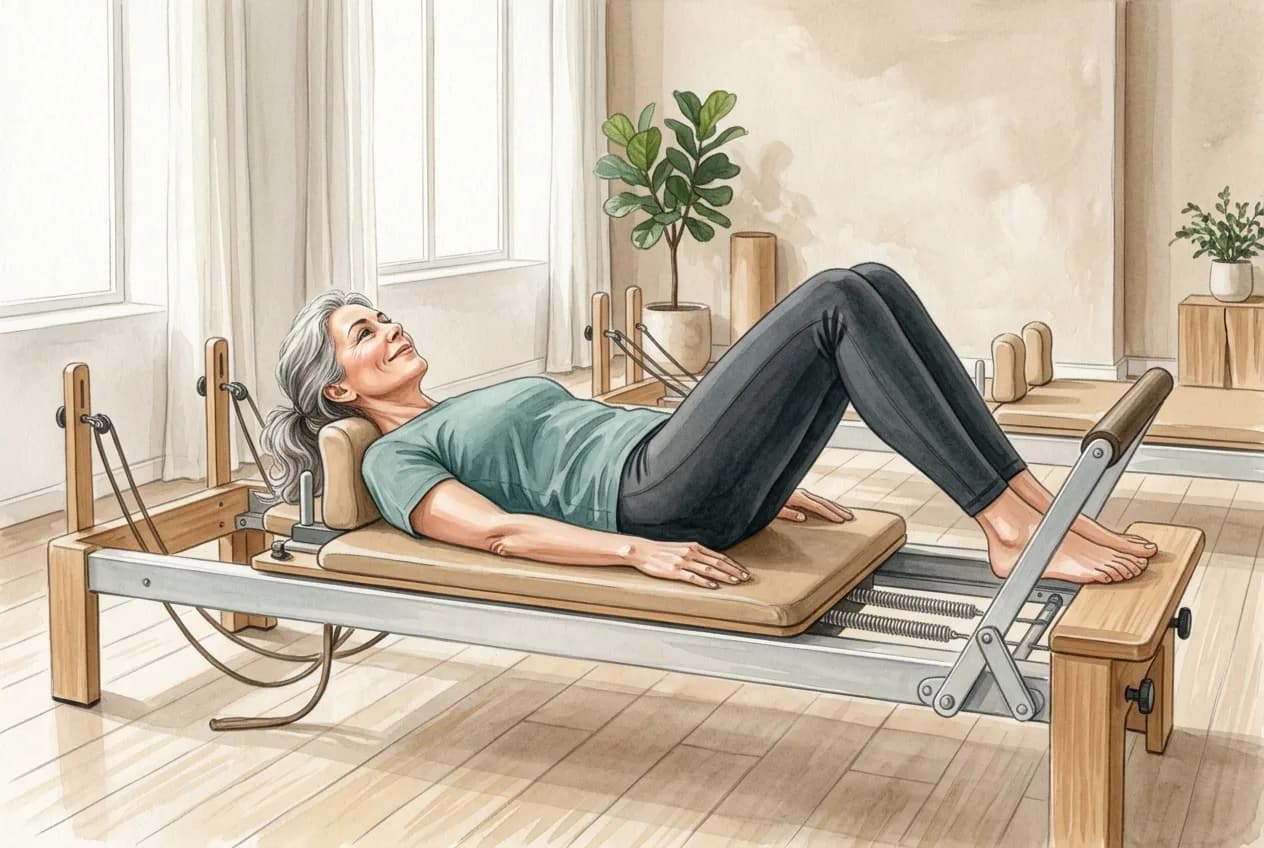
One note in the other direction: the reformer deserves credit here. Its springs push back, and that resistance gives a joint a steady stream of information about where it is, feedback many hypermobile people find genuinely clarifying. If a machine class with an attentive teacher is available to you, it can be one of the friendlier rooms a lax body will find.
Pilates and the Feldenkrais Method®, two different mechanisms
The two are often lumped together, and they are not the same. Pilates trains controlled load: precise exercises, repeated, so that the muscles supporting a joint become reliable throughout its range. The Feldenkrais Method trains sensing and self organisation: lessons use slow, small, endlessly varied movements so that your nervous system builds a sharper map of where each joint is and how the rest of you participates in its movement. One conditions the support. The other refines the perception that tells the support when and how to act.
Neither mechanism outranks the other, and many hypermobile people happily keep both, using pilates for structured practice and something like Feldy's hypermobility program or our free set of exercises for hypermobility for the sensing side. On the evidence front, candor is required in both directions: a systematic review that pooled 20 randomized controlled trials described the findings for the Feldenkrais Method as promising, including for functions such as balance, while flagging a high risk of bias across those trials (Hillier and Worley, 2015). Emerging evidence, in other words, not settled proof.
A word on care
Everything above is movement education, offered with warmth rather than authority. If your joints slip out of place, dislocate, or your pattern of laxity makes you suspect a connective tissue condition, a doctor or physiotherapist should look at your particular joints first. Their assessment travels comfortably next to whatever gentle practice you choose afterwards. And if you are still weighing which styles of movement suit a lax body at all, our overview of exercises for hypermobility syndrome lays the gentle options out side by side.
Stability without gripping
Now for stability that does not rely on gripping. The Feldy program builds a clearer sense of where the body rests, so steadiness grows from awareness, through Feldenkrais® lessons. Gentle, guided, and self-paced.
Start my free 7-day trialNo credit card needed.
Common Questions about pilates for hypermobility (FAQ)
Is pilates safe for hypermobility, and who should be cautious?
For most hypermobile people, yes, especially in a small class led by someone who understands joint laxity. Extra caution belongs to anyone whose joints slip or give way often, or who suspects a connective tissue condition. In practice, caution means staying short of your end range and choosing precision over depth, not giving up the method altogether.
How often should I do pilates if I am hypermobile?
Two or three sessions a week suits many hypermobile bodies, with quieter days in between to notice how your joints respond. Frequency matters less than quality: one attentive session where you stay inside a controlled range teaches more than several where you drift out to your limits. Let how steady you feel the next day set the number.
How long until pilates makes a difference for hypermobility?
Most people need several weeks of consistent practice before control feels noticeably different, and a few months before that steadiness shows up in everyday life. Hypermobile students often learn the choreography quickly yet take longer to feel the deeper, quieter work underneath it, so a growing sense of ease is a more reliable progress marker than any calendar.
Is pilates or yoga better for hypermobility?
Many hypermobile people find pilates the easier fit, because its culture prizes control and precision rather than depth. A typical yoga class includes more long holds near the edge of a stretch, a place a lax body reaches without effort and without gaining much there. Yoga can still work beautifully with a teacher who keeps you well inside your range, so the specific class matters more than the label.
How is pilates different from the Feldenkrais Method for hypermobility?
Pilates trains controlled load: you repeat precise exercises so the muscles around a joint learn to support it through movement. The Feldenkrais Method works through sensing: slow, small, varied movements help you feel where a joint is and how the whole of you organises around it, with almost no repetition or effort. They are different mechanisms rather than rivals, and plenty of hypermobile people enjoy both.
When should I see a professional about hypermobility?
See a doctor or physiotherapist if a joint dislocates or partly slips out, if pain keeps returning, or if marked laxity runs in your family and you suspect a connective tissue condition. An assessment is also sensible after an injury, before you begin anything new. That kind of clinical attention sits comfortably alongside gentle movement of any style.
Stability without gripping
See the programRelated resources
Hypermobility Exercises to Avoid (and Gentler Choices)
A calm guide to the hypermobility exercises to avoid, or approach with care, and the slower, steadier movement that tends to serve a loose-jointed body better.
Gentle Exercises for Hypermobility: Stability First
Gentle exercises for hypermobility that build control, proprioception, and mid-range stability rather than more flexibility, with a short lesson you can scale to your day.
Getting out of breath may be the hypermobility symptom that quietly shrinks your day
Ready to start moving better?
Gentle, guided lessons for your body. Try your first one free, no credit card required.