
What Do Tight Hips Look Like? Signs You Can Actually See
Tight hips are easier to feel than to see, and most of the visible signs are really signs of how you move. What to look for, and what it does not mean about you.
In short
What tight hips look like is mostly movement, not shape: a shorter stride, a pelvis that tips forward when you stand, difficulty sitting cross legged, and a habit of rising from a chair with the upper body rather than the legs. There is no single posture that identifies them.

Prefer to ease in gently?
See a few gentle exercises for knees and hips to try.
Before you begin. Stiffness that comes and goes with activity is common and usually not worrying. See a doctor or physiotherapist about hip pain that wakes you at night, follows a fall, comes with fever or swelling, makes the leg give way, or steadily worsens over weeks. Gentle movement sits alongside clinical care and does not replace it.
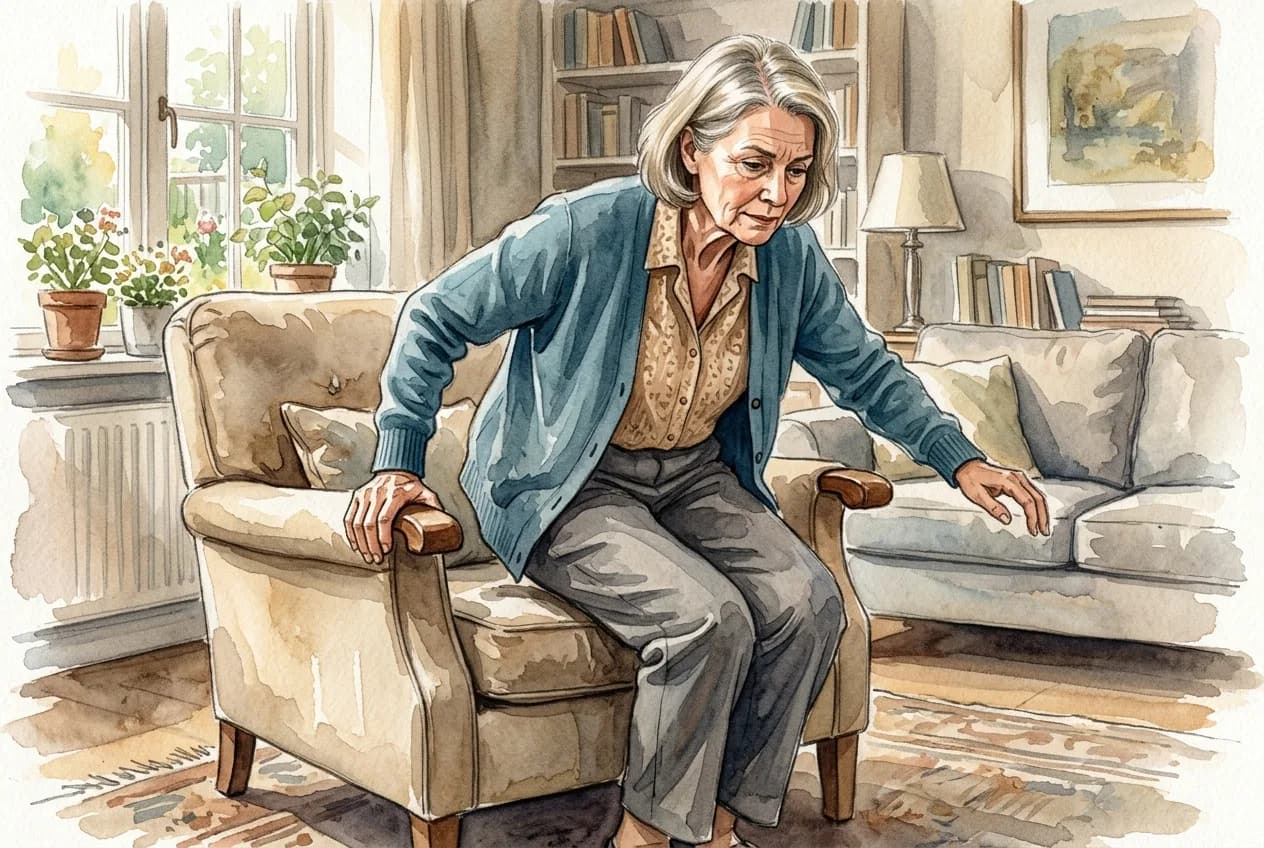
What do tight hips look like? Mostly they look like movement rather than shape. Someone with genuinely restricted hips tends to take a slightly shorter stride, to rise from a chair by leading with the head and chest rather than the legs, to sit down in stages, and to find sitting cross legged on the floor awkward or impossible. Standing still, they usually look unremarkable, which is the part most articles on this topic get wrong.
What do tight hips look like when you are moving
Watch walking first. As you step forward on one leg, the other thigh should travel a little way behind your body before it swings through. When the hips are restricted, that trailing part shrinks, and the stride gets shorter and quicker. People often compensate by arching the lower back a little more, so the pelvis tips forward to buy the range the hip is not offering.
Then watch a chair. Rising from sitting is a hip dominant task. When hips are stiff or sore, the pattern usually shifts: the chest dives forward further than it needs to, the hands push off the armrests, and the whole movement takes longer and happens in two parts rather than one. Sitting down shows the same thing in reverse, often ending with a small drop over the last few inches.
Finally, watch the floor. Sitting cross legged, kneeling, or squatting down to a low shelf are the movements that make hip restriction obvious, because none of them can be borrowed from elsewhere.
What tight hips do not look like
They do not look like a specific posture. There is no standing shape that identifies restricted hips, and the popular idea that a forward tipped pelvis is diagnostic does not hold up well. A tipped pelvis is common in people with no symptoms whatsoever. Build, habit, footwear, and simply which foot you happened to put your weight on all change what a mirror shows you.
This matters because a great deal of anxiety gets generated by photographs of ideal alignment. It is more useful, and more accurate, to treat your hips as something you assess by moving than as something you assess by looking. Our Feldypedia entry on hip stiffness and limited mobility covers the underlying picture in more depth.
Why the hip feels tight when the muscle may not be short
The everyday assumption is that tightness equals shortness, and that the answer is therefore length. Often it is not. A hip that is being held protectively, or one whose neighbours have quietly stopped contributing, produces exactly the same sensation of restriction without any tissue having shortened. That sensation has an enormous amount of company: roughly 1.71 billion people live with a musculoskeletal condition of one kind or another (WHO, 2022), and much of what they describe is stiffness, not injury.
This is why so many people stretch diligently for months and report that the feeling returns within an hour. The stretch addresses length. It does not address the pelvis that has stopped rocking as you walk, or the ribs that no longer turn, or the low grade guarding that follows an old injury nobody thinks about anymore.
An awareness approach works on that second layer. The Feldenkrais Method®, which is what Feldy teaches, does this through slow, small movements done lying down, where the point is to notice which parts of you join in and which stay silent. Awareness Through Movement® lessons deliberately keep everything below the threshold where a hip starts to guard, because a guarding hip cannot tell you much. Clinical care sits alongside this: a physiotherapist assessing a painful hip is doing necessary work that movement education does not replace. Other movement methods get at the territory another way, with yoga and Pilates accumulating strength and range by repeating set forms, a different engine rather than a worse one.
If you want somewhere concrete to begin, our lesson on knee proprioception is the broadest starting point for the whole leg, and our guides on tight hip flexors and how to loosen tight hip flexors go deeper on the front of the hip specifically. The full approach is on our knee and hip page.
A simpler way to check
Rather than photographing your posture, try this over a week: notice how you get out of a chair, whether your stride feels even on both sides, and how it feels to sit on the floor. Those three observations tell you more about your hips than any mirror will, and they are the things that actually change when movement gets easier.
Kinder movement for knees and hips
Understanding the strain is half of it. The Feldy program helps knees and hips carry less of it by reorganising how the whole body moves, through Feldenkrais® lessons. Gentle, guided, and self-paced.
Start my free 7-day trialNo credit card needed.
Common Questions about what tight hips look like (FAQ)
Can you actually see tight hips in the mirror?
Only indirectly. There is no reliable posture that marks a person as having tight hips, and studies of standing posture repeatedly find that people with and without symptoms stand in similar ways. What you can see is movement: how far your knee travels behind you as you walk, whether your pelvis tips as you stand, how you get out of a chair. Watching yourself move tells you far more than watching yourself stand still.
Is an anterior pelvic tilt a sign of tight hips?
Sometimes, though it is far less diagnostic than it is usually made out to be. A forward tipped pelvis is a common and largely normal variation, present in plenty of people with no hip symptoms at all. It can accompany short feeling hip flexors, but it can equally reflect build, habit, or simply how you are standing at that moment. It is worth noticing, not worth worrying about.
Are tight hips dangerous?
Ordinary hip stiffness is uncomfortable rather than dangerous, and for most people it varies with how much they have been sitting. It becomes a matter for a clinician if the hip is painful at night, gives way, swells, follows an injury, or worsens steadily over weeks. Persistent groin pain that limits turning the leg in also deserves a professional look rather than a stretching routine.
How often should I move if my hips feel tight?
Little and often works better than one long session. Hips stiffen with stillness more than with age, so brief changes of position through the day, a few minutes of slow movement in the morning, and getting up regularly from a chair all matter more than a weekly stretching block. Frequency is the active ingredient here, not duration or intensity.
How long until tight hips feel easier?
Many people feel some change within a single session of slow, unhurried movement, largely because the hip stops bracing. A more durable change in how you walk and rise from chairs usually builds over several weeks of short regular practice. If nothing at all shifts over a month, that is useful information to take to a physiotherapist rather than a reason to push harder.
How is this different from just stretching my hip flexors?
Stretching works on tolerance and length in one muscle group, and it can feel good. An awareness approach asks a different question: what is the hip doing during the other sixteen waking hours, and which parts of you are not joining in when you walk. Many people find their hips feel tight not because a muscle is short but because the pelvis and ribs have stopped participating. The two approaches are compatible, and they address different things.
Kinder movement for knees and hips
See the programRelated resources
Running With Tight Hips: What Actually Loosens Them
Tight hips from running are rarely short muscles. They are usually a narrow, repeated stride. Here is why stretching underdelivers and what changes the feeling.
What Causes Tight Hips? The Real Reasons, and What Helps
Tight hips are less often short muscles than a hip whose habits have narrowed. Here are the causes worth knowing, and the ones worth ignoring.
Feldenkrais® for Tight Hips: A Gentle Fit Check
A Guild Certified Feldenkrais practitioner on why hips that feel tight are often hips that feel guarded, and what slow awareness lessons can offer.
Ready to start moving better?
Gentle, guided lessons for your body. Try your first one free, no credit card required.