
Plantar Flexion: The Push Off in Every Step You Take
Plantar flexion points the foot away from the shin and powers every step. Why it quietly stiffens with age, and how gentle attention invites it back.
In short
Plantar flexion is the ankle movement that points your foot down and away from your shin, the opposite of dorsiflexion. Your calf muscles produce it through the Achilles tendon, and it supplies the push off at the end of every walking step.

Prefer to ease in gently?
See a few gentle exercises for stiffness after 60 to try.
Before you begin. This is general information and gentle self care, not medical advice. If your ankle or Achilles area is painful, swollen, or recently injured, or if cramping is frequent, check with a doctor or physical therapist before exploring, and keep every movement small, slow, and comfortable.
Plantar flexion is the movement that points your foot down and away from your shin, the way it does when you press a gas pedal or rise onto your toes to reach a high shelf. Its opposite, dorsiflexion, draws the toes up toward you. Between the two, plantar flexion does the quieter, heavier work, because it is the push that finishes every step you take. This guide looks at what the movement actually is, where it shows up in an ordinary day, and why the slow, attentive style of Feldenkrais® lessons, especially Awareness Through Movement®, is such a friendly way to visit it when ankles have grown stiff.
What plantar flexion is and how it works
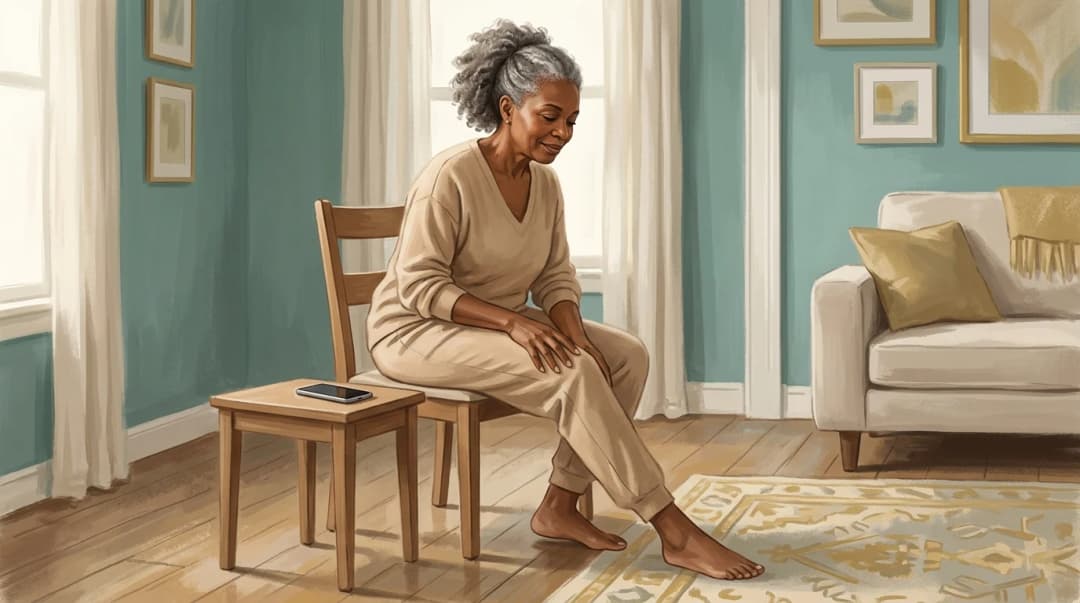
Try this before reading further. Sitting, with one foot flat on the floor, slowly let the heel float up while the ball of the foot stays down. That small rise is plantar flexion under load, and you can feel the calf gathering to produce it. The main engines are gastrocnemius and soleus, the two muscles of the calf, which share the Achilles tendon and pull the heel upward so the front of the foot presses into the ground. Deeper helpers join in, tibialis posterior along the inner shin and the muscles that bend the toes, which is why a committed point of the foot often comes with a faint sense of the toes wanting to curl. Charts place the typical range somewhere near 40 to 50 degrees, but people vary enormously, and the number is far less interesting than a comparison you can feel: point one foot, then the other, and notice which one travels further and which one moves more smoothly on the way.
The movement that carries you through each step
Every step has the same quiet shape. One heel meets the ground, your weight rolls forward along the sole, the heel peels away, and for a moment the ball of the foot and the toes are all that connect you to the floor. Right then the calf presses down through the front of the foot, the ankle points, and that press is what sends you into the next step. Plantar flexion is that ending, the push off. When it is generous, walking has spring in it and each stride covers a comfortable distance. When it fades, nothing announces the loss. Steps simply land a little flatter and a little shorter, stairs start asking more of the knees and hips, and rising onto the toes for a shelf becomes something you think about first. Our Feldypedia entry on gait changes and walking difficulty traces how these small shifts accumulate over the years.
All of that force travels through the Achilles tendon, the strong cord joining calf to heel, and it is a busy structure by any measure: Achilles tendinopathy carries a lifetime injury incidence of about 2.35 per 1,000 people, and among athletes the cumulative lifetime figure reaches roughly 24 percent (StatPearls, 2024). You do not need to be an athlete for the point to land. This tendon, and the movement it serves, carries you further every day than you probably notice.
Why plantar flexion quietly stiffens
Several ordinary habits narrow this direction without any injury at all. Shoes with a raised heel hold the calf in a slightly shortened position for hours at a time, so full pointing and full lengthening are both visited less. Long sitting parks the ankles in one middle position for most of the day. After an ankle sprain, the calf often keeps guarding well after the tissues have settled, holding the joint in a cautious middle range. And simple disuse plays its part, since few of us rise onto our toes for any reason once ladders and dance floors leave our lives. If your ankles feel narrowed in more directions than this one, our guide on how to improve ankle mobility widens the view to the whole joint.
More range without stretching harder
Here is the part a stretching chart leaves out. How far your ankle points is not only a question of how long the calf tissues are. It is also a question of how clearly your nervous system senses the foot and organizes the press, and that clarity responds to slow, small, attentive movement remarkably well. Point the foot at a quarter of your possible speed and notice where the pressure sits on the ball of the foot, whether it favors the big toe side or the little toe side, and what the toes are doing. Often the second or third slow repetition already travels further than the first, not because anything lengthened in those thirty seconds but because the movement became clearer to you. This is the ground Feldy's lessons are built on, and the stiff after 60 program takes the same idea through the whole body at a gentle pace. None of this is a promise of a particular result, and stretching remains a reasonable approach with its own logic; it simply is not the only door into a stiff ankle.
If you would like a concrete sequence for the ankle itself, the short lesson of ankle mobility drills moves through this territory one easy step at a time. And the broader collection of gentle exercises for seniors is the natural home page for this whole topic, worth bookmarking as your starting point whenever you want to move rather than read.
Find where to start
Plantar flexion is one direction of one joint, and bodies rarely stiffen in just one place. If you are not sure whether your ankles, hips, or something else entirely deserve your first few minutes of attention, a quick pointer helps.
Wondering which method suits you? Take the Movement Match quiz, four quick questions in about two minutes, to find your movement method.
Move easier again, whatever the calendar says
Now for the part that changes it. The Feldy program helps a body that has carried itself for decades find lighter, freer movement, through gentle Feldenkrais® lessons at home. Gentle, guided, and self-paced.
Start my free 7-day trialNo credit card needed.
Common Questions about plantar flexion (FAQ)
What muscles produce plantar flexion?
The two calf muscles, gastrocnemius and soleus, do most of it, pulling the heel up through the Achilles tendon so the front of the foot presses down. Tibialis posterior along the inner shin and the muscles that bend the toes assist, which is why a strong point of the foot often includes a slight curl of the toes.
What is the difference between plantar flexion and dorsiflexion?
They are the two opposite directions of the ankle. Plantar flexion points the foot down and away from the shin, as when you rise onto your toes or press a gas pedal. Dorsiflexion draws the top of the foot up toward the shin, as when your heel lands and your toes clear the ground during a step.
Is it safe to explore plantar flexion, and who should be careful?
Slow, small pointing of the foot within easy comfort is gentle for most people. Be more cautious if you have a recent ankle or Achilles injury, noticeable swelling, frequent calf cramps, or diabetes with reduced feeling in the feet. In those cases ask a doctor or physical therapist first, and let their guidance shape what you try.
How often should I explore plantar flexion?
Short visits, repeated through the week, tend to teach an ankle more than one long effortful session. A minute or two of slow pointing while seated, and an occasional easy rise onto the toes at the kitchen counter with a hand resting there, is plenty. Let comfort decide the size of the movement each time.
How long until plantar flexion feels easier?
Many people notice within one sitting that the second foot points more smoothly than the first did, simply from moving slowly and paying attention. Change you can feel in walking, such as a springier or slightly longer stride, usually gathers over weeks of relaxed repetition rather than days, and it rarely arrives on a schedule.
When should I see a professional about my ankle or calf?
Get a medical opinion if pointing the foot causes sharp pain, if the back of the heel or the calf is swollen or tender to touch, if stiffness followed an injury, or if you feel a sudden snap or new weakness when pushing off. Those signs deserve assessment before any movement exploration continues.
What is the best way to improve plantar flexion?
The most reliable route is frequency plus attention rather than intensity: slow pointing of the foot in sitting, small comfortable heel raises with support under your hand, and genuine curiosity about how the pressure travels across the ball of the foot. Aggressive stretching has its place for some people, but it is not required for the range to return.
What should I avoid when working on plantar flexion?
Avoid forcing the point to its very end range, bouncing at the limit, or pushing into a cramp, since a calf close to cramping is asking for a smaller movement. Skip strong toe raises on stairs if your balance feels uncertain, and stop for the day if anything sharpens rather than eases as you repeat it.
Move easier again, whatever the calendar says
See the programRelated resources
How to Improve Ankle Mobility: A Gentle Guide
How to improve ankle mobility after 60 with small, slow, varied movement and friendly attention, so balance, walking, and stairs feel steadier and more at ease.
Stiff Ankles: Gentle Movement to Ease and Steady
Stiff ankles often ease with slow, frequent movement that restores their natural range, and supple ankles also support balance and confident walking.
Fifteen thousand people did the same digital knee program and went four different ways
Ready to start moving better?
Gentle, guided lessons for your body. Try your first one free, no credit card required.