
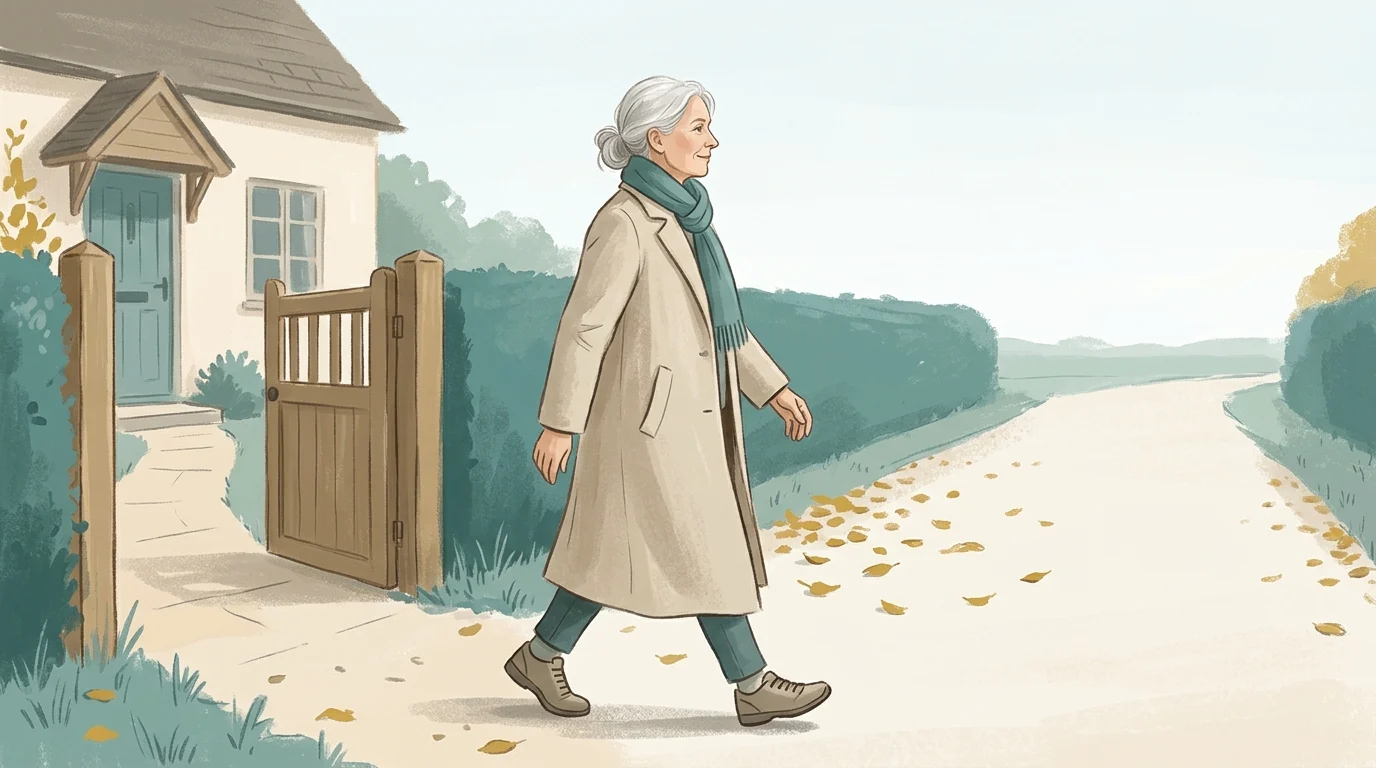
In 94,422 adults, fewer falls went with steady walks, not scattered steps
An unhurried pace was enough to meet the study's bar. Falls were tracked for about seven years through hospital records.
We often hear that every step counts: the trips to the kitchen, the hallway, the garden and back all add up. For staying on your feet, a large new study suggests the total may hide the part that goes with fewer falls. Among people who wore wrist trackers, those who took more steps during steady walking were less likely to have a fall recorded in hospital in the years that followed. Short, stop and start steps through the day, like the ones most of us take around the house, showed no clear link to falls once those walks were counted.
If your walking has shrunk to the steps between rooms, after a wobble, a hard winter or years spent looking after someone else, this may sound discouraging. It doesn't have to be. The researchers did not look for fast walking. They looked for a steady pace of at least 40 steps a minute. A relaxed, comfortable walk usually reaches that.
Steady walks, fewer falls
The data come from UK Biobank, a large health study of middle aged and older British adults (Hu and colleagues, Journal of Global Health, 2026). The researchers split each person's daily steps into two kinds. They called the steps taken in steadier, more sustained walking purposeful. The scattered, stop and start steps below that rhythm they called incidental.
People who took at least 4,000 purposeful steps a day were roughly a fifth to a third less likely to have a fall recorded in hospital than those who took fewer, depending on what else was taken into account. Most of that difference was already there in the middle groups. Hip fractures showed a similar link from about 6,000 of these steps a day upward, and the link grew stronger as people took more of them.
So the practical message is simple, with one caution for women: the link was clearest in men, while in women it was too weak to be sure. Instead of asking "how many steps have I taken today?", it may be more useful to ask "did I have a walk where I kept a comfortable rhythm?" The authors add a point I'd underline: the lack of a link for scattered steps does not mean walking is ineffective. It means a step count alone, without the pace of the steps, can't tell the two kinds of walking apart.
Ten years of mixed signals
You may have read that walking does little to prevent falls, or that it can even raise the risk. Studies have found different results. In 2015, older British men who wore hip trackers showed a split: among men with no mobility problems, falls rose once they walked a great deal, while among men who already had mobility limits, more steps went with fewer falls (Jefferis and colleagues, 2015). One possible reason: more time on your feet can also mean more chances to trip.
In 2020, a large review prepared for the World Health Organization found that balance exercises, practising everyday movements, and tai chi lowered the rate of falls, while the effect of programmes built mainly on walking stayed uncertain (Sherrington and colleagues, 2020). Then in 2024, a study of older Australian women found that those who reported brisk walking were less likely to have falls without injury, but not clearly less likely to have falls that caused injury (Kwok and colleagues, JAMA Network Open, 2024).
Taken together, they leave room for one possibility: the total number of steps may not tell the whole story. The newest study looks at this by separating each tracker's steps by their rhythm.
What the headline will miss
This was an observational study, so it shows what travelled together, not what caused what. People who already feel a little unsteady may simply walk less in long stretches, and the authors say they cannot rule that out. Walking was measured for a single week. Only falls serious enough to reach a hospital record were counted, so the everyday stumble at home is not in these numbers.
There is another important point, especially for women. When they looked at men and women separately, and at other groups, the link held in men, in people over 60, and in those who were not frail or obese. In women, and in the other groups, it was too weak to be certain. None of this tested the Feldenkrais Method® or any movement practice, and walking does not replace balance exercises, which have the strongest trial evidence for fewer falls. If you've fallen recently, or feel unsteady when you walk, talk with your doctor or physiotherapist before you add more walking.
The better question
The study counted how many steps came at a steady pace. A Feldenkrais® lesson would ask how that rhythm feels in your body. When walking is a short trip from one room to another, your eyes go to where you're headed and the steps come in bursts, with a pause and a slight tightening before each turn. If your eyes stay on the floor just ahead, the head and upper back may slowly follow them forward, which is one way stooped walking can creep in without you noticing. When a walk keeps going, something else can happen: the arms begin to swing on their own, the breath settles, and the feet start to find the ground without being told. In my classes I often see that people who feel unsure on their feet don't always lack strength. Sometimes what they lack is a few uninterrupted minutes in which the body can find its own pace.
One walk that keeps going
Next time you walk, notice the moment your steps stop feeling separate and become a rhythm. If it feels comfortable and safe, keep going a little past it, on a route you know, at a pace that feels easy.
Let Feldy guide you, eyes closed
A calm voice walks you through gentle moves so your attention stays in your body, not on the screen.
Try Feldy Free for 7 daysNo credit card needed.
Sources
- Association of intensity-based walking steps and incident falls: a population-based cohort study— Journal of Global Health, 2026
- Association of intensity-based walking steps and incident falls (PubMed record)— PubMed, 2026
- Physical Activity and Falls in Older Men: The Critical Role of Mobility Limitations— Medicine & Science in Sports & Exercise, 2015
- Evidence on physical activity and falls prevention for people aged 65+ years: systematic review to inform the WHO guidelines on physical activity and sedentary behaviour— International Journal of Behavioral Nutrition and Physical Activity, 2020
- Leisure-Time Physical Activity and Falls With and Without Injuries Among Older Adult Women— JAMA Network Open, 2024
Movement Pulse is informational, not medical advice. See our editorial policy.
Move better with Feldy
See the programMovement Pulse Weekly
The week's best research, in your inbox Tuesday.
Movement science, gentle-practice ideas, and a practitioner's read on what's new. Free.
More from Movement Pulse
Older adults whose bladder leaks stopped were still likelier to fall
Mention leaks, past or present, when balance comes up. Across five ageing studies, they also went with daily tasks getting harder.
Nov 7, 2026
Why the balance exercise that works in a class may not be the one that works at home
A new analysis pooled 423 trials and nearly 34,000 older adults to compare 19 ways of training balance. The ranking changed depending on which kind of balance was being measured.
Aug 16, 2026
Even strong athletes wobble when the eyes close
A July 2026 study found even competitive weightlifters lost steadiness once the surface softened and the eyes closed. Balance is sensing, not strength.
Jul 6, 2026Ready to start moving better?
Gentle, guided lessons for your body. Try your first one free, no credit card required.