

The Best Way to Sleep With SI Joint Pain
Eight hours is a long time to hold a pelvis in a position it does not like. Here is how to set up a night that does not hand you a worse morning.
In short
The best way to sleep with SI joint pain is on your side with a firm pillow between your knees and ankles, so the top leg cannot drop forward and twist your pelvis. Back lying with a pillow under the knees suits others. What matters most is that your pelvis stays level and untwisted all night.

Prefer to ease in gently?
See a few gentle exercises for stress and sleep to try.
Before you begin. This is general movement and comfort guidance, not medical advice. Sacroiliac pain has several possible causes and is worth having assessed once, particularly if it began after a fall, arrived during or after pregnancy, or came with fever, unexplained weight loss, numbness, leg weakness, or any change in bladder or bowel control. Those need prompt medical attention rather than a new pillow.
Finding the best way to sleep with SI joint pain matters more than it sounds, because sleep is the longest single position your pelvis holds all day. A sacroiliac joint that is quietly irritated by a slightly twisted position at eleven at night has had eight uninterrupted hours to become properly unhappy by seven the next morning. Most people meet this as a mystery: nothing happened, and yet the first steps to the bathroom are the worst of the day.
The sacroiliac joints sit either side of the base of your spine, where the triangular sacrum meets the two halves of your pelvis. They are built for stability rather than movement, and they are sensitive to being held asymmetrically. Low back pain in its various forms affects around 619 million people worldwide (WHO, 2023), and sacroiliac irritation is one of the presentations inside that number.
The best way to sleep with SI joint pain
The principle behind every suggestion below is the same. Keep the two halves of your pelvis level with each other, and stop one side rotating forward relative to the other for hours at a time.
Side lying, with a proper pillow. Lie on whichever side is more comfortable, with your knees bent. Place a firm pillow between your knees that is thick enough to keep the upper thigh roughly parallel with the mattress, and long enough that your ankles rest on it too. A thin pillow at the knees alone still lets the top foot drop, which twists the pelvis from below.
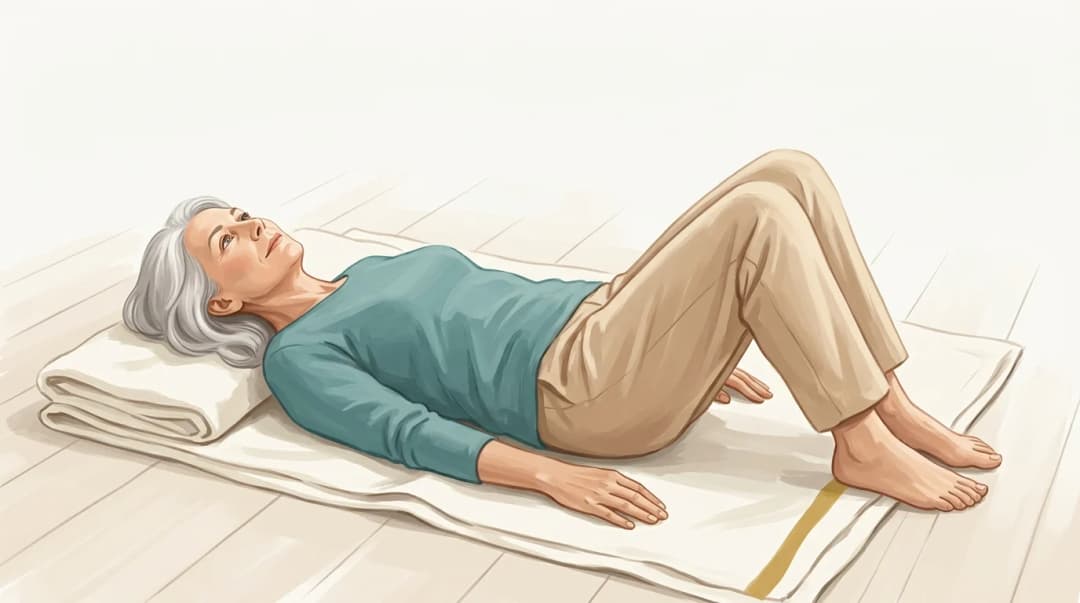
On your back, with support under the knees. If you prefer your back, a pillow or a rolled towel under both knees takes the pull off the lower back and lets the pelvis settle evenly. A small folded towel under the painful side sometimes helps, though this one is individual.
Hugging a pillow. Many people find the upper arm also drags the torso into a twist. A second pillow to hold against your chest keeps the shoulders stacked above one another.
Our Feldypedia article on sleep disruption and physical tension covers why a body that is already guarding tends to sleep more restlessly, which then feeds back into the pain.
What tends to make the night worse
The position most likely to irritate a sacroiliac joint is side lying with the top leg fallen forward onto the mattress, ahead of the lower leg. That shape rotates one half of the pelvis against the other and holds it there. It is also the default shape almost everyone drifts into without a pillow.
Stomach sleeping is the next most common troublemaker, mostly because of the sustained head turn and the forward tip it gives the pelvis. Neither position is dangerous. They are simply the two that most often produce a stiff, sore morning.
Getting into and out of bed
This part is quietly important and rarely mentioned. Sitting straight up from lying asks a cold sacroiliac joint to do real work. Roll onto your side with your knees held together so the pelvis turns as a single piece, let your lower legs travel off the edge of the bed, and push yourself up sideways with your arms. Reverse the sequence going in.
Why position alone is only half of it
A pillow between the knees changes what the night does to you. It does not change what the day did. If your pelvis arrives at bedtime already braced, it will find a way to hold that bracing whatever you prop it with.
This is the part the Feldenkrais Method® works on. Slow, small, comfortable movements give the nervous system clearer information about how the two halves of the pelvis are moving, and a joint that feels better informed tends to be guarded less fiercely. It is gentle work, and it suits an irritable joint far better than stretching into the sore spot. Our somatic exercises for sleep are a good place to feel what that is like before bed, and the Feldy program for stress and sleep builds it into a nightly habit.
Two companion pages are worth reading alongside this one: SI joint pain exercises to avoid, which covers the daytime movements that most often stir the joint up, and our SI joint stretches page for the gentler end of what helps.
A calmer body, easier nights
Understanding it is calming, moving with it more so. The Feldy program is meditation in movement, slow Feldenkrais® lessons that help a busy body settle so sleep can arrive on its own. Gentle, guided, and self-paced.
Start my free 7-day trialNo credit card needed.
Common Questions about sleeping with SI joint pain (FAQ)
What is the best way to sleep with SI joint pain?
Side lying on the less painful side, with a firm pillow filling the gap between your knees and reaching down to your ankles. That stops the upper leg falling forward, which is the movement that twists the pelvis and irritates the joint. If side lying does not suit you, lying on your back with a pillow under both knees is the usual second choice.
Should I sleep on the painful side or the other one?
Most people are more comfortable with the sore side uppermost, so nothing presses on it. Some find the opposite, because the mattress supports the painful joint. Try both for a few nights each and let your mornings decide rather than following a rule.
Is sleeping on my stomach bad for SI joint pain?
It is not harmful, but it is usually the least comfortable option. Stomach sleeping turns your head to one side for hours and tends to tip the pelvis forward, which many irritable sacroiliac joints dislike. If you sleep this way and wake up fine, there is no reason to change.
What kind of mattress helps SI joint pain?
Something medium firm is the general starting point. A mattress soft enough to let one hip sink deeper than the other encourages exactly the pelvic twist you are trying to avoid, while a very hard surface can concentrate pressure on the joint itself. A mattress topper is a cheap way to test a change before buying anything.
Why is my SI joint pain worse in the morning?
A pelvis held slightly twisted for seven or eight hours has had a long time to stiffen, and the first movements of the day ask that joint to work before it has warmed up. Morning stiffness that eases within twenty or thirty minutes of gentle moving is a common pattern. Stiffness lasting well over an hour, especially in someone under forty, is worth mentioning to a doctor.
How should I get out of bed with SI joint pain?
Roll onto your side first, keeping your knees together so your pelvis turns as one piece, then let your legs travel down off the edge as you push up sideways with your arms. The thing to avoid is sitting straight up from your back, which asks the sacroiliac joint to work hard while it is still cold.
When should I see a professional about SI joint pain?
See someone if the pain has run several weeks without improving, if it began after a fall or an accident, or if it started around pregnancy. Seek prompt care for fever, weight loss you cannot account for, a leg that feels numb or gives way, or bladder and bowel habits that change suddenly.
A calmer body, easier nights
See the programRelated resources
SI Joint Pain: Exercises to Avoid, and Gentler Options
SI joint pain exercises to avoid include deep twists, single-leg loading, heavy hip hinges, and end-range stretches that shear the joint. Here is what tends to aggravate it, and a gentle practice to calm the area.
SI Joint Stretches That Do Not Provoke a Sore Pelvis
SI joint stretches that stay small and slow, in a short lying down lesson for that nagging one sided ache low beside the tailbone.
Lying down is not the same as resting, and researchers have now measured the difference
Ready to start moving better?
Gentle, guided lessons for your body. Try your first one free, no credit card required.