
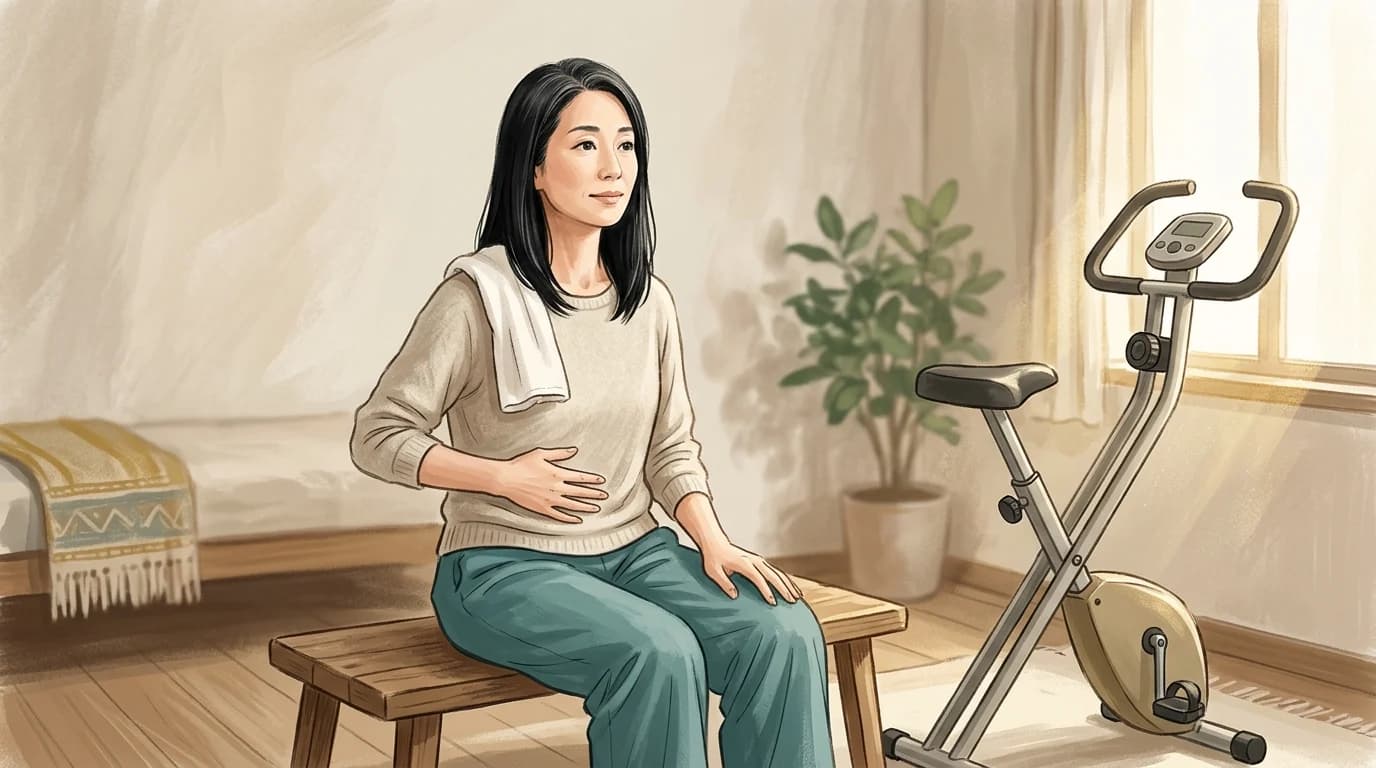
When stress has worn you out, gentler exercise was easier on the nervous system
In a Stockholm study, people with stress related exhaustion showed a calmer heart rhythm after a light bike ride than after a moderate one. How hard you go seems to matter more once the system is already tired.
The usual advice for stress is to move, and to move hard enough to break a sweat. Burn it off. There is good research behind the general idea.
But what happens when stress has already left you exhausted? A team in Stockholm asked exactly that. Their answer, published on 25 October, points somewhere gentler: in people diagnosed with stress related exhaustion, a light 22 minute bike ride was easier on the heart's resting rhythm than a moderately harder one, while in healthy people the two rides made no difference (European Journal of Applied Physiology, 2026).
Two rides, one small step apart
Jenny Kling and colleagues at the Swedish School of Sport and Health Sciences worked with 30 adults who had exhaustion disorder, a diagnosis Sweden added to its version of the international disease codes in 2005 for stress that has turned into lasting fatigue, poor sleep and trouble thinking clearly. A doctor had confirmed each diagnosis, and nobody was in the acute phase (ClinicalTrials.gov). Twenty nine healthy adults of similar age and sex made up the comparison group. Almost all of them, 93%, were women, mostly in their mid forties.
Everyone rode a stationary bike for 22 minutes on two separate days, once at a light effort and once at a moderate one, in an order set by chance. The step between the two was small: about 40% of each person's estimated aerobic capacity against about 55%. Neither ride was hard.
The team tracked heart rate variability, the tiny shifts in timing from one heartbeat to the next, before, during and after each ride, and took saliva samples for cortisol. More of that variation generally goes with the resting, recovering side of the nervous system; less of it goes with readiness and alarm.
The difference showed up after stopping
While people were pedalling, the two groups looked alike. The gap opened afterwards. In the time after the ride, the exhausted group's heart rhythm stayed further from rest than the healthy group's, and that was where the two groups differed most clearly.
Intensity mattered for one group only. In people with exhaustion disorder, the moderate ride went with less of that resting variation, and with a balance tipped further toward alertness, than the light ride. In the healthy volunteers the two efforts looked the same. Cortisol told a less tidy story: broad differences between the groups, but no clear pattern across the hour.
The authors read this as a stress system that is regulated differently in exhaustion. When exercise advice is tailored for this group, they write, two things deserve attention: the intensity, and the period after the session.
What the headline will miss
This was one session at each effort, measured over about an hour, so it says nothing about what weeks of regular exercise would do; the team describes it as groundwork for a later treatment trial. Thirty people is a small group. A heart rhythm is a marker, not a feeling, and the published summary reports the heart and cortisol rather than how calm or tired people felt. The trial was registered after it had started. People with chronic fatigue syndrome, long covid or fibromyalgia were excluded, so the results don't speak to those conditions, where effort is a separate question. The work was funded by the Swedish Knowledge Foundation.
Doing less
In a Feldenkrais Method® lesson, effort is turned down on purpose. Movements get smaller and slower, and sometimes you simply lie still for a while. When the nervous system is already running hot, less effort leaves attention free to notice what changes, and it leaves something in reserve for the hour after. What I see again and again in my classes is that people who arrive depleted expect to be asked for more, and they are surprised by how small the useful thing turns out to be. A bike at two speeds is not a lesson, and the study did not test the method. Still, it points the same way: for a tired system, the lighter dose was the one the heart seemed to settle from more easily.
A pace that leaves something over
None of this says that people with exhaustion should stop moving, and both rides in the study were modest. What it suggests is that, for a nervous system already worn down, the half hour after a session belongs to the session, and that a light pace may sit better there. That could be a walk slow enough to talk through, a few minutes of easy movement on the floor where you only go where it feels easy, pleasant, and comfortable, or simply stopping a little before you have had enough rather than at the point where you feel spent. If you are working with a doctor or a physiotherapist on exhaustion, gentle movement sits alongside that care, not in place of it. The Feldypedia entry on fatigue that movement can address looks at why tiredness can persist even with rest, and how much of it may come from effort we no longer notice we are making.
Next time you finish a walk, notice the ten minutes after you sit down. Does your breathing settle easily? Or does it take a while to find its way back?
Let Feldy guide you, eyes closed
A calm voice walks you through gentle moves so your attention stays in your body, not on the screen.
Try Feldy Free for 7 daysNo credit card needed.
Sources
- Heart rate variability and cortisol responses to acute low- and moderate-intensity exercise in stress-related exhaustion— European Journal of Applied Physiology, 2026
- Heart rate variability and cortisol responses to acute low- and moderate-intensity exercise in stress-related exhaustion (PubMed record)— PubMed, 2026
- Acute Psychological and Physiological Exercise Effects Among Patients With Stress-related Exhaustion Disorder. Role of Exercise Intensity (NCT06429423)— ClinicalTrials.gov
Movement Pulse is informational, not medical advice. See our editorial policy.
Move better with Feldy
See the programMovement Pulse Weekly
The week's best research, in your inbox Tuesday.
Movement science, gentle-practice ideas, and a practitioner's read on what's new. Free.
More from Movement Pulse
Slow movement and stress: what trials keep finding
A new controlled trial joins years of research linking slow, attentive movement with a calmer nervous system, and showing where doing more stops helping.
Jul 13, 2026
Box breathing calmed people in the moment, while deeper stress markers mostly held still
A September 2026 review went looking for every randomized trial of the counted breathing square and found eight. A practitioner's read on the counting, the holds, and what the breath does when you leave it alone.
Sep 29, 2026
Lying down is not the same as resting, and researchers have now measured the difference
A panel of 27 people and 162 adults living with fatigue helped build a scale for rest. One of its six parts is called lack of skill.
Sep 13, 2026Ready to start moving better?
Gentle, guided lessons for your body. Try your first one free, no credit card required.