
How to help aging parents move without nagging
Five ideas that start from her choices. From gentle audio lessons for two to a daily walk with a reason.
 Chava SoraniGuild Certified Feldenkrais Practitioner (GCFP)
Maybe you noticed it on your last visit, when your mom got up from her chair more slowly. Now you are wondering how to help without making her feel watched.
She stopped her evening walks. She holds the railing on the stairs. When you ask, she says "I'm fine."
You make a suggestion, but it comes out sounding like a reminder she did not ask for. Your visits give her a lift, but once you leave, things often go back to how they were.
What helps most is something she can enjoy on her own, between your visits, that starts from her choices. Here are five things families say work. Not every idea fits every family, so take the ones that sound like her.
1. Gentle lessons, alone or together
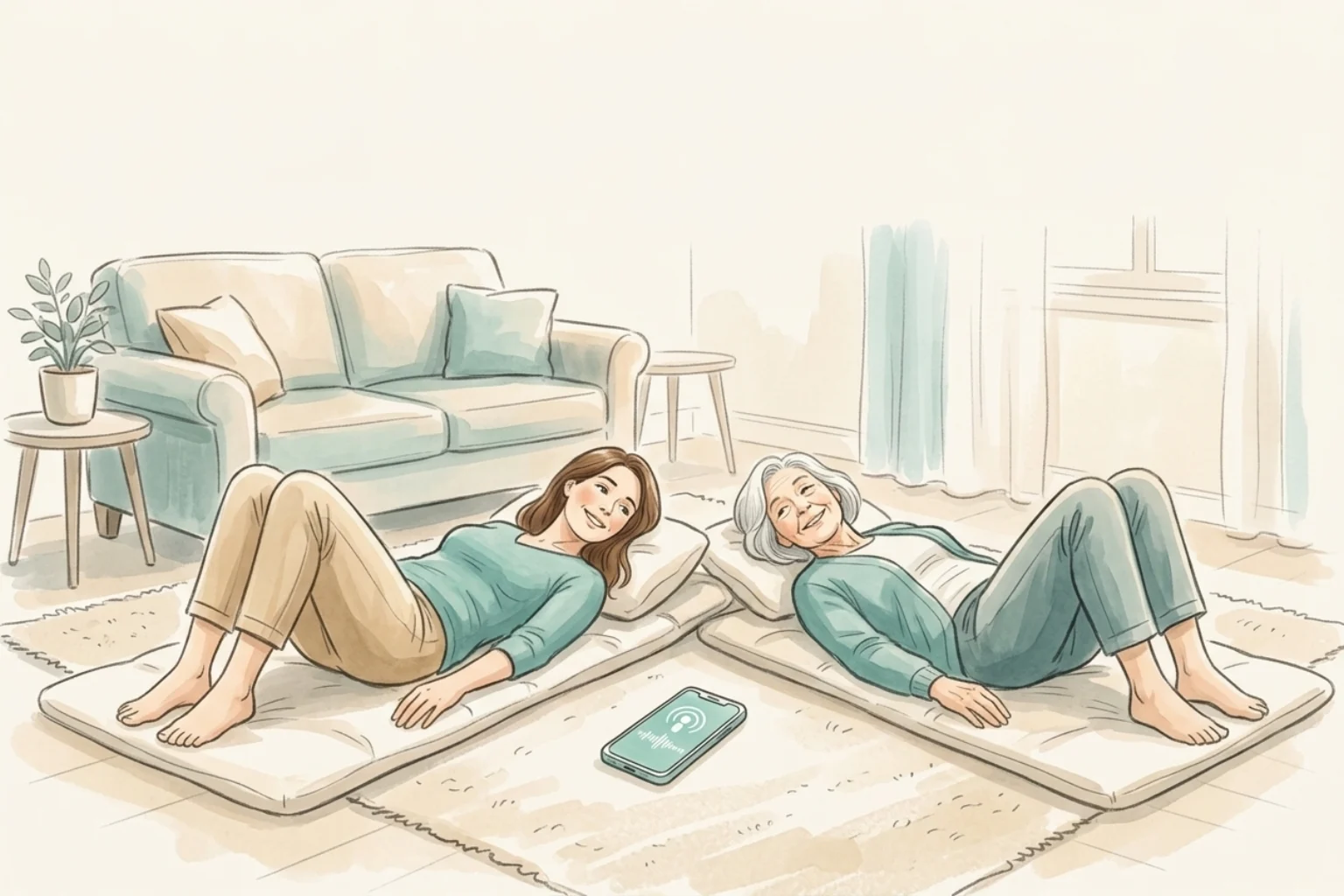
Feldy is my online movement program, based on the Feldenkrais Method®. She follows my voice through slow, gentle movements, with no screen to watch. Most lessons are lying down or in a chair, about 10 to 20 minutes. She can do them on her own, whenever she likes, with a reminder she sets.
It can be a mom and daughter thing too. On your next visit, lay two blankets on the floor, play one lesson, then talk about how it felt. Or play the same lesson at home at the same time, then call each other. You may enjoy it as much as she does. The first week is free and needs no credit card. When it ends, nothing renews unless she chooses to go on. Share a free week with your mom or dad.
2. A walk with a reason
Ask people who have kept walking for years, and many will tell you the secret is a daily walk with a purpose. To the market. To the mailbox. With the dog, or arm in arm with you.
Choose a regular day and time together, and put it in both your calendars. If you live far away, she walks on her own and then calls you to tell you what she saw. Perhaps the neighbor's roses are in bloom, or a new café has opened. Having something to tell you gives the walk a second purpose. If walking is hard for her right now, a slow lap of the garden counts too.
3. Movement inside her ordinary day
Gardening, cooking, housework, music in the kitchen, carrying the watering can to the tomatoes. All of this is movement, and she already knows how to do it. Many families buy a treadmill or an exercise bike with love, only to see it stand in a corner for years. Movement inside things she already likes is much easier to keep up.
So ask her what she used to love doing. Dancing in the living room? Baking bread? Planting bulbs every autumn? This week, offer to do one with her, or bring a bag of soil or an old record she loves.
4. Other people to move with
Water aerobics, tai chi, chair yoga, dance, a walking group at the community center. Each one is a different way of working with the body, and the one that fits is the one she chooses. People who go to a class often say it is what gets them out of the house, and the friends there keep them coming back.
Let her pick the class. Then offer to drive her to the first one, or to go with her once. Walking into a new room is easier with someone she knows beside her. And if groups are not her thing, one friend to move with works just as well.
5. Ask, listen, let her choose
Arguing and ultimatums tend to backfire. An invitation usually works better. So ask how moving feels for her these days. Is she more tired than before? Does her knee hurt? Is she worried about falling? Has she been feeling low? She knows her own answers best.
Then ask what she would like to be able to do. Carry the shopping up the stairs? Walk to the bakery again? The goals that last are the ones she names herself. If something has changed suddenly, like a fall, new dizziness, or sudden pain or weakness, the first call is to her doctor.
What tends not to work
Arguing, or giving her an ultimatum, usually makes her dig in. Big equipment bought as a hint tends to gather dust. Helping with every step, when she can manage on her own, can slowly wear down her confidence. All of this usually comes from a good place, from love and a little worry.
What this means for you
This week, pick one of the five things. Before you act on it, ask her about it. Would she like a walk on Thursdays? A class she would like to try? Two blankets on the floor next time you visit? Let her answer shape the plan.
And maybe take ten minutes on the floor for yourself. You carry a lot, too.
The better question
In my lessons I rarely ask people how much they moved. I ask how the movement felt. Was it easier to turn the head the second time?
In Feldenkrais, change often starts with curiosity about the feeling. Doing more tends to follow later, once moving is something a person looks forward to.
You can borrow that question for your mom or dad. Leave aside how far she walks or how often she exercises. Wonder instead what moving feels like for her now, on an ordinary Tuesday afternoon.
Next time you call, ask her what would make moving feel a little more like her own idea.
A free week for your mom or dad
A free 7 day trial of the Feldy online movement program: gentle lessons voiced by Chava, lying down or in a chair, with no credit card needed.
See how it could work for herThese ideas are for general interest. Gentle movement sits alongside, never in place of, advice from your parent's doctor, especially after a fall or if something has changed suddenly.
FAQ about helping your parent keep moving
How can I help my mom or dad keep moving without nagging?
Try inviting rather than reminding. Suggest a walk together, or share a lesson you enjoyed, and let her decide. Ask how moving feels for her now, and leave the counting out. When the choice stays with her, moving becomes her own idea.
What kind of movement suits a parent who is not very active?
Start with what she already likes, such as a walk to the shops, the garden or music in the kitchen. Gentle lessons like the ones in Feldy are mostly done lying down or in a chair, slowly, only as far as feels comfortable. If something has changed suddenly, such as a fall, new dizziness, or sudden pain or weakness, talk with her doctor first.
How can we move together when I live far away?
Pick the same time and do the same thing in two places: a walk, or the same Feldy lesson, then a phone call to compare how it felt. A regular day and time in both your calendars helps it happen. The call afterwards is often the part you both look forward to.
Does the free week of Feldy renew on its own?
No. The free week needs no credit card, and nothing happens on its own when it ends. If she enjoys the lessons, she can choose to go on; if not, the week simply ends.
What if my mom or dad is not comfortable with technology?
Feldy lessons are audio, so there is no screen to watch. Your parent listens to my voice and follows along. You can add Feldy to the home screen of her phone or tablet and help her start on a visit or a video call, and she can choose a time for a reminder.
Start your free 7-day trial
Start free trialMore Articles
Fibromyalgia and slow lessons: what eased, and what did not
Symptom load and the dread around pain improved. In 128 people, mostly women, daily life only trended better, and there was no comparison group.
Nov 18, 2026
Sore After Physical Therapy? What to Do the Next Day
Soreness after physical therapy is often a normal part of the work. What to watch for, and how gentle movement can sit alongside your program.
Oct 4, 2026
Somatic Movement: Where Feldenkrais Fits
Is Feldenkrais somatic movement? What the word somatic points to, and where the Feldenkrais Method sits among the many somatic practices.
Nov 20, 2026Ready to Start Moving Better?
Try your first lesson for free. No credit card required.