

Why the fear of moving and the confidence to move seem to pull each other along
A new analysis in Pain, drawn from a trial of 521 adults, tracks how the pieces of recovery move each other week by week.
Ask someone whose back has hurt for four or five years what needs to change, and you'll almost always hear about the back. A disc. An alignment. A core that somebody once called weak. A paper that landed in PubMed on August 19, running in the September issue of Pain, asks a stranger question. The answer has stayed with me all week.
The paper is a secondary analysis of a randomized trial of 521 adults with chronic low back pain, run by Burns and colleagues, in which people received eight individual sessions of cognitive therapy, mindfulness based stress reduction, or behavior therapy, or simply carried on with their usual care (Burns et al., Pain, 2022). That original trial had already reported something that unsettled a few assumptions. The three treatments produced roughly the same improvements, held them at six months, and separated from usual care at about session six, whichever one you got.
What the new analysis adds is the order things happened in. Because the working parts were measured every single week, the researchers could ask what a before and after design cannot touch: did a change in one thing during one week predict a change in a different thing the following week (Burns et al., Pain, 2026)?
It did. Two findings stand out. The first is that the relationship between pain catastrophizing, meaning the pull toward expecting the worst from a sensation, and pain self efficacy, meaning the belief that you can do a thing despite pain, ran in both directions. Each predicted movement in the other the week after. Reciprocal. By contrast, the links running from catastrophizing to mindfulness and from catastrophizing to behavioral activation went one way only. The second finding is that the treatment label did very little. Interactions between treatment condition and mechanism came out nonsignificant, a dry way of saying the machinery turned much the same way whichever therapy a person had walked into. It echoes a direction this section keeps running into, that the more useful target in chronic back pain is often the nervous system rather than the structure. The strength of those links, person by person, predicted how much someone improved overall.
What this looks like from the floor
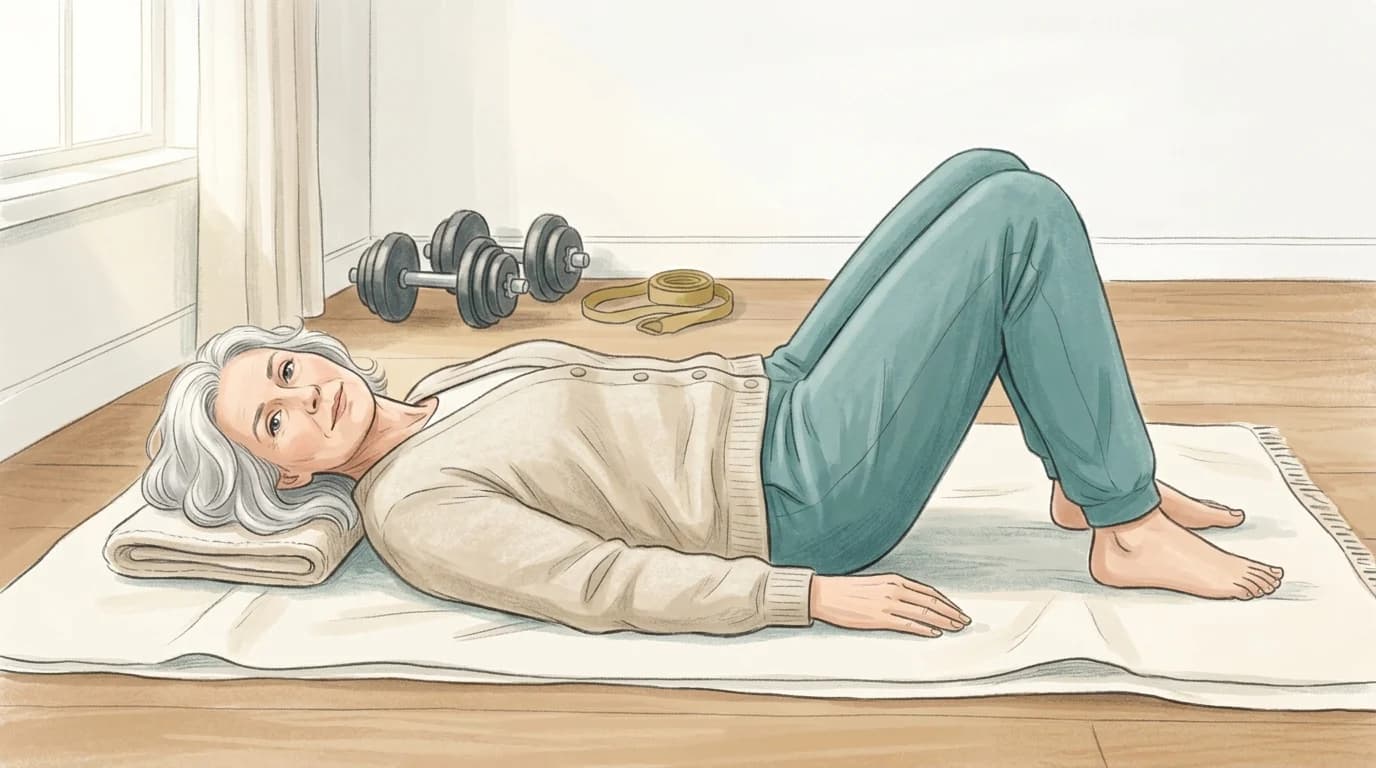
I don't teach cognitive therapy and I'm not a psychologist. But pain self efficacy, taken off its measurement scale and put back into a room, is the plainest thing I watch change in people living with chronic low back pain, and it is what I would name first if you asked what actually shifts in a Feldenkrais Method® lesson. Not flexibility. The sentence a person stops saying to themselves before they move.
A woman I've worked with since March arrived certain that turning her head to look behind her while backing the car down her driveway was the one movement guaranteed to set her back off, a rule she had assembled over four years of careful avoidance and had never once actually put to the test. Not a theory. A law. We spent most of a lesson rolling the head and the eyes to one side, very slowly, very small, resting often, staying inside the range where it felt easy and pleasant and comfortable. Near the end she turned further than she had in a long time and nothing happened at all. She laughed, said "huh," then said the sentence I hear more than any other in this work: I didn't know I could still do that.
That is the loop the new analysis describes, running in a living room in real time. Something she expected went differently, so the expecting loosened; the loosening made the next attempt easier to consider; the easier attempt produced more evidence. You can step into that loop from the thinking end, which is roughly what cognitive therapy does. You can also step into it from the moving end. The data suggest the loop is not fussy about which door you came through.
It matches a thing I say too often to claim any originality about it. Most people who find their way to me have not lost the movement. They've lost the trust that moving will help.
What to do with a finding like this
Careful, first. This is a secondary analysis of one trial, and lagged models tell you about ordering and prediction rather than cause. Better evidence than a single before and after snapshot, and still a long way from a mechanism nailed down.
What it might reasonably change is how you read a week. If confidence and expectation move ahead of the pain rather than trailing it, then a week in which the pain score sat exactly where it was, but you did one thing you had quietly stopped doing, is not a failed week. It may be the week the loop turned over. Most people grade themselves on pain, and pain is the slowest of the variables.
Gentle work has a structural advantage inside a loop like that, and I'll state it plainly rather than grandly: the likelier a movement is to go fine, the more reliably it feeds the thing that makes the next movement possible. Yoga, Pilates and Tai Chi each work on the same person by their own mechanism, and each has its own strengths. Feldenkrais® works mostly by changing what you notice while you are moving, a different kind of lever. None of it replaces clinical care. If your back pain is new, severe, or arrives with leg symptoms, numbness, or anything that worries you, that belongs with a clinician first, and this sort of movement work sits alongside what your physiotherapist has given you rather than in place of it.
The part I still can't account for is why some people's loop is tightly wound and other people's is slack. The analysis measured that difference and found it predicted outcomes. It could not say where it comes from. My own guess is worth what a guess is worth, and it has something to do with how much attention a person can hold on a movement while the movement is happening, an awkward thing to measure and an easy thing to feel. Meanwhile there is a woman in a parked car, one hand on the passenger headrest, turning to look over her shoulder at an empty driveway. Checking.
Let Feldy guide you, eyes closed
A calm voice walks you through gentle moves so your attention stays in your body, not on the screen.
Try Feldy Free for 7 daysNo credit card needed.
Sources
Movement Pulse is informational, not medical advice. See our editorial policy.
Move better with Feldy
See the programMovement Pulse Weekly
The week's best research, in your inbox Tuesday.
Movement science, gentle-practice ideas, and a practitioner's read on what's new. Free.
More from Movement Pulse
239 back pain trials searched for the ideal exercise dose. More added surprisingly little
A new review names a best dose for chronic back pain, then says it can barely tell that dose apart from the others. That caveat is the real finding.
Sep 30, 2026
The exercise that made people feel best was not the one that calmed the inflammation
Fifty nine randomized trials, seven exercise methods, 3,404 adults with axial spondyloarthritis. Different methods moved different things, and one measure moved for nobody.
Sep 21, 2026
A back support helped in one trial. Then Cochrane pooled eight of them and found a gap
Cochrane went looking for evidence on lumbar supports and other assistive devices for chronic low back pain. It found eight small trials, 501 people, and not one study that recorded whether anyone fell.
Sep 5, 2026Ready to start moving better?
Gentle, guided lessons for your body. Try your first one free, no credit card required.