
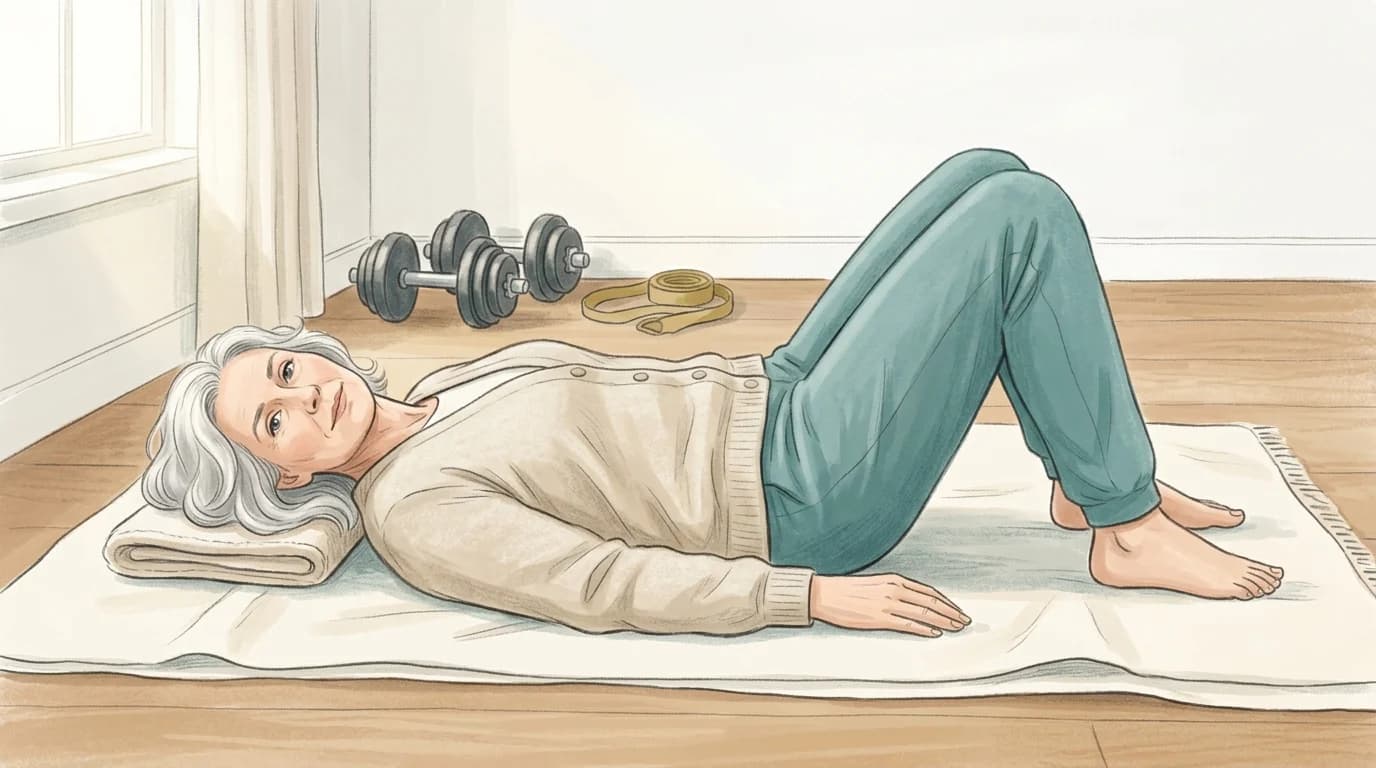
239 back pain trials searched for the ideal exercise dose. More added surprisingly little
A new review names a best dose for chronic back pain, then says it can barely tell that dose apart from the others. That caveat is the real finding.
Every so often a paper lands that people will be quoting as a prescription within the week. This is one of them. A review in the British Journal of Sports Medicine pooled 239 randomized trials of exercise for chronic low back pain and asked the question most of us have put to a physiotherapist at some point: how much, and how often?
What the review did
The team, working out of Bochum University of Applied Sciences in Germany with Daniel Belavý as senior author, gathered every exercise trial they could find in adults whose back pain had lasted longer than three months, 252 reports in all, searched up to June 2025, and then modelled how pain and disability shifted as the dose changed: sessions per week, minutes per session, weeks in total (British Journal of Sports Medicine, 2026). Almost every trial, 99.2% of them, dealt with the common kind of chronic low back pain that has no single clear structural cause.
The model produced two numbers that will travel. For disability in the short term, meaning up to about three months, the predicted sweet spot was four sessions a week of around 25 minutes, over 13 weeks. For pain, it was three sessions a week of around 30 minutes, over eight weeks. Higher doses added only limited extra benefit. Just 28.5% of the trials reported on side effects at all, and what they did report was mostly minor, mostly muscles and joints.
What the headline version will miss
Here is the sentence that tends to get dropped. For most of the doses compared, the ranges of likely benefit overlapped, which means the study can't cleanly separate most schedules from their neighbors, three sessions a week from four, a little longer from a little shorter. The authors say so plainly: the evidence does not support a single optimal dose.
Beyond the first three months? Very few dose combinations reached the threshold the team had set in advance for a change a person would actually notice, five points on a 100 point scale. And 84% of the trials were rated at high risk of bias, so the certainty behind the whole picture came out low to very low.
None of this makes exercise pointless. A Cochrane review of 249 trials in 2021 found that exercise probably eases chronic back pain compared with doing nothing, though its effect on daily function was small (Cochrane, 2021). An umbrella review this July, spanning 157 reviews across many kinds of pain, found the largest effects in lower intensity programs shorter than twelve weeks (Pain Reports, 2026). The new paper sits on that same line; modest amounts help, and heroic amounts don't seem to help more. What it can't hand anyone is a number precise enough to feel guilty about missing. (A similar ceiling showed up for walking and back pain earlier this year.)
One detail I liked. Two of the 24 authors list German patient associations as their home base, one for people with ankylosing spondylitis and one run by people living with chronic pain, so people who know these backs from the inside were at the table when the evidence was read.
The better question
A dose answers how much. The Feldenkrais Method® asks how. Two people can spend the same 25 minutes, one bracing through every repetition and the other moving with enough ease to notice where the effort goes, and I wouldn't expect their backs to learn the same thing. Trials rarely record that difference because it is hard to measure, and it may be part of why their results scatter so widely.
What I see again and again is people arriving with a number (three times a week, ten repetitions, half an hour) and a quiet sense of failing it. The question I'd rather they carried is smaller: could this movement be done with a little less effort, and what changes when it is?
Where that leaves you
If you live with chronic back pain and have a program from your physiotherapist, this review is no reason to abandon it. It suggests a regular, moderate amount is a reasonable aim and that pushing far past it is unlikely to buy much extra, especially over the longer run. Gentle movement work sits alongside that program, not in place of it. In an Awareness Through Movement® lesson you only go where it feels easy, pleasant, and comfortable, which is what makes it something people come back to on a bad week as well as a good one.
Two hundred and thirty nine trials, and the most useful number in them may be the one the authors declined to give. What would three easy sessions this week feel like, if nobody were counting?
Let Feldy guide you, eyes closed
A calm voice walks you through gentle moves so your attention stays in your body, not on the screen.
Try Feldy Free for 7 daysNo credit card needed.
Sources
- Optimal exercise dose in adults with chronic low back pain disorders: systematic review with dose-response network meta-analysis— British Journal of Sports Medicine
- Exercise therapy for chronic low back pain— Cochrane Database of Systematic Reviews
- The effect of exercise on clinical pain: a systematic umbrella review and meta-meta-analysis— Pain Reports
Movement Pulse is informational, not medical advice. See our editorial policy.
Move better with Feldy
See the programMovement Pulse Weekly
The week's best research, in your inbox Tuesday.
Movement science, gentle-practice ideas, and a practitioner's read on what's new. Free.
More from Movement Pulse

The exercise that made people feel best was not the one that calmed the inflammation
Fifty nine randomized trials, seven exercise methods, 3,404 adults with axial spondyloarthritis. Different methods moved different things, and one measure moved for nobody.
Sep 21, 2026
Why the fear of moving and the confidence to move seem to pull each other along
A new analysis in Pain, drawn from a trial of 521 adults, tracks how the pieces of recovery move each other week by week.
Aug 26, 2026
A back support helped in one trial. Then Cochrane pooled eight of them and found a gap
Cochrane went looking for evidence on lumbar supports and other assistive devices for chronic low back pain. It found eight small trials, 501 people, and not one study that recorded whether anyone fell.
Sep 5, 2026Ready to start moving better?
Gentle, guided lessons for your body. Try your first one free, no credit card required.