
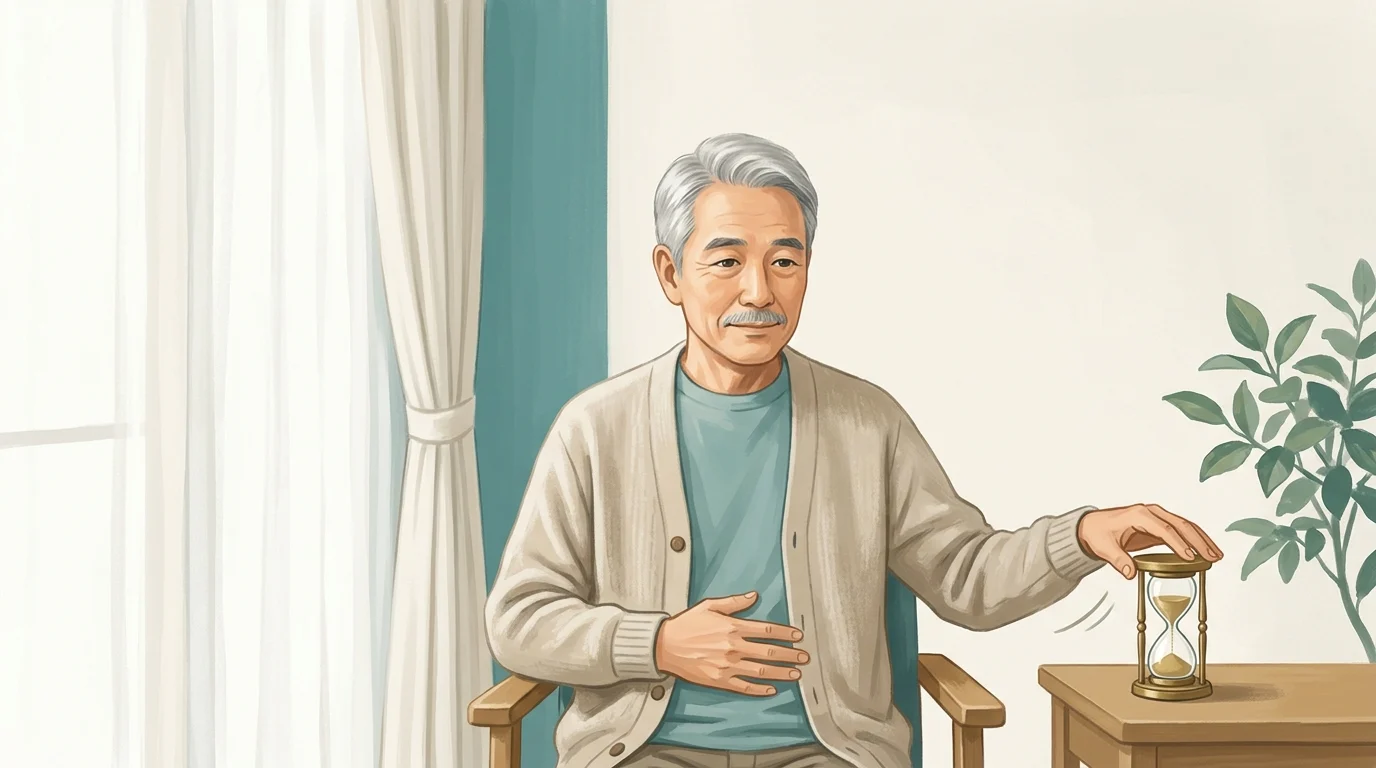
Box breathing calmed people in the moment, while deeper stress markers mostly held still
A September 2026 review went looking for every randomized trial of the counted breathing square and found eight. A practitioner's read on the counting, the holds, and what the breath does when you leave it alone.
Breathe in for four, hold for four, out for four, hold for four. Box breathing may be the most recommended calming technique of the past decade. It turns up on phone apps, in workplace wellness sessions and in countless articles about anxiety, which is why it's a little surprising how few trials have tested the square itself.
On 21 September a team at Galgotias University in India published a systematic review in Applied Psychophysiology and Biofeedback that set out to gather every randomized trial of box breathing as its own practice: the equal four part pattern, not slow breathing in general (Applied Psychophysiology and Biofeedback, 2026). They found eight. Those eight differed so much in who took part, how the breathing was taught and what was measured that the authors could not pool them into one result, so they described them side by side.
Across the set, box breathing tended to ease how stressed, anxious and low people felt in the short term, though not evenly from one study to the next. The body's side of the story was patchier. Some trials saw breathing rate come down; others saw changes in heart rate or in heart rate variability, a measure of how flexibly the heartbeat adjusts from moment to moment. In the clinical trials, which included women after childbirth and women recovering from surgery, the review reports less postpartum pain and better results on some breastfeeding measures. No trial looked at lung function or aerobic fitness, and very few followed anyone for long.
A trial published in June shows the short term pattern clearly. At Texas State University, 66 adults were split into three groups of 22 and, before facing a standard laboratory stress test delivered virtually, practiced either ordinary breathing, a long slow exhale, or the box (Comprehensive Psychoneuroendocrinology, 2026). Both breathing groups showed a smaller rise in heart rate, in felt anxiety, and in a saliva enzyme that tracks the body's fast alarm response. Cortisol, the slower stress hormone, did not differ between the groups. Neither did heart rate variability, or performance on the thinking tasks.
One more detail matters for anyone who uses the square every day. In a 2023 Stanford trial, 108 people spent five minutes a day for a month on one of three breathing patterns or on mindfulness meditation (Cell Reports Medicine, 2023). The pattern built around long exhales lifted daily mood the most and slowed breathing the most, both clearly more than meditation. The box group improved too, but not by enough to set it apart from meditation.
So the fair reading is a modest one. The square seems to take the edge off a stressful moment. As a way of retuning the nervous system over weeks, the evidence is thin, and where patterns were compared directly, the ones that lingered on the breath out did at least as well.
The habit underneath
What interests me is the hold. Two of the square's four sides ask you to stop breathing, and stopping the breath is already one of the most common habits I meet in people who live with stress. Reach for a high shelf, lift a heavy pot, open a difficult email, and very often the breath catches and holds without anyone deciding to. For some people a counted hold is a welcome anchor. For others it can quietly rehearse the same brace they came to let go of (jaw set, throat closed, waiting for the count to end). Neither is a fault. It's information. In the Feldenkrais Method® I rarely tell anyone how to breathe; we make the movement easier and let the breath change on its own.
If the square works for you, there's no reason to drop it. The experiment below keeps its shape and softens its corners, so you can feel for yourself which of its pauses is a rest and which is a grip.
A square with softer corners
About 5 minutes. Move slowly, do less than you can, and stay well below any pain. Rest whenever you need to.
- 1
Sit comfortably with your feet on the floor and your hands resting wherever they like. For a few breaths, change nothing. Notice where the breath moves: belly, lower ribs, chest, or somewhere you didn't expect. Notice whether there is already a pause somewhere, and whether it comes after the breath in or after the breath out.
- 2
Now try two or three rounds of the square at a gentle count, three if four feels long: in, hold, out, hold. Go only where it feels easy, pleasant and comfortable. While you hold, notice your jaw, your throat and your shoulders. Is anything gripping to keep the breath still?
- 3
Let the counting go and breathe as you normally would for a few breaths. Then let one breath out go a little slower than usual. At the end of it, wait, without holding anything shut, and let the next breath in arrive when it wants to. Do this four or five times.
- 4
Compare the two kinds of pause. One you may have made by closing something. The other may simply have happened, because nothing was asking you to breathe yet. Where in your body could you tell the difference?
- 5
Return to your ordinary breathing and sense your shoulders, jaw and belly again, next to how they felt at the start. If you felt lightheaded at any point, let the breath go back to its own pace; the next time can be shorter.
Let Feldy guide you, eyes closed
A calm voice walks you through gentle moves so your attention stays in your body, not on the screen.
Try Feldy Free for 7 daysNo credit card needed.
Again and again, people who live with a loop of fast breathing and worry tell me that the counting itself turns into one more thing to perform, a small test they can pass or fail while their shoulders creep up. If that sounds familiar, the research offers some permission: most of the calming in these trials seems to have come from slowing down, and a slower breath doesn't have to be a square. Breathing practice of any shape sits alongside what a doctor or therapist offers for ongoing anxiety, not in place of it. If you're wondering where slow, gentle movement fits in that picture, I've gathered what's known about Feldenkrais for anxiety in one place.
Eight trials in, nobody has yet measured the thing I find myself most curious about, which is what the breath does in the quiet minute after the counting stops, when no one is telling it what to do.
Sources
- Systematic Review of Randomised Controlled Trials Evaluating Box Breathing for Stress, Autonomic, and Clinical Outcomes— Applied Psychophysiology and Biofeedback, 2026
- Box breathing and prolonged exhalation reduces markers of physiological stress reactivity in response to a virtual trier social stress test— Comprehensive Psychoneuroendocrinology, 2026
- Brief structured respiration practices enhance mood and reduce physiological arousal— Cell Reports Medicine, 2023
Movement Pulse is informational, not medical advice. See our editorial policy.
Move better with Feldy
See the programMovement Pulse Weekly
The week's best research, in your inbox Tuesday.
Movement science, gentle-practice ideas, and a practitioner's read on what's new. Free.
More from Movement Pulse
What a slower exhale does to a stressed nervous system
A small June 2026 study found that lengthening the exhale eased tension and quieted a marker of brain arousal in 40 minutes. A practitioner's read on why.
Jun 30, 2026
Slow movement and stress: what trials keep finding
A new controlled trial joins years of research linking slow, attentive movement with a calmer nervous system, and showing where doing more stops helping.
Jul 13, 2026
Lying down is not the same as resting, and researchers have now measured the difference
A panel of 27 people and 162 adults living with fatigue helped build a scale for rest. One of its six parts is called lack of skill.
Sep 13, 2026Ready to start moving better?
Gentle, guided lessons for your body. Try your first one free, no credit card required.