
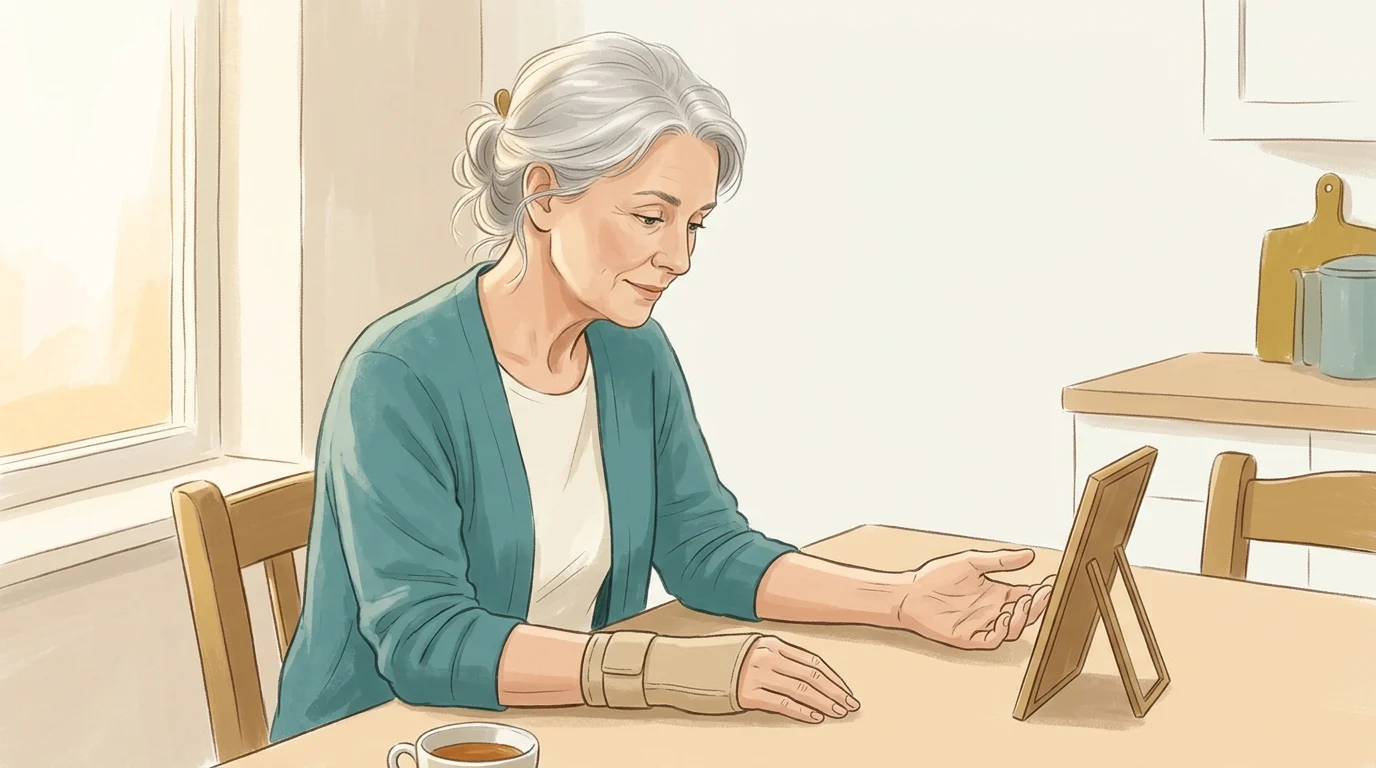
After a broken wrist, people who pictured moving regained more wrist use
Arm and wrist worked better in four small trials. People practised with a mirror or with imagery; pain and grip showed no clear gain.
A broken wrist often starts with a fall you didn't see coming, and then come the weeks in a cast while your other hand does everything. When the cast comes off, the bone may have healed, yet the hand can feel as if it belongs to someone else: stiff, careful, slow to answer.
If you've been there, you may wonder whether anything besides more exercises can help that hand feel like yours again.
There is a gentle option, and it starts in your mind. In four small trials with 117 people, those who practised picturing the movement, or watching it in a mirror, in supervised sessions regained more use of the arm and wrist than the people they were compared with (Atencio-Aguilar and colleagues, Journal of Hand Therapy, 2026). The review found no clear extra gain in their pain or their grip strength.
Arm and wrist worked better
There are a few ways to do this. In mirror therapy, a mirror hides the injured hand and shows the reflection of your good hand moving, so it looks as if the injured one is moving too. In motor imagery you picture a movement in detail, from the inside, without doing it. Graded motor imagery builds in steps, from telling left hands from right hands in photographs, to imagining, to the mirror.
The gain showed up in scores for how well the arm and wrist worked. There was no clear extra easing of pain or gain in grip, although single trials of imagery leaned that way.
So here's what's in it for you. If your hand is slow to come back, practising the movement in your mind is something gentle you can ask your hand therapist about, and the early, still weak evidence suggests it may help with using the arm and wrist. It showed no clear effect on pain.
What the trials did
The programs used simple, low cost materials, such as a mirror. People practised a few times a week for several weeks, some face to face with a therapist and some remotely. They started within two weeks of surgery, or after six weeks in a cast for those who didn't need an operation.
The usual explanation, which this review did not test, goes like this: when a hand can't move, or hurts when it does, the brain gets fewer messages from it, and picturing the movement may keep the practice going while the wrist itself rests. In my experience, coming back after an injury is as much about relearning ordinary movement as about the bone.
A learning problem
I don't think a hand forgets how to move during six weeks in a cast. What I see again and again in my classes, in people coming back after an injury, is that the whole arm has learned to protect it: the shoulder lifts a little, the elbow pulls in, the breath stops before the hand even turns. That guarding made sense while the bone was healing, and if you've wondered what muscle guarding feels like, it is often exactly this. The work afterwards is learning, not repair.
In Feldenkrais® Awareness Through Movement® lessons we often make a movement on one side and only imagine it on the other, and people are surprised by how different the imagined side feels afterwards. None of these trials tested the Feldenkrais Method®; this is how I read the finding from my teaching.
Here's a short practice in that spirit. You only go where it feels easy, pleasant and comfortable. If your wrist is still healing, keep that side imagined only, unless your hand therapist has said it may move.
Turning a hand in your mind
About 5 minutes. Move slowly, do less than you can, and stay well below any pain. Rest whenever you need to.
- 1
Sit at a table and rest both forearms on it, palms down. Let your hands be heavy.
- 2
Slowly turn your easier hand palm up, then palm down again. Notice your elbow and shoulder too.
- 3
Rest. Now only imagine the same turn with your other hand, slowly, palm up and palm down.
- 4
Where did you feel something while you imagined it? Your fingers, your shoulder, your breath?
- 5
Turn the easier hand once more, and picture the other hand turning with it at the same pace.
- 6
If your hand therapist has said it may move, let that hand make the turn very small. Otherwise keep imagining.
- 7
Rest both hands on the table. Does the hand you only imagined feel any different now?
Let Feldy guide you, eyes closed
A calm voice walks you through gentle moves so your attention stays in your body, not on the screen.
Try Feldy Free for 7 daysNo credit card needed.
What the headline will miss
Four trials is a small base. The reviewers rated their confidence in these results as low to very low, so the real benefit could be smaller, or might not hold up in bigger trials. If pain is what troubles you most, this review offers no clear answer. These techniques were done in supervised sessions. They sit alongside what your surgeon and hand therapist give you, not in place of it.
If your fingers become more swollen, numb, cold or pale, or the pain grows instead of settling, seek medical advice promptly.
Start with the easier hand
When one hand is slow to come back, start with the hand that moves easily, and let the other one follow in your mind or in a mirror.
Sources
- Effectiveness of movement representation techniques on function, pain intensity, and handgrip strength in patients with distal radius fracture: A systematic review and meta-analysis— Journal of Hand Therapy, 2026
- Effectiveness of movement representation techniques in patients with distal radius fracture (PubMed record)— PubMed
Movement Pulse is informational, not medical advice. See our editorial policy.
Move better with Feldy
See the programMovement Pulse Weekly
The week's best research, in your inbox Tuesday.
Movement science, gentle-practice ideas, and a practitioner's read on what's new. Free.
More from Movement Pulse
Why twenty two years of research on imagining movement for back pain still says maybe
Large effects, very low certainty, and a direction that has not changed since 2004. What the arc of imagined movement research actually adds up to.
Aug 29, 2026
Tennis elbow that lingers: grip gained more with motor learning added
Pain at rest eased a little more too, in 43 adults over six weeks. Pain during use eased in both groups, with no clear difference.
Nov 21, 2026
Asked to picture a short walk, older adults imagined four seconds. It took them six
Picture yourself walking across the room and back. A new study timed that picture in 85 adults in their seventies, then timed the real walk.
Oct 3, 2026Ready to start moving better?
Gentle, guided lessons for your body. Try your first one free, no credit card required.