
How much walking is enough for back pain
A 2026 analysis pooled 13 trials to put a number on walking for chronic back pain. The surprising part is how modest that number turned out to be.
Ask most people what a back specialist would tell them to do about long standing back pain, and few would guess the answer is a walk. A new analysis makes that guess look less strange, and it does something unusual on top. It puts a number on how much walking the research actually points to, and the number is smaller than you would think.
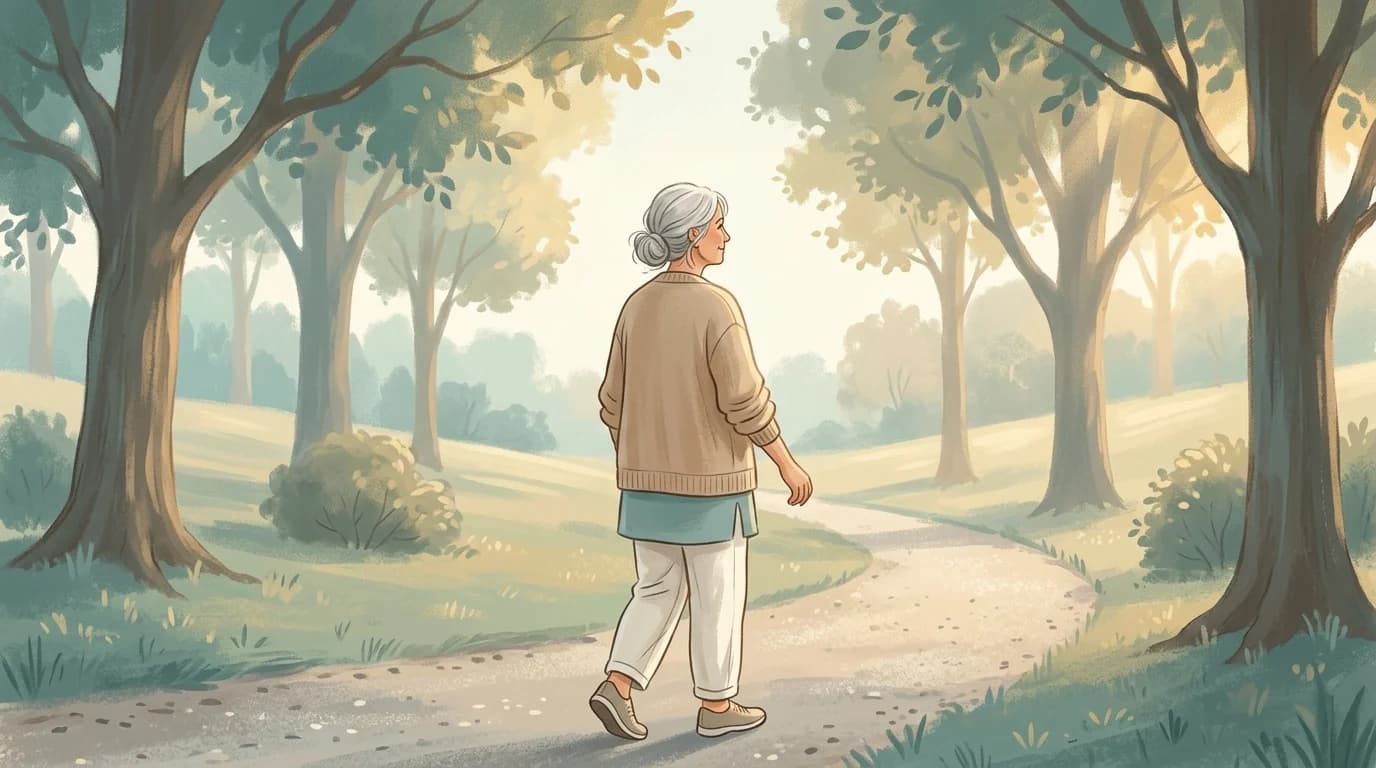
The analysis appeared in the journal PM&R in July 2026 and pooled 13 randomized trials of walking programs for adults with ongoing low back pain, the common kind with no single clear structural cause (PM&R, 2026). Rather than ask the usual yes or no question, the researchers mapped how the benefit changed with the amount of walking people did. The clearest result sat around 1,000 minutes of walking gathered over roughly eight weeks, which lined up with the largest reduction in pain. Disability, the degree to which a back limits an ordinary day, eased most at around 900 minutes. Spread across eight weeks, 1,000 minutes is close to a comfortable twenty minute walk on most days. For context, the World Health Organization calls low back pain the single leading cause of disability in the world, affecting 619 million people in 2020 (World Health Organization).
Two details are worth pausing on. The first is that the benefit did not keep climbing as the walking climbed. It rose, then flattened, and at the highest volumes it even began to slip back, so the study pointed to a comfortable middle rather than a case of more being better. The second is that the researchers were careful about certainty. They rated the confidence in the disability finding as moderate and the confidence in the pain finding as low, which is an honest way of saying this is a strong signal rather than a settled fact. They also noted that walking outdoors and having some encouragement or structure seemed to matter, both of which nudged the results in a better direction.
The line this study sits on
This is where a single piece of news becomes an arc rather than a headline. For years the honest answer about walking and back pain was that it probably helped and was worth trying. Then in 2024 a large trial named WalkBack, published in The Lancet, moved the conversation forward (The Lancet, 2024). It followed 701 adults who had recently recovered from a bout of back pain and gave half of them an individual walking plan alongside a handful of education sessions guided by a physiotherapist. The people who walked went far longer before their pain returned, a median of 208 days compared with 112 in the group left to their own devices. They also sought roughly half as much healthcare and took roughly half as much time away from work.
So the shape of the evidence has shifted in a specific way. WalkBack showed that regular walking pushes back the next episode. The 2026 analysis begins to answer the natural question that follows, which is how much walking that actually takes. Read together, the two point somewhere Feldy has always pointed. The useful dose is modest, regular, and well within reach, and pushing far past it does not seem to buy you more.
What I notice in the people I work with is that this news lands as relief rather than another item on a list. Someone who has been told to exercise often hears it as a demand for effort they do not have, especially on the days a back is loudest. A twenty minute walk is a different kind of ask. It is gentle, it is free, it fits around a life, and the research suggests it does not need to be heroic to count. Walking also sits comfortably next to clinical care. In WalkBack the walking was paired with a physiotherapist's guidance, not set against it, and that is the right relationship. Walking works alongside physiotherapy, not in place of it.
How you walk, not only how long
There is one thing I would add from the movement side, because a number of minutes is not the whole story. A back that has learned to guard will often carry that bracing into a walk, and twenty minutes of tense, held walking is a different experience from twenty minutes of easy, swinging walking. This is where gentle awareness matters. A short Awareness Through Movement® lesson before or after a walk, the kind of slow, attentive practice the Feldenkrais Method® is built on, helps the hips and ribs and spine rediscover how to move freely, so the walking itself becomes lighter. The daily rituals inside the Feldy online movement program are made for exactly that, a few minutes of easy floor movement that leaves you walking with less effort. You only go where the movement feels easy, pleasant, and comfortable, which is how a wary back learns to trust movement again. If you are weighing that kind of practice against a gentle class, our comparison of Feldenkrais and yoga lays out what each one asks of you.
That trust is the deeper thread under a study about minutes. Persistent back pain rarely means the body has lost its ability to move. More often it has lost confidence that movement will help, after enough painful episodes taught it to wait and brace. What both of these studies quietly hand back is that confidence, and they hand it back cheaply. You do not have to earn your way home with punishing effort. A short, regular, comfortable walk, ideally outdoors, is enough to begin, and the science now suggests that a modest amount, done consistently, may serve a back better than a heavy amount you cannot keep up. Find the dose you can return to on the good days and the hard ones alike, and let the ease build from there.
Let Feldy guide you, eyes closed
A calm voice walks you through gentle moves so your attention stays in your body, not on the screen.
Try Feldy Free for 7 daysNo credit card needed.
Sources
- How much walking is enough for chronic low back pain? A systematic review and dose-response meta-analysis— PM&R
- Effectiveness and cost-effectiveness of an individualised, progressive walking and education intervention for the prevention of low back pain recurrence in Australia (WalkBack): a randomised controlled trial— The Lancet
- Low back pain fact sheet— World Health Organization
Movement Pulse is informational, not medical advice. See our editorial policy.
Move better with Feldy
See the programMovement Pulse Weekly
The week's best research, in your inbox Tuesday.
Movement science, gentle-practice ideas, and a practitioner's read on what's new. Free.
More from Movement Pulse
With knee or back pain after 65, exercise may change how you walk more than how much
52 adults over 65 wore ankle sensors for twelve weeks. Their daily steps stayed flat while each ordinary step grew about an inch, a signal the authors call suggestive.
Oct 11, 2026
Why the first swimming trial for back pain is really a story about fear of moving
The first randomized trial of swimming for chronic low back pain compared it to education alone, not to other exercise. That comparison is the real story.
Jul 26, 2026
45 back pain trials, and still no single best method
A network meta analysis pooled 45 trials of movement and manual therapy for chronic low back pain. No approach clearly won, which changes how to choose.
Jul 2, 2026Ready to start moving better?
Gentle, guided lessons for your body. Try your first one free, no credit card required.