
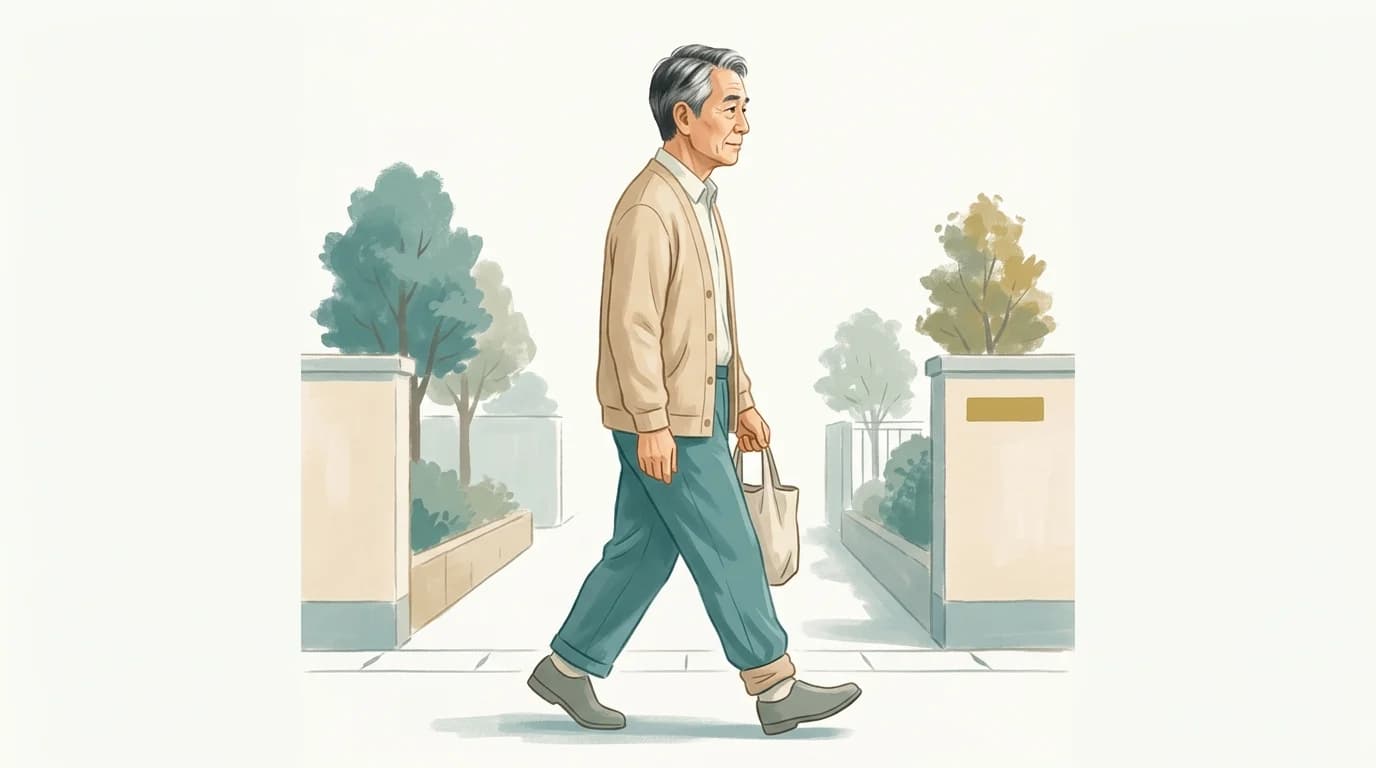
With knee or back pain after 65, exercise changed how people walked more than how much
52 adults over 65 wore ankle sensors for twelve weeks. Their daily steps stayed flat while each ordinary step grew about an inch, a signal the authors call suggestive.
The usual advice for a sore knee or an aching back after 65 is simple: keep walking, and keep count. Ten thousand steps, or seven thousand, or whatever number the phone on the kitchen counter has settled on. A small trial from Japan, published in JMIR Aging on 8 October, put a sensor on the ankles of older adults with exactly those complaints, and the count turned out to be the thing that didn't move.
What moved, a little, was the step itself.
What the trial did
A team from Saitama Medical University and the Tokyo Metropolitan Institute of Gerontology recruited 59 people aged 65 and over who lived near a community exercise centre in Iruma, a city northwest of Tokyo (JMIR Aging, 2026). Their average age was about 74, and a little over half were men. All of them had mild to moderate knee pain, low back pain, or both; on average it sat around three out of ten, the kind of pain that shapes a day without stopping it.
Half came to the centre twice a week for twelve weeks and followed a video programme on a screen, with staff in the room to ease off anything that hurt. Twelve stretches held for 30 seconds at the most comfortable range, nine strengthening moves done at an effort that felt somewhat hard. The other half came once a week for talks about knee and back pain. Everyone wore a small sensor on the ankle through their waking hours, and the researchers compared one ordinary week before the programme with one near its end. The exercises were done standing or seated in place, so the sensor only counted the walking people did in their own lives: to the shops, around the house, down the road and back.
What the study actually showed
A quick summary would say exercise improved walking in older adults with joint pain. That isn't quite what happened.
Daily steps didn't change. Neither did distance walked, or the energy people spent moving through their day; on every one of those measures the exercise group and the lecture group finished in the same place. What shifted was the shape of the walking. Compared with the lecture group, the exercise group's everyday steps grew about two and a half centimetres longer (close to an inch), and their walking speed edged up too, though that difference fell just short of the line researchers use to rule out chance. Steps per minute stayed where they were. Nobody was hurrying their feet; each step simply covered a little more ground.
Two details change how that reads. When the authors plotted the weeks, the exercise group looked steady rather than steadily better, while the lecture group's walking speed slowly slipped, so part of the gap may be about holding on rather than gaining. And the step length finding weakened when they analysed only the 44 people who kept closely to the programme, and again under a stricter statistical check, which is why they describe it as "suggestive rather than definitive." This was a second look at a trial designed to measure pain and disability, with about 50 people in the final analysis, and the programme was funded and delivered by a fitness company that the authors say had no role in analysing the data.
The habit underneath
What I see again and again, in people who've lived with a sore knee or a grumbling back for years, is a shortened step that nobody chose. The body learns to spend as little time as it can on the side that complains: the hip stops swinging through, the back foot lifts before it has finished rolling. Sensible. Protective, even. It just tends to outlast the reason it began.
In the Feldenkrais Method® we look at that short step as a habit worth getting curious about, never a fault. A stride rarely comes from the leg alone; it comes from the pelvis turning a little, the ribs answering it, the back foot being allowed to finish. Twelve weeks of stretching and strengthening may have given people back some of that room without anyone asking them to walk differently at all.
What to try instead of counting
None of this is a reason to stop counting steps if the number is what gets you out the door. But if a knee or your back has made walking feel like something to get through, the count may be the less interesting figure, and the authors themselves note their programme made no attempt to raise it. Next time you walk to the corner, you might notice how your back foot leaves the ground: does it peel from heel to toes, or lift off flat and early? You don't need to change it. You only go where it feels easy, pleasant, and comfortable, and noticing is often where a change in walking starts, especially when knees have grown stiff over the years. If a physiotherapist has given you exercises for your knee or back, this sits alongside what they gave you, not in place of it.
The people in Iruma took about the same number of steps at the end of twelve weeks as at the start. Somewhere in those weeks, without being told to, each step began to reach a little further, and the sensor on the ankle had no way to record what that felt like from the inside.
Let Feldy guide you, eyes closed
A calm voice walks you through gentle moves so your attention stays in your body, not on the screen.
Try Feldy Free for 7 daysNo credit card needed.
Sources
Movement Pulse is informational, not medical advice. See our editorial policy.
Move better with Feldy
See the programMovement Pulse Weekly
The week's best research, in your inbox Tuesday.
Movement science, gentle-practice ideas, and a practitioner's read on what's new. Free.
More from Movement Pulse
Why the first swimming trial for back pain is really a story about fear of moving
The first randomized trial of swimming for chronic low back pain compared it to education alone, not to other exercise. That comparison is the real story.
Jul 26, 2026
How much walking is enough for back pain
A 2026 analysis pooled 13 trials to put a number on walking for chronic back pain. The surprising part is how modest that number turned out to be.
Jul 23, 2026
45 back pain trials, and still no single best method
A network meta analysis pooled 45 trials of movement and manual therapy for chronic low back pain. No approach clearly won, which changes how to choose.
Jul 2, 2026Ready to start moving better?
Gentle, guided lessons for your body. Try your first one free, no credit card required.