
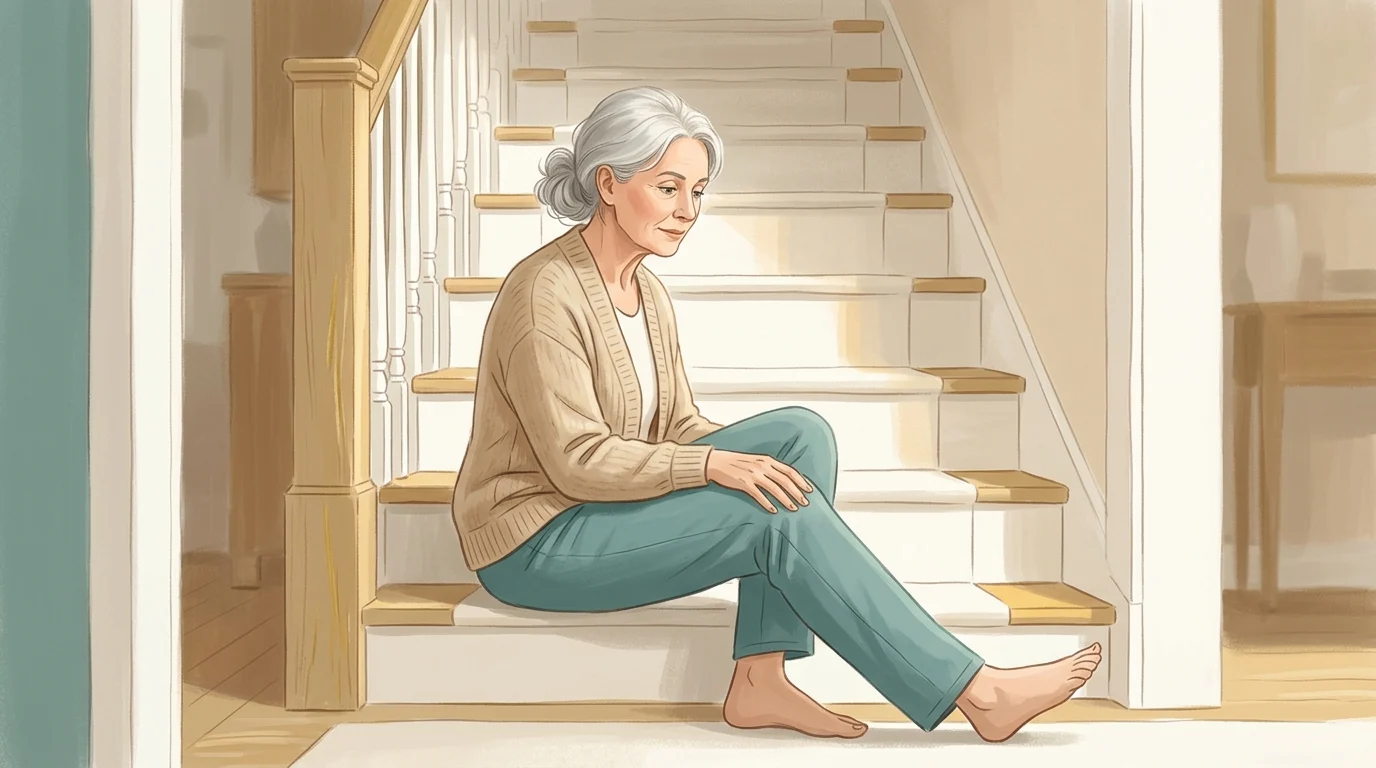
What 29 trials say a physiotherapist's hands add to exercise for knee arthritis pain
Manual therapy on top of exercise eased knee pain a little more for weeks to a few months, then the gap closed, in evidence the authors rate mostly very low certainty.
Your knee feels looser when you leave the treatment table. By the time you reach the stairs at home, it feels like your usual knee again.
A review published on 16 October in the European Journal of Pain looked at that gap. Physiotherapy researchers in Brazil and Australia asked a simple question: when people with knee osteoarthritis already exercise, does adding manual therapy give them more, and for how long (da Silva and colleagues, 2026)?
What the review compared
The team pooled 29 randomized trials with 2,289 participants. In every trial both groups did the same exercise programme, and only one group also had manual therapy, so the comparison shows what the hands add. Most of it was joint mobilisation (25 trials), sometimes with the person moving the joint while the therapist guided it. Ten trials used massage or acupressure, and five used manipulation.
Early weeks: a little extra relief
Within four weeks (15 trials), people who also had manual therapy rated their pain a little over one point lower on a scale of zero to ten than people who only exercised. They also rated their daily function better. The authors rate both findings very low certainty, mostly because many trials were small, unblinded and did not agree with each other.
A few months: a smaller edge
From four weeks to six months (8 trials), the pain difference stayed at about one point. The paper rates this low certainty in its results and moderate in its summary. The function gain was smaller, at very low certainty. These were the only time windows where the pain difference reached the size the authors counted as one people would notice.
After six months: no difference
Only four trials followed people for longer, three of them from the same research group. With moderate certainty, manual therapy added nothing to pain beyond exercise alone, and one trial of 300 people carried much of that result. Function showed no difference, at very low certainty. On walking, stair and chair tests, most differences were too small to notice; only one fast walking test passed that line.
The authors suggest manual therapy may help early on, when less pain could make exercise easier. They could not tell which technique or dose works best. A Brazilian public research agency funded the study, and the authors report no conflicts of interest.
The better question
The review asks how much the hands add. The Feldenkrais Method® asks something else: what do you do with the easier weeks?
Relief is a window. A knee that hurts a little less can move with less guarding. People with sore knees often tell me the joint feels free on the table and heavy on the walk home. Part of that may not be the cartilage at all. Pain can change how much we stiffen and how carefully we move, often before a movement even begins. In a Feldenkrais lesson you only go where it feels easy and comfortable. That is one way to use the window without spending it.
Questions for your next appointment
What is the hands on part meant to do for me, and how will we know? If the aim is to calm pain so the exercises feel easier, ask how you will both judge that, and by when.
What should I practise at home while the knee feels easier? Every trial in this review paired manual therapy with exercise. Ask which movements matter most in the days after treatment.
What is the plan for six months from now? The longer trials suggest the extra relief does not last on its own. Ask what keeps helping once sessions become less frequent or stop.
The Feldypedia entry on osteoarthritis and joint discomfort explains why knee pain and the scan so often disagree, and the one on knee stiffness after 60 looks at the habits that build up around a sore joint. Short, slow lessons like the ones in the Feldy online movement program sit alongside your physiotherapy, not in place of it.
The table. The hands. The lighter step out of the clinic. Then the stairs. Which of those moments is your knee still learning from?
Let Feldy guide you, eyes closed
A calm voice walks you through gentle moves so your attention stays in your body, not on the screen.
Try Feldy Free for 7 daysNo credit card needed.
Sources
- Additional Effects of Manual Therapy to Exercise on Pain and Function in Individuals With Knee Osteoarthritis: A Systematic Review and Meta-Analysis— European Journal of Pain, 2026
- Additional Effects of Manual Therapy to Exercise on Pain and Function in Individuals With Knee Osteoarthritis (PubMed record)— PubMed
- Additional Effects of Manual Therapy to Exercise on Pain and Function in Individuals With Knee Osteoarthritis (open access full text)— PubMed Central
Movement Pulse is informational, not medical advice. See our editorial policy.
Move better with Feldy
See the programMovement Pulse Weekly
The week's best research, in your inbox Tuesday.
Movement science, gentle-practice ideas, and a practitioner's read on what's new. Free.
More from Movement Pulse
The stiffness you feel is not the stiffness we can measure
A 2025 knee osteoarthritis study measured muscle stiffness with shear wave elastography and found it did not correlate with the tightness patients reported feeling.
Jul 17, 2026
Half an hour of stretching a day gave tight hamstrings no clear edge over a few minutes
A six week trial in Thailand set 210 minutes of stretching a week against nine. A practitioner's read on why the range changed while the muscle did not, and a short practice that asks for less.
Oct 4, 2026
The same muscle, the same knee angle, a stiffness reading that changed when the hip moved
A randomized crossover study in Scientific Reports measured quadriceps stiffness in four body positions. Keeping the knee at the same angle, changing the hip position changed the measured stiffness of a muscle that does not cross the hip.
Sep 19, 2026Ready to start moving better?
Gentle, guided lessons for your body. Try your first one free, no credit card required.