

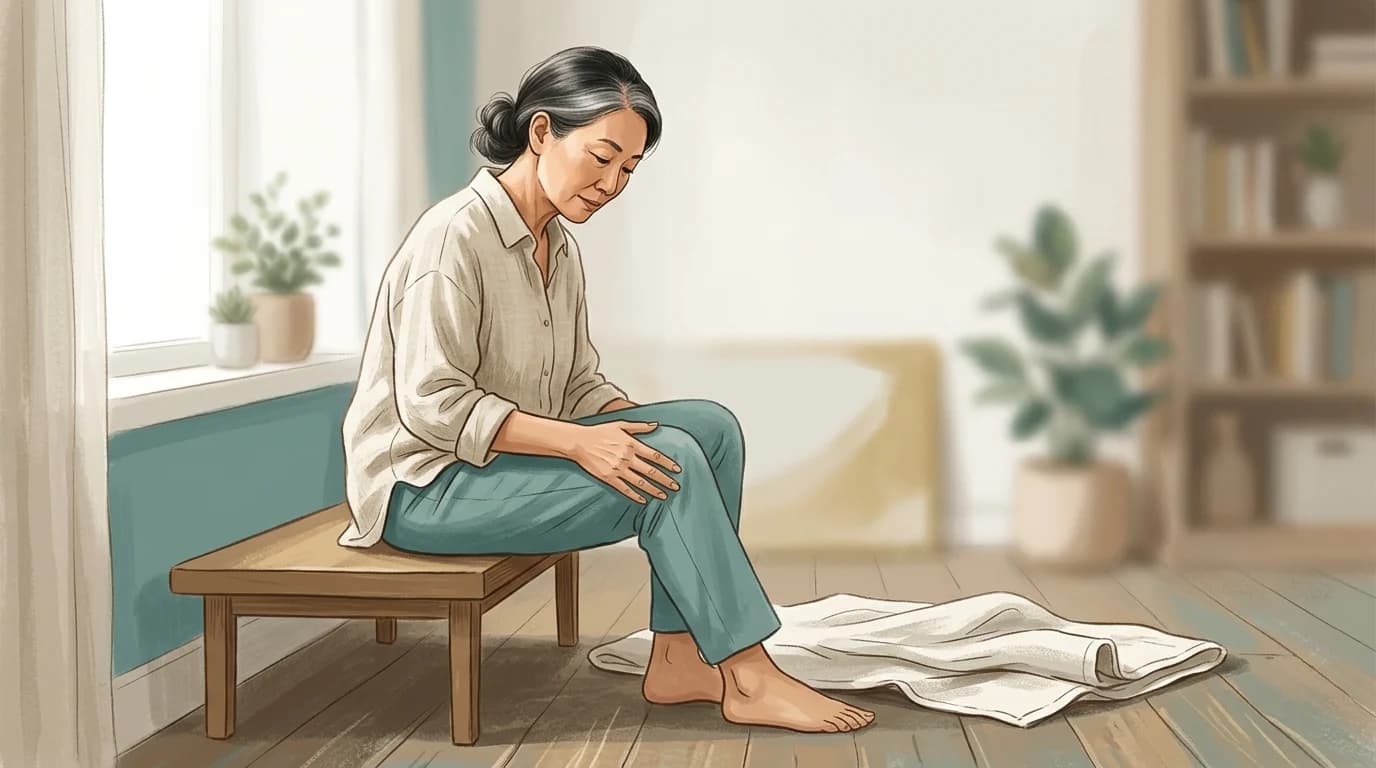
The same muscle, the same knee angle, a stiffness reading that changed when the hip moved
A randomized crossover study in Scientific Reports measured quadriceps stiffness in four body positions. Keeping the knee at the same angle, changing the hip position changed the measured stiffness of a muscle that does not cross the hip.
Most of what people believe about their own stiffness assumes it sits still. The tight thigh is tight. A study published this month in Scientific Reports measured the same muscle in the same person four times over a few minutes, changed nothing except how the body was arranged, and got four different readings.
The team recruited 36 healthy young adults, 18 men and 18 women, average age just under 22, none of whom had done systematic leg strength training in the previous six months. They used shear wave elastography, an ultrasound method that sends a mechanical wave through tissue and clocks how fast it travels, which returns a physical value for stiffness rather than a clinician's impression of one. Two muscles of the quadriceps were mapped: the rectus femoris, which crosses both the hip and the knee, and the vastus lateralis, which crosses only the knee. Each was sampled at 30 regions per muscle across three depths (Scientific Reports, 2026).
The four positions were deliberately plain. Lying on the back, knee bent to 60 degrees, then to 20. Sitting with the hip folded to roughly 85 degrees, knee at 60, then at 20.
Lying flat with the knee bent to 60 degrees produced the stiffest readings of the whole set. For the rectus femoris that is close to expected: lying down opens the hip, bending the knee draws on the lower end, and a muscle spanning both joints gets asked from two directions at once.
The vastus lateralis is the one worth sitting with. It attaches above the knee and below it, and by the textbook drawing it does not cross the hip. Yet its measured stiffness changed when hip position changed. With the knee held at the same 60 degrees in both conditions, changing only whether the person was lying or sitting shifted the reading, and lying flat came out stiffest of the four positions for that muscle too. Roughly a five percent difference in tissue that was supposed to be mechanically identical either way.
One more pattern held everywhere: the most superficial layer of both muscles measured stiffer than the intermediate and deep layers, in every single position. The authors put that down to the denser fascia and connective tissue sitting closest to the skin.
What I see again and again in my classes is a fixed noun. My thighs are tight. My hips are locked. That noun does quiet damage, because a noun can't be negotiated with, only attacked, so people pull harder on the tight place, hold the stretch longer, press deeper into it with a ball or a roller, and then report back that the sensation is unchanged or slightly worse than when they started.
Two honest limits before the translation. This was a laboratory measurement of a passive tissue property in young healthy legs, registered as NCT05905406, and the authors say plainly that the findings are limited to young healthy individuals and should be read with caution for clinical populations. Measured stiffness is also not felt stiffness, and those two have already been shown to come apart in people with knee osteoarthritis.
What the study does establish is mechanical: passive stiffness changed with body position. Passive tension in a muscle depends on the arrangement of the whole limb it belongs to, including joints the muscle does not cross. Put plainly, measured stiffness is not a fixed property of a muscle. In this study it changed with body position even when the knee angle stayed the same. Whether the same holds for older or clinical populations, this study cannot say.
This maps onto something I meet in every class. Where a person is placed before being asked to move is not a staging detail. It is part of what gets measured. The same slow knee movement done lying on the floor, done sitting on a chair, done on the side, arrives in the body as three different movements, and people describe them in three different ways without being prompted to. I used to explain that almost entirely as a nervous system effect, a shift in what attention is picking up. Some of it is simply the tissue, arranged differently.
So when something feels tight, changing the arrangement may tell you something that applying more force cannot. You can borrow the question from the study: before adding force to the tight place, change the arrangement. Fold the hip more. Turn the foot out. Lie down instead of sitting. Then notice whether the experience is the same. For hip stiffness that limits how far you can move, and for knee stiffness that arrives after sixty, it gives you another variable to explore before assuming the answer is simply to stretch harder, and finding out costs nothing. The same caution applies to the home flexibility checks people find online. The psoas test that gets tried on the edge of a bed reads the hip in one particular arrangement, and one arrangement is precisely what this study showed does not settle the question.
It is also the ordinary grammar of a Feldenkrais® lesson. Awareness Through Movement®, the guided lessons of the Feldenkrais Method®, spends most of its time changing the background arrangement instead of pushing the foreground movement: the same small motion explored lying down, then with the other leg long, then on the side, then with the head turned away. Do less, and the differences become readable.
None of this replaces clinical care. If a physiotherapist or an orthopaedic clinician is following your knee or your hip, gentle movement work sits alongside the plan they gave you rather than in place of it. Among the movement methods people practice on their own, yoga, Pilates, tai chi, and the Feldenkrais-based work I teach, the honest framing is different mechanisms with different strengths: yoga and Pilates ask for a shape to be found and held well, and Feldenkrais asks how many arrangements of that shape are available to you.
Nobody has yet put an older knee, one quietly guarded for a decade, under that probe in those four positions. Until somebody does, there is a thigh on a wooden floor, a knee bent to the same angle twice, and a number that refuses to stay put.
Let Feldy guide you, eyes closed
A calm voice walks you through gentle moves so your attention stays in your body, not on the screen.
Try Feldy Free for 7 daysNo credit card needed.
Sources
- Effect of knee and hip joint positions on passive stiffness of the rectus femoris and vastus lateralis in healthy individuals— Scientific Reports, 2026
- Effect of knee and hip joint positions on passive stiffness of the rectus femoris and vastus lateralis in healthy individuals (PubMed record)— PubMed
Movement Pulse is informational, not medical advice. See our editorial policy.
Move better with Feldy
See the programMovement Pulse Weekly
The week's best research, in your inbox Tuesday.
Movement science, gentle-practice ideas, and a practitioner's read on what's new. Free.
More from Movement Pulse
The stiffness you feel is not the stiffness we can measure
A 2025 knee osteoarthritis study measured muscle stiffness with shear wave elastography and found it did not correlate with the tightness patients reported feeling.
Jul 17, 2026
Stiff most mornings? What the largest review of tai chi and qigong actually found
A new BJSM umbrella review grades the evidence for tai chi, qigong and related practices across 1,744 trials. Plus a five minute weight shift experiment.
Aug 20, 2026
The back that feels stiff is the back that moves in fewer positions
A 2025 daily life study of 312 people found chronic back pain patients adopt significantly fewer distinct lumbar postures across the day than pain free controls.
Jul 17, 2026Ready to start moving better?
Gentle, guided lessons for your body. Try your first one free, no credit card required.