
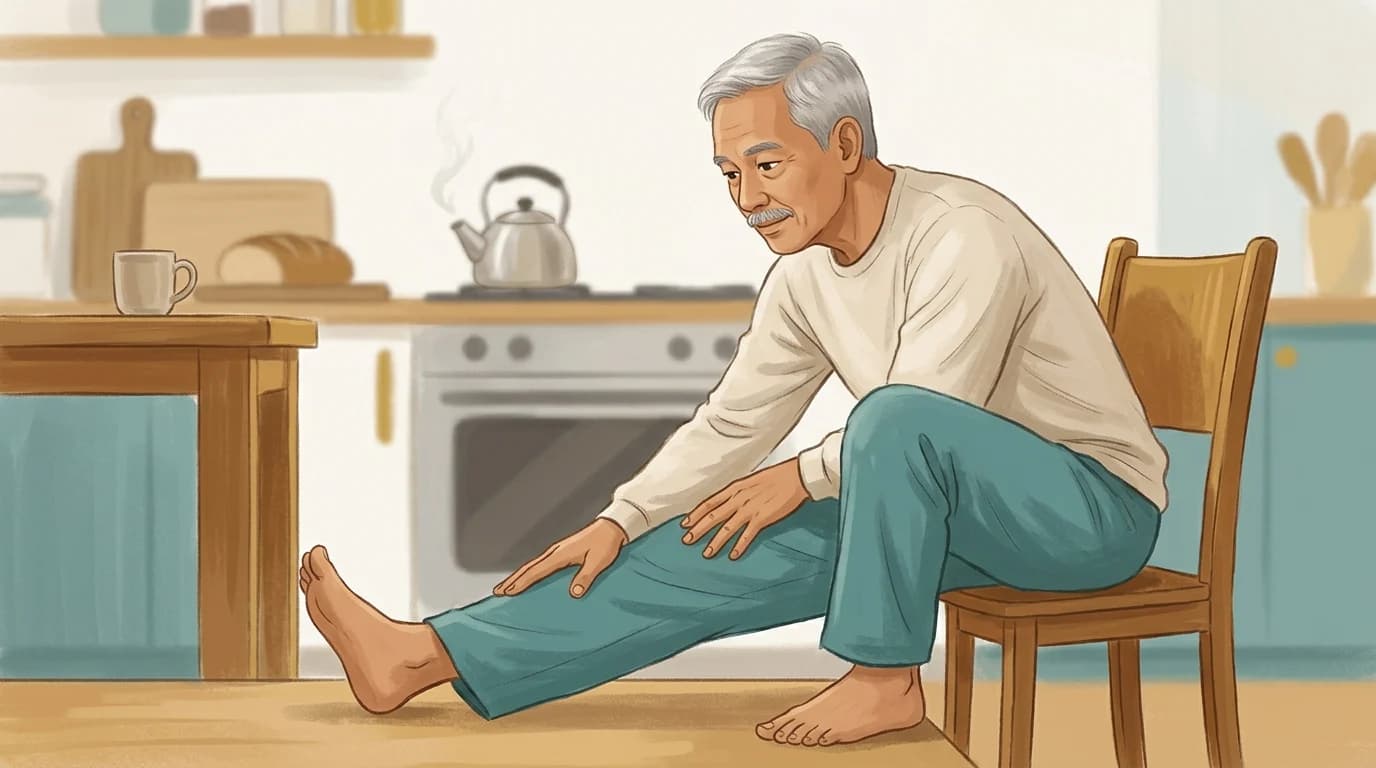
Half an hour of stretching a day gave tight hamstrings no clear edge over a few minutes
A six week trial in Thailand set 210 minutes of stretching a week against nine. A practitioner's read on why the range changed while the muscle did not, and a short practice that asks for less.
Most stretching advice for stiff legs carries a quiet assumption: if a little helps, more will help more. A small trial published on 28 September put that idea to a direct test in people in their sixties and seventies, and the extra half hour a day did not show up where most of us would expect it to.
Thirty minutes against three
The study comes from a team at Burapha University in Chonburi, Thailand, working with a colleague in Lithuania (European Journal of Applied Physiology, 2026). They recruited 68 adults living at home, average age about 67, all with tight hamstrings and early signs of the muscle loss that tends to come with age. For six weeks, at home, one group held static stretches for 30 minutes every day. A second group stretched for 3 minutes, three days a week. A third did slow lowering strength work (eccentric exercise, where the muscle works while it lengthens), and a fourth carried on as usual.
Put the two stretching doses side by side and the gap is enormous: 210 minutes a week against nine. Both groups gained range. The long stretchers added about 12.4 degrees on the range test, the short stretchers about 10.3, and the researchers could not find a real difference between the two.
Three things keep this in proportion. The groups were small, around 17 people each, and the trial wasn't built to prove the two doses are equal; the authors say plainly that equivalence was not established. When they set the stretching groups against the people who did nothing, the extra range came in below the smallest change their test can reliably pick up, so the gain itself is modest. And range was the only thing stretching moved, because the measured stiffness of the muscle and tendon, the thickness of the muscle, balance on a reaching test and everyday physical function all stayed much where they were in every group that stretched, which is a long list of things a person might hope thirty daily minutes would buy. The strength group did get stronger, by a clear margin over the people who did nothing, though the gain stayed in the trained leg.
So the result is narrow but useful. For range in tight hamstrings after 60, a few minutes a week seems to have done about as much as half an hour a day. Neither dose made the tissue itself any less stiff.
A learning problem
To me that last detail matters more than the headline. If the muscle didn't get less stiff, what changed? The likeliest answer is older than this trial. In 2010 Charles Weppler and Peter Magnusson reviewed the stretching research and concluded that most of the extra length people gain over weeks of stretching comes from a change in sensation, a greater tolerance for the stretch, rather than from muscles that are physically longer (Physical Therapy, 2010). The nervous system moves its stop sign a little further out.
Seen through the Feldenkrais Method®, that's a learning problem, not a tissue problem. Something in you is deciding, moment by moment, how far it's safe to let the leg go. My guess is that it learns from the quality of what you do at least as much as from the minutes, and three calm minutes in which nothing is forced may teach it as well as thirty spent pulling against a guard.
The practice below is short on purpose. It asks the back of the leg to lengthen without asking you to pull.
Lengthen without pulling
About 5 minutes. Move slowly, do less than you can, and stay well below any pain. Rest whenever you need to.
- 1
Sit near the front edge of a firm chair with both feet on the floor. Slide your right foot forward until the leg is almost straight, the heel resting on the floor and the knee soft, not locked. Before you do anything else, notice where you sense the back of that leg: behind the knee, along the thigh, up near the sitting bone, or nowhere in particular.
- 2
Keeping your back as it is, let your pelvis roll forward a little so your chest travels a short way toward the right foot, then come back up. Do this slowly, five or six times, and go only where it feels easy, pleasant and comfortable. Notice the moment the back of the leg first begins to speak, and turn around a little before it.
- 3
Pause. Now let the toes of your right foot swing slowly inward and outward a few times, like a windscreen wiper, while the heel stays where it is. Then try the small lean again with the toes turned a little in, and once more with them turned a little out. Which way lets you travel further for less effort?
- 4
Rest your eyes on the right knee and lean a few times. Then lift your gaze to the far wall and lean a few times. Does what your eyes are doing change how far the leg lets you go, or how soon you notice it?
- 5
Bring the foot back, stand up and take a few slow steps. Compare the two legs. Does one meet the floor differently, or feel a little longer? You can do the left side now or another day; a minute or two is plenty.
Let Feldy guide you, eyes closed
A calm voice walks you through gentle moves so your attention stays in your body, not on the screen.
Try Feldy Free for 7 daysNo credit card needed.
What I see again and again in my classes is that people with stiff legs arrive expecting to be told to stretch harder, and grow a little suspicious when the work gets smaller. Then they stand, walk across the room, and one leg seems to meet the floor differently from the other. Often the change shows up first around the hip, not where they were pulling. That isn't proof of anything. It does point the same way as this trial.
A few practical notes, held loosely. If a physiotherapist has given you a stretching routine, this sits alongside it, not in place of it. If your goal is strength, the trial is a reminder that stretching didn't build any, while the slow strength work did. And if you've been treating loss of flexibility after 50 as a muscle that has run out of length, it may be worth considering that part of what's missing is permission. If you'd like more practices built that way, I've gathered what Feldenkrais exercises for seniors look like, and how they differ from a stretching routine.
Nobody in the trial was asked what those last few degrees felt like: whether they arrived as a pull, or as a quiet sense that the leg could go a little further. I'd love to know which group felt more of the second.
Sources
- High versus low volume static stretching and eccentric exercise: a randomized controlled trial in older adults with hamstring tightness and possible sarcopenia— European Journal of Applied Physiology, 2026
- Increasing muscle extensibility: a matter of increasing length or modifying sensation?— Physical Therapy, 2010
Movement Pulse is informational, not medical advice. See our editorial policy.
Move better with Feldy
See the programMovement Pulse Weekly
The week's best research, in your inbox Tuesday.
Movement science, gentle-practice ideas, and a practitioner's read on what's new. Free.
More from Movement Pulse
The same muscle, the same knee angle, a stiffness reading that changed when the hip moved
A randomized crossover study in Scientific Reports measured quadriceps stiffness in four body positions. Keeping the knee at the same angle, changing the hip position changed the measured stiffness of a muscle that does not cross the hip.
Sep 19, 2026
Stiff most mornings? What the largest review of tai chi and qigong actually found
A new BJSM umbrella review grades the evidence for tai chi, qigong and related practices across 1,744 trials. Plus a five minute weight shift experiment.
Aug 20, 2026
The stiffness you feel is not the stiffness we can measure
A 2025 knee osteoarthritis study measured muscle stiffness with shear wave elastography and found it did not correlate with the tightness patients reported feeling.
Jul 17, 2026Ready to start moving better?
Gentle, guided lessons for your body. Try your first one free, no credit card required.