
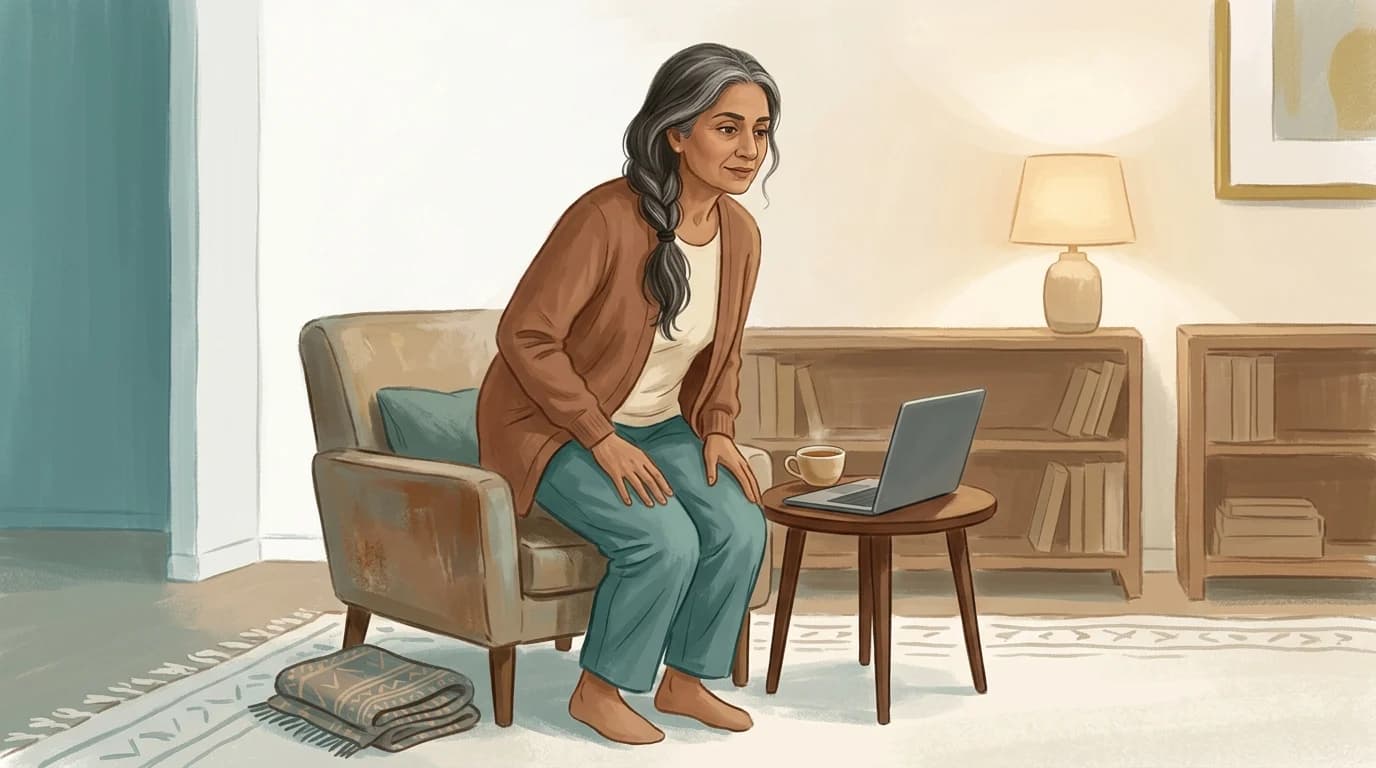
A live class or a recording? For chronic back pain, the format barely changed the outcome
A Montreal trial gave the same twelve week program over Zoom with an instructor, or as videos done alone. Pain eased about equally. It is the fourth study since June where the detail people argue about most turned out to matter least.
Since June I've written about three studies that each asked a version of the same question about back pain and movement, and each time the answer came back blurrier than the question. A fourth landed this week. I think it's time to say plainly what the four of them are pointing at.
The new one is a randomized trial from McGill University and a geriatrics research centre in Montreal, published on 28 September in the European Journal of Pain (Gevers-Montoro and colleagues, 2026). It enrolled 94 adults with chronic low back pain and split them three ways. One group did a twelve week general exercise program, three one hour sessions a week mixing flexibility, aerobic and strength work, live over Zoom in groups of five to ten, with a kinesiologist watching and adjusting in real time and an optional fifteen minutes afterwards to talk. The second group got the very same program as recorded videos, done alone, whenever suited them, with no contact with the instructor at all. The third group waited.
What the trial found
Fifty seven people finished, 36 of them women, average age about 48. Both exercising groups reported more than a fifth less pain than the waiting group, which is the threshold the field treats as a change worth the effort: roughly two and a half points on a ten point scale for the live group, a little over two for the recorded one. Fifteen of the 18 live finishers crossed that bar, and 16 of the 21 who trained with recordings. Side by side, the two formats did not differ on pain, or on how hard, tiring or satisfying the sessions felt.
There are real limits here. The trial is small, a third of the people who started did not finish, and the person running the physical tests knew who was in which group. Attendance in the recorded group could only be self reported (about 14 of the 36 sessions on average, against about 19 live), so neither group came close to doing the whole program. The exercise was general fitness work, not anything Feldenkrais based. And I should say this plainly: Feldy is a recorded program, so a result like this is convenient for me. That is the reason I read the limitations section twice.
The arc
Line the four studies up and a pattern shows. In June a network meta analysis of 45 trials looked for the best method for chronic low back pain, Pilates, motor control work, manual therapy and others, and found no clear winner among the leaders (Journal of Clinical Medicine, 2026). In mid September the MATCH trial let 587 adults living after cancer treatment choose between Tai Chi and a mindfulness course, with pain among the outcomes, and choosing your own practice made no measurable difference (Journal of Clinical Oncology, 2026). On 30 September I wrote about 239 back pain trials searched for the ideal dose; the authors could barely tell most doses apart (British Journal of Sports Medicine, 2026). Now: live or recorded, no clear difference.
Which method, how much, chosen or assigned, live or on a screen by yourself. Those are the four questions people spend the most energy on before they start, and four times in four months the gap between the options shrank to something the studies could not separate, while moving still beat waiting every time. If you're comparing options right now, a side by side of the best somatic movement programs online is worth one read; after that, the program you'll actually open on a tired Tuesday is the one that counts.
What did matter
This trial went one step further than most and asked what the improvement travelled through. Three things carried it: people rating their own general health as better, being more active in daily life, and walking a little faster at their ordinary pace. Several things you might expect did not carry it, including fear of movement, worry about pain, mood, sleep, and the strength and balance tests.
One small detail in the tables changes how I read the rest. Pain at rest barely changed. What fell was the pain that arrived with moving: after standing up from a chair, after walking a few metres, after getting up, walking a short way and turning back.
The better question
"Live or recorded?" is a question about the wrapper. The Feldenkrais Method® asks a different one: what happens in you in the second before you stand up? That is where this trial found its change. My reading, and the trial didn't test it, is that pain arriving with movement is partly a prediction, and a prediction can be revised by an ordinary movement done many times without the expected penalty. You haven't lost movement. You've lost trust that movement will help. Trust like that comes back through repetition at an easy, comfortable range, wherever the instructions happen to come from, and an Awareness Through Movement® lesson is one way of giving it those repetitions slowly.
One thing the trial couldn't explain away
Women reported noticeably less relief than men, the same pattern this team found in their earlier trial of exercise done in a gym. The authors suggest a heavier load of work, household and caregiving duties, and possibly biological differences in how the body turns down pain. Most of the people I teach are women in exactly that position, so this is the finding I'd most like to see someone test properly; this paper did not check whether either format narrowed the gap. Any exercise program, live or recorded, sits alongside what your physiotherapist or doctor has given you, not in place of it.
So the format question may be closer to settled than it feels. The open one is about the women who got less, and about what a 6pm session on a fixed schedule, or a video you promise yourself for after dinner, actually asks of a day that already has no room in it.
Let Feldy guide you, eyes closed
A calm voice walks you through gentle moves so your attention stays in your body, not on the screen.
Try Feldy Free for 7 daysNo credit card needed.
Sources
- Effectiveness, Mediators and Moderators of Remote Live vs. Pre-Recorded Physical Exercise Training for Chronic Low Back Pain— European Journal of Pain, 2026
- Effectiveness, Mediators and Moderators of Remote Live vs. Pre-Recorded Physical Exercise Training for Chronic Low Back Pain (full text)— PubMed Central
- Comparative Effects of Therapeutic Exercise and Manual Therapy Techniques on Self-Reported Disability in Chronic Non-Specific Low Back Pain: A Network Meta-Analysis— Journal of Clinical Medicine, 2026
- Mindfulness and Tai Chi for Sleep, Fatigue, and Pain in Distressed People After Cancer Treatment: A Partially Randomized Patient-Preference Comparative Effectiveness Trial— Journal of Clinical Oncology, 2026
- Optimal exercise dose in adults with chronic low back pain disorders: systematic review with dose-response network meta-analysis— British Journal of Sports Medicine, 2026
Movement Pulse is informational, not medical advice. See our editorial policy.
Move better with Feldy
See the programMovement Pulse Weekly
The week's best research, in your inbox Tuesday.
Movement science, gentle-practice ideas, and a practitioner's read on what's new. Free.
More from Movement Pulse
Group mindfulness visits and chronic back pain
A large new trial tested telehealth mindfulness group visits for chronic low back pain. The result was telling. Here is what to raise with your doctor.
Jul 7, 2026
Tai Chi changed how older brains process back pain
An 8 week randomized neuroimaging trial found Tai Chi lowered chronic back pain and quieted the brain circuits that build the pain. The mechanism is the interesting part.
Jun 21, 2026
People chose between mindfulness and Tai Chi, and choosing did not make it work better
A trial of 587 adults let people pick their own gentle practice. Both helped sleep, fatigue and pain. The picking made no measurable difference.
Sep 17, 2026Ready to start moving better?
Gentle, guided lessons for your body. Try your first one free, no credit card required.