
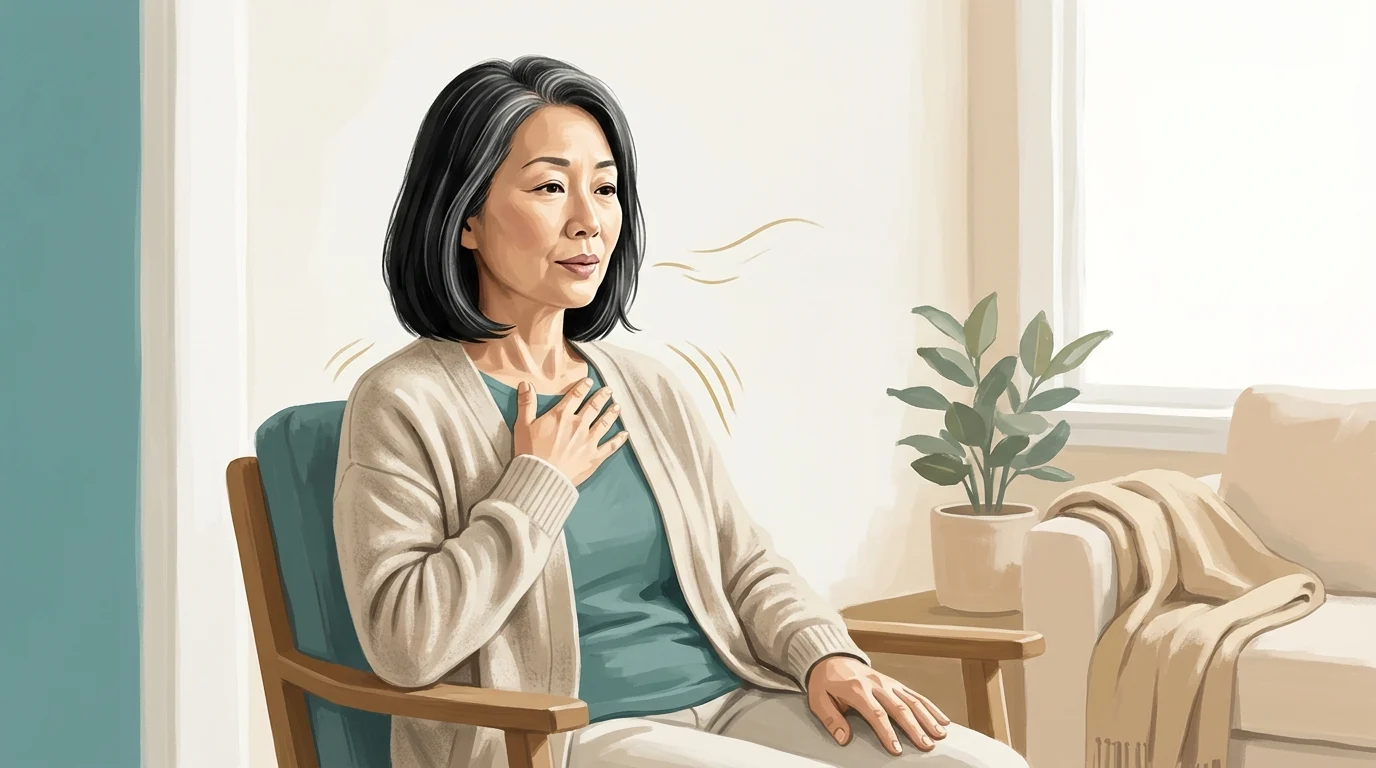
Humming did what a metronome didn't for people with chronic pain
Only the hum reached a long breath out without a count. Pain was rated lower after it than after ordinary breathing, in one sitting.
If you live with pain most days and keep being told to "just breathe", you may wonder whether changing the way you breathe can really make a difference.
Breathing exercises that ask you to count, or to follow a beat, can feel like one more task to manage, on days when your body already needs so much of your attention.
In a new trial with 304 people living with chronic pain, a soft humming breath did what breathing to a metronome didn't: it gave people a long, slow breath out. Their pain was also rated lower right after it than after ordinary breathing (Katare and colleagues, Complementary Medicine Research, 2026). The idea for you is simple: instead of counting your breath, give it a gentle sound to follow.
The hum found the long breath out
The people in the trial were split into four groups, and each group tried one way of breathing. Two groups breathed along to a metronome. One was asked for a short breath in and a long breath out; the other for a breath in and out of the same length. The third group did bumblebee breath, a yoga practice also called Bhramari: you breathe in through the nose and hum softly on the way out. The fourth group simply breathed as usual.
Only the humming group reached the long breath out they were aiming for: their breath out became much longer than their breath in. The metronome group that was asked for a long breath out didn't get there, even with a beat to follow.
So if counting your breath makes you tense, a hum may be an easier way into a longer breath out. In this trial, it also went with lower pain ratings straight after.
Pain was rated lower right after
People rated how strong their pain felt. After the humming breath, and after the metronome breathing with the long breath out, pain was rated lower than after ordinary breathing.
The team also checked heart rate variability, the natural change in the time between your heartbeats. It was higher during all three guided ways of breathing than during ordinary breathing, but this study can't tell us whether that makes any difference to your pain in everyday life.
All of this was measured during one sitting and just after it. Nobody was followed for weeks, so the trial tells us about a moment, not about what regular practice would do.
From the inside
A hum turns the breath out into something you can feel and hear. Your lips buzz a little, the face and chest join in, and the sound itself tells you when the air is running out. No number needed.
What I see again and again in my classes is that when I ask for a longer breath out, people work for it: the belly pulls in hard, the shoulders creep up, the jaw sets, and the breath that was meant to soften everything becomes one more effort, the opposite of what they came for. With a quiet hum, attention moves to the sound and the vibration instead of the length, and the effort often drops. In Feldenkrais® lessons we treat the breath the same way, as something to notice rather than control. If your breath tends to stay high in your chest and short, you may recognize this from chronic shallow breathing.
Here's a short practice in that spirit. You only go where it feels easy, pleasant and comfortable. Keep the hum quiet and short enough that you never run out of air. If you feel dizzy, light headed or uncomfortable, stop and go back to your normal breathing.
A soft hum on the way out
About 3 minutes. Move slowly, do less than you can, and stay well below any pain. Rest whenever you need to.
- 1
Sit near the front of a chair, feet flat, hands loose on your thighs.
- 2
Breathe as you do now, lips softly closed. Is your breath out shorter or longer than your breath in?
- 3
Breathe in through your nose. On the way out, hum quietly, like a bee far away.
- 4
Let the hum fade out on its own. Rest and breathe normally for a few breaths.
- 5
Hum again, a little softer. Where do you feel the buzz: lips, face, throat or chest?
- 6
Rest one hand lightly on your chest and hum once or twice more. Make it quieter if anything strains.
- 7
Stop and breathe normally. Compare your breath out now with the start. What has changed?
Let Feldy guide you, eyes closed
A calm voice walks you through gentle moves so your attention stays in your body, not on the screen.
Try Feldy Free for 7 daysNo credit card needed.
What the headline will miss
This was an exploratory trial, the kind that tests an idea before a larger study. Each person tried just one way of breathing, on one occasion. Pain was what people reported themselves, and the published summary doesn't say how long the lower ratings lasted. Because the metronome groups didn't breathe the way they were asked to, the trial can't tell us whether the long breath out matters more than the hum itself.
The study didn't test the Feldenkrais Method®; the connection I make with our lessons is my own reading. Bumblebee breath comes from yoga, a different way of working with the body, and each method has its own strengths. If you're curious, here is how Feldenkrais and yoga differ.
A practice like this sits alongside your pain care, not in place of it. If your pain changes suddenly, or comes with new symptoms such as numbness, weakness or fever, seek medical advice.
Give the breath a sound
The next time you want a longer, softer breath out, give it a sound to follow instead of a number, and notice what the rest of you does while the hum lasts.
Sources
Movement Pulse is informational, not medical advice. See our editorial policy.
Move better with Feldy
See the programMovement Pulse Weekly
The week's best research, in your inbox Tuesday.
Movement science, gentle-practice ideas, and a practitioner's read on what's new. Free.
More from Movement Pulse
Self guided pain therapy beat seeing a therapist, and the gap is smaller than it sounds
A trial of 764 adults found the self guided version came out ahead on every measure it tracked. The most useful number in it is not the headline one.
Aug 11, 2026
Pain climbed through working years for one in five women, then eased
Aches that build for years don't always keep climbing. In 42 years of Swedish surveys, the group in most pain peaked around retirement age.
Nov 3, 2026
With knee or back pain after 65, exercise may change how you walk more than how much
52 adults over 65 wore ankle sensors for twelve weeks. Their daily steps stayed flat while each ordinary step grew about an inch, a signal the authors call suggestive.
Oct 11, 2026Ready to start moving better?
Gentle, guided lessons for your body. Try your first one free, no credit card required.