

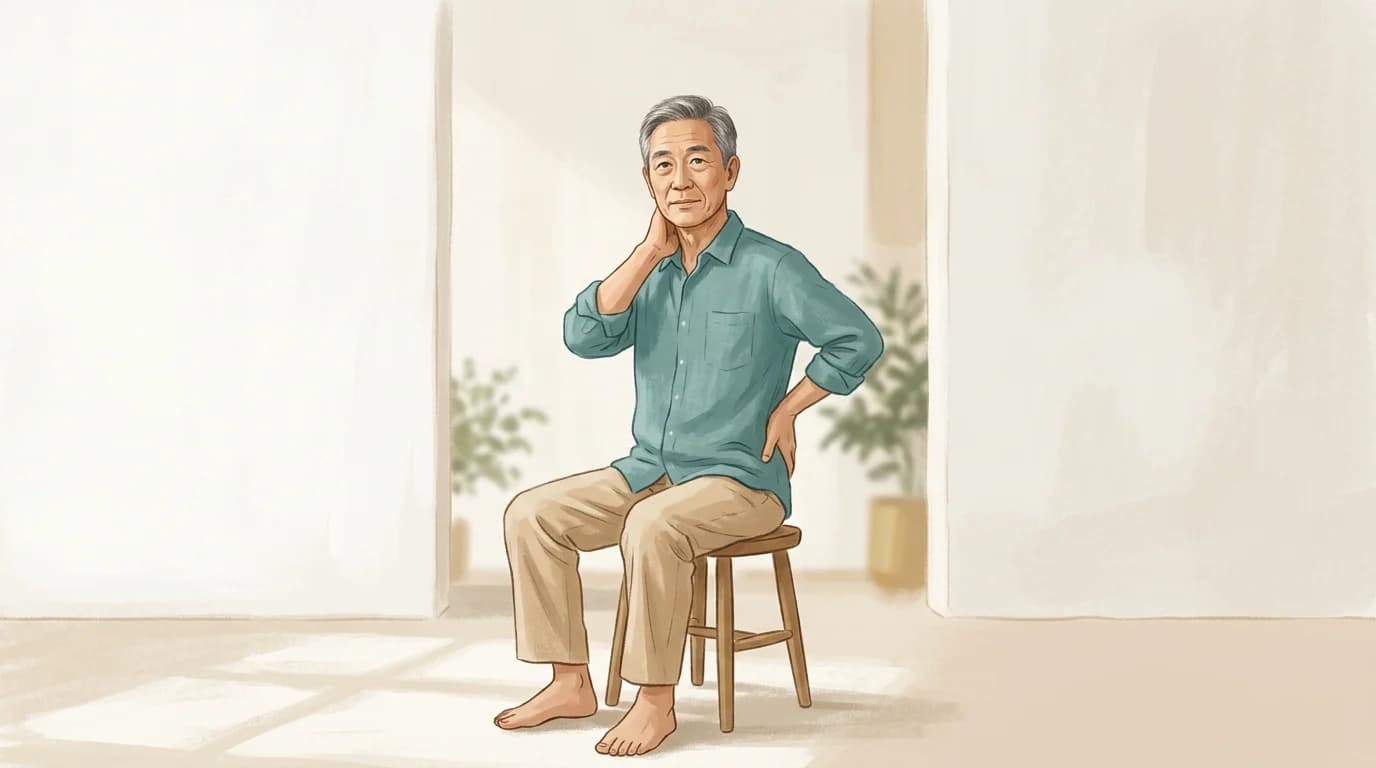
The headache, the neck pain, and the low back keep pointing at the same mechanism
A July review finds all three share cortical hyperexcitability and impaired descending inhibition. It is the latest step in a nine year shift in how pain gets classified.
On July 28 a team writing in Pain Therapy published a review that puts three conditions most clinics treat separately into a single frame. Migraine, the neck pain that so often travels with it, and chronic low back pain are described there as central pain processing disorders that frequently coexist (Pain Therapy, 2026).
Taken by itself that claim is not novel. What makes it worth reading is where it sits in a line of work that has been building for close to a decade.
What the review reports
Onan and colleagues searched PubMed and Web of Science for clinical and neurophysiological studies of central sensitization and nociceptive processing across the three conditions. The convergence they describe sits at the level of mechanism rather than symptom. All three show cortical hyperexcitability, impaired descending inhibitory control, and altered spinal and supraspinal nociceptive processing. Persistent input from one region, they argue, makes pain at further regions more likely.
Impaired descending inhibitory control is the phrase worth slowing down for. The nervous system runs its own brake on incoming nociceptive signal, a damping that travels from brainstem down toward the spinal cord. When that brake is intact, ordinary input stays ordinary. When it is not, the same input arrives louder. Someone whose descending inhibition is compromised is not exaggerating, and is not simply deconditioned. The signal reaching them has been amplified before it ever reached awareness.
On treatment the review stays measured. Physical therapy approaches can influence central pain mechanisms, though the authors are clear that the strength of the evidence varies by intervention type. That is an accurate read of a literature still thin in places, and it is worth reporting at its actual weight rather than rounding it up.
The arc it belongs to
This is the fourth marker in a line that runs back to 2017.
That year the International Association for the Study of Pain introduced nociplastic pain as a third mechanistic descriptor, sitting alongside nociceptive and neuropathic pain. It named something clinicians had been describing for years without a category to put it in: pain arising from altered nociception, which neither tissue damage nor nerve lesion fully accounts for.
In 2021 a group led by Eva Kosek published clinical criteria and a grading system for chronic nociplastic pain of the musculoskeletal system in Pain, the journal of the IASP (Pain, 2021). One of those criteria does quiet, radical work. Alongside pain lasting more than three months and clinical signs of hypersensitivity in the painful region, the criteria ask whether the pain is regional, multifocal, or widespread rather than discrete. Spread stopped being noise in the history. It became a diagnostic signal.
In 2022 a Danish group pooled 24 studies on how often neck pain accompanies migraine. Across clinic based samples the pooled figure was 77.0% in the migraine group against 23.2% in people without headache, rising to 87.0% in chronic migraine (Cephalalgia, 2022). At those numbers, neck pain alongside migraine is not a subgroup finding. It is close to the default presentation.
And now 2026, naming the shared machinery underneath all three.
Read in sequence, that is nine years of a field quietly demoting the question it once treated as primary. Not where does it hurt, but how is this system processing.
What this changes in a session
The people I work with rarely arrive with one complaint. They arrive with a list, and the list has usually been organised into separate projects with separate appointments. The headaches belong to one clinician, the neck to a second, the low back to a third or to nobody. Each region has been examined locally, each has been given local work, and none of the three has moved much.
What I notice is not that the local work was wrong. It is that someone managing three parallel projects has usually stopped moving as one thing. Guarding around the neck shows up in how the ribs travel, or fail to. Breath held at the low back changes what the head is willing to do. When a system has become efficient at amplifying signal, more careful local input is not obviously the missing piece.
What is worth trying either way
For clinicians the practical shift is smaller than the theory makes it sound. Assessment that takes mechanism seriously mostly means asking about spread before assuming three separate stories, and staying interested in whether load anywhere calms or provokes the whole picture.
The harder question is the one between visits. If descending inhibition is the thing you are trying to reach, what matters is repeated low threat input that someone will actually do on the days nobody is watching. That is a homework problem at least as much as a treatment problem.
This is the ground the Feldenkrais Method® works on. Awareness Through Movement®, its guided lesson form, is slow and small by design, and you only go where it feels easy, pleasant, and comfortable. The intent is not to load a region harder. It is to give a sensitized system repeated evidence that movement is safe, which is closer to what the mechanism actually describes. You have not lost movement. You have lost trust that movement will help.
Two clarifications matter here, and they are different clarifications. Work of this kind sits alongside physiotherapy, medical care, and any plan built for a specific diagnosis. It does not replace them, and nothing in this review suggests it should. Among the movement methods people practise on their own, yoga, Pilates, tai chi, and the Feldenkrais based work I teach are different mechanisms, each with its own strengths, and that is a comparison rather than a ranking.
Where a format like the Feldy online movement program fits is exactly that gap between visits: short, gentle, audio guided lessons done at home, deliberately kept low intensity. It is not a treatment and it does not compete with clinical care.
None of this settles what to do about any single one of the three conditions. What nine years of this work does suggest is that treating them as three unrelated problems is getting harder to defend, and that the thing worth doing in the body is often less than we assume, done more often, with more attention.
Let Feldy guide you, eyes closed
A calm voice walks you through gentle moves so your attention stays in your body, not on the screen.
Try Feldy Free for 7 daysNo credit card needed.
Sources
- Common Mechanisms in Migraine, Migraine-Related Neck Pain, and Low Back Pain: Implications for Treatment— Pain Therapy
- Chronic nociplastic pain affecting the musculoskeletal system: clinical criteria and grading system— Pain (IASP)
- Prevalence of neck pain in migraine: A systematic review and meta-analysis— Cephalalgia
Movement Pulse is informational, not medical advice. See our editorial policy.
Move better with Feldy
See the programMovement Pulse Weekly
The week's best research, in your inbox Tuesday.
Movement science, gentle-practice ideas, and a practitioner's read on what's new. Free.
More from Movement Pulse

Exercise eases pain. Harder is not the point.
An umbrella review of 157 reviews and 221,000 people found exercise reliably reduces pain, with greater effects in lower intensity, shorter programs.
Jul 9, 2026
The thing that stopped people finishing a pain education programme was not the schedule
Sixty three adults with chronic neck pain were asked to name, in their own words, what got in the way of staying with a pain neuroscience education and exercise programme. The barrier they rated highest was not the timetable. It was whether the programme fit their body.
Sep 11, 2026
Why the pain score they ask for said the least about how the fibromyalgia week went
Two studies published a day apart counted the symptoms nobody scores. In both of them, the pain rating was not the number carrying the information.
Sep 4, 2026Ready to start moving better?
Gentle, guided lessons for your body. Try your first one free, no credit card required.