
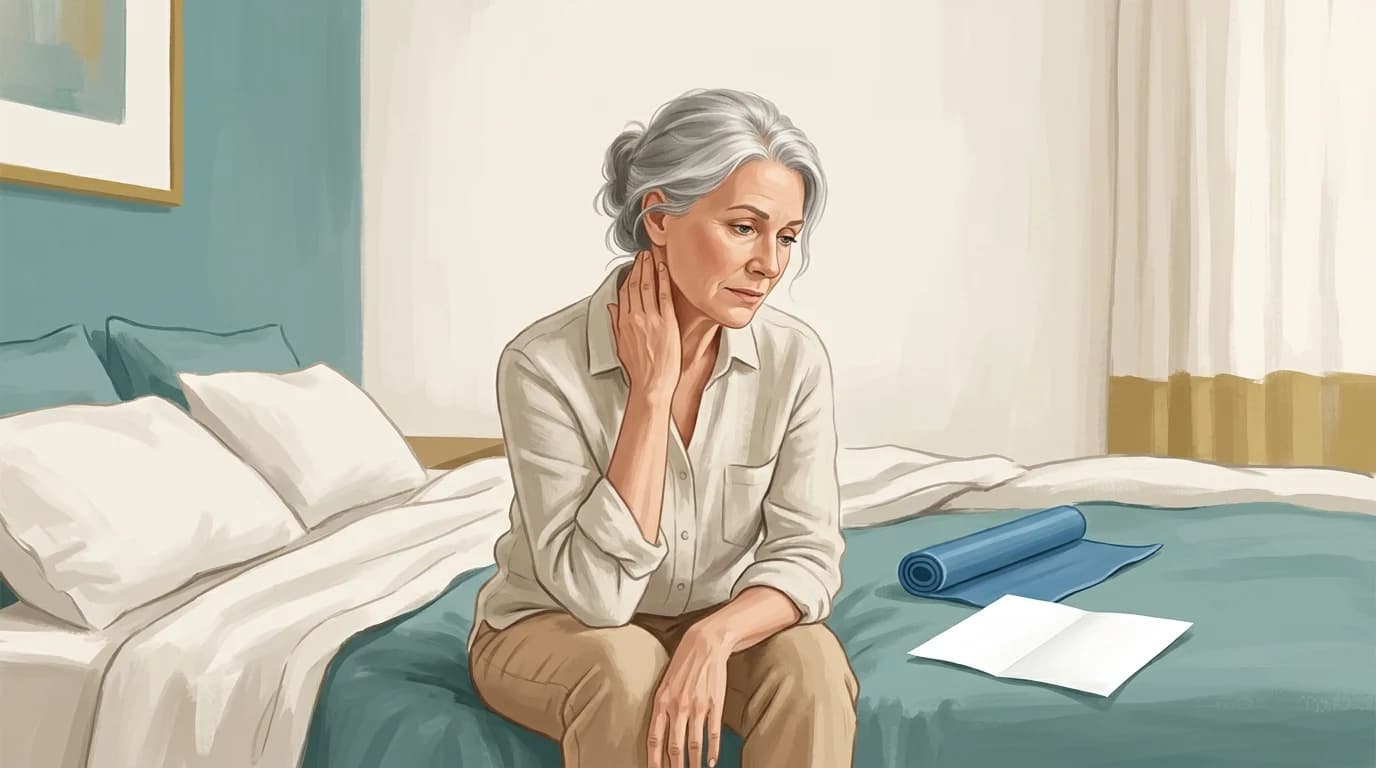
The thing that stopped people finishing a pain education programme was not the schedule
Sixty three adults with chronic neck pain were asked to name, in their own words, what got in the way of staying with a pain neuroscience education and exercise programme. The barrier they rated highest was not the timetable. It was whether the programme fit their body.
Pain neuroscience education paired with therapeutic exercise has enough trial support behind it now that most clinicians treat the question as closed. A team working out of two primary care centres in Catalonia went back to the people who had sat through one of those programmes and asked something the efficacy trials almost never ask. Not whether it worked. Whether they could keep doing it.
The answers landed on 8 September in Clinical Rehabilitation (Clinical Rehabilitation, 2026). Sixty three adults with chronic neck pain, all graduates of the same group programme, were asked to write their own statements about what got in the way. Not to tick boxes on a barriers questionnaire drafted by the research team, which is how most adherence data gets collected and is also why most adherence data tells you what the researchers already suspected. Their own sentences. Then sorted and rated by the same participants for importance and for how often each one showed up.
Thirty two statements survived the sorting. They settled into four groups: adequacy and adaptation, organisation and format, information and educational support, and therapeutic relationship.
The order is the story. What people rated highest, for both importance and frequency, was adequacy and adaptation: whether the programme actually fit them. Information and educational support followed, meaning the pain science itself never fully landed. Then therapeutic relationship. Organisation and format, the schedule and the logistics, finished last.
So the thing that stopped people was not the timetable. It was fit, the match between the programme and the body and the belief of the person in front of it. Which is roughly the reverse of where programmes spend their redesign budget.
One subgroup signal is worth holding loosely. Participants who had attended less than 70% of the sessions rated the understanding related difficulties higher than the regular attenders did, and younger participants rated the organisational and information barriers higher than older ones. The authors call these analyses exploratory, and the numbers behind each subgroup are small. Still, the direction points somewhere uncomfortable.
What the word adherence quietly assumes
When a programme writes down its attendance figure, that number goes into the paper under adherence, and adherence gets read downstream as motivation. The patient did not comply. Maybe the patient was not ready.
The people in this study described something closer to a fitting problem.
Adequacy and adaptation, translated out of cluster language, means the programme did not fit the body it was handed to. The exercise was too much, or moved too fast, or was built for a neck that rotates further than theirs does. A person in that position has two options inside a group format: do it badly and hurt, or quietly stop. Neither of those is a motivation deficit.
The second cluster is the one I keep turning over. Information and educational support is the pain neuroscience content itself. Pain neuroscience education asks a person to revise a belief about what their pain means, and the exercise that follows only makes sense if that revision has landed. If it has not, you have someone performing movements that hurt, for reasons they have been told are not the real reasons. Of course they stop. That is not stubbornness; that is a rational response to an explanation that did not reach them.
And the people who attended least were the ones who reported understanding it least. Read that in either direction and it should slow you down.
What I see on the other side of it
This is the part I recognise most from my own classes. People come in able to recite the framework back to me, word perfect. Nervous system. Sensitization. The alarm that keeps ringing after the fire is out. And then, in one form or another, they tell me the same thing: they understand all of it, and still do not believe it about their own neck.
That gap is the whole thing. You haven't lost movement. You've lost trust that movement will help, and a well delivered explanation does not restore trust on its own, because trust is not a cognitive object. It gets rebuilt through a few dozen small experiences of moving and not being punished for it.
And this is the hopeful part, and the reason I keep doing this work. That trust does come back. In a gentle Feldenkrais® lesson, where nothing is forced and every movement stays inside what feels easy, those small, safe experiences are exactly what a person collects, one after another. Again and again I get to watch the belief catch up with the explanation: a neck that had stopped trusting itself begins, quietly, to move as though it might be safe after all. The work is unhurried on purpose, and that patience is what gives the body the room to find its own way back to ease.
Where this leaves the between session work
Two things follow for the homework portion, where most of these programmes live or die.
The first is that adaptability has to be built into the instruction rather than negotiated afterwards. A prescription of ten repetitions is a pass or fail structure. An instruction to make the movement smaller until it is easy hands the scaling decision to the person doing it, in the moment, with the only information that matters, which is what their neck is saying right now. The Feldenkrais Method® is organised around exactly that move. Awareness Through Movement® lessons ask the person to reduce the range until the movement is easy, pleasant and comfortable, and to treat any increase as optional. There is no target to miss.
The second is that comprehension needs checking somewhere other than in conversation. A person can repeat the neuroscience faithfully and still not have felt anything change. Feldenkrais based lessons are self referencing by design: each one ends with a comparison, this side against that side, before against after, so the person gets their own evidence rather than waiting for the next appointment to be told whether it is going anywhere. That sits alongside what a physiotherapist has prescribed rather than substituting for it, and it is why the Feldy online movement program is built as short audio guided lessons rather than a video of a range you are supposed to match. For anyone weighing formats for that between session slot, our comparison of the best somatic movement programs online looks at which offer a sequence and which hand you a library to curate.
A narrative review published this year opens with the prevalence figure, roughly 20% of the global population living with chronic pain, and closes by recommending pain neuroscience education plus exercise as the framework for handling it (Frontiers in Public Health, 2026). I think that's right. The Catalonia study does not contradict it. It just points at the layer underneath the framework, where the fit gets decided.
What the study could not reach are the people who never enrolled. Somewhere in those two primary care catchments there is a person who read the leaflet about the group programme, pictured a room of strangers rotating their necks to a count, and put it back on the table.
Let Feldy guide you, eyes closed
A calm voice walks you through gentle moves so your attention stays in your body, not on the screen.
Try Feldy Free for 7 daysNo credit card needed.
Sources
- Barriers to adhering to a pain neuroscience education and therapeutic exercise programme in people with chronic neck pain: A mixed-methods study— Clinical Rehabilitation (PubMed)
- Use of pain neuroscience education, balance evaluation, and exercise for treating chronic pain with kinesiophobia: a narrative review with clinical recommendations— Frontiers in Public Health (PubMed)
Movement Pulse is informational, not medical advice. See our editorial policy.
Move better with Feldy
See the programMovement Pulse Weekly
The week's best research, in your inbox Tuesday.
Movement science, gentle-practice ideas, and a practitioner's read on what's new. Free.
More from Movement Pulse
The back pain trial where a pill known to be a placebo did about as well as a painkiller
130 adults with chronic low back pain took a painkiller or a pill they knew was empty for three weeks. Paired with one encouraging video, the empty pill kept pace.
Oct 7, 2026
Chronic back pain slowed how quickly people sensed their back, while their hands kept pace
Nineteen people with long standing low back pain and nineteen matched controls judged left from right on pictures of twisting bodies and rotated hands. Only the trunk task separated the groups. The answers stayed accurate, and the delay did not track how much it hurt.
Sep 26, 2026
The APA pain guideline backs exercise, then declines to say which kind is better
A summary of the APA's chronic musculoskeletal pain guideline has just appeared in American Psychologist. Its first line list is short and firm. Almost every comparison between one movement approach and another came back as insufficient evidence.
Aug 23, 2026Ready to start moving better?
Gentle, guided lessons for your body. Try your first one free, no credit card required.