
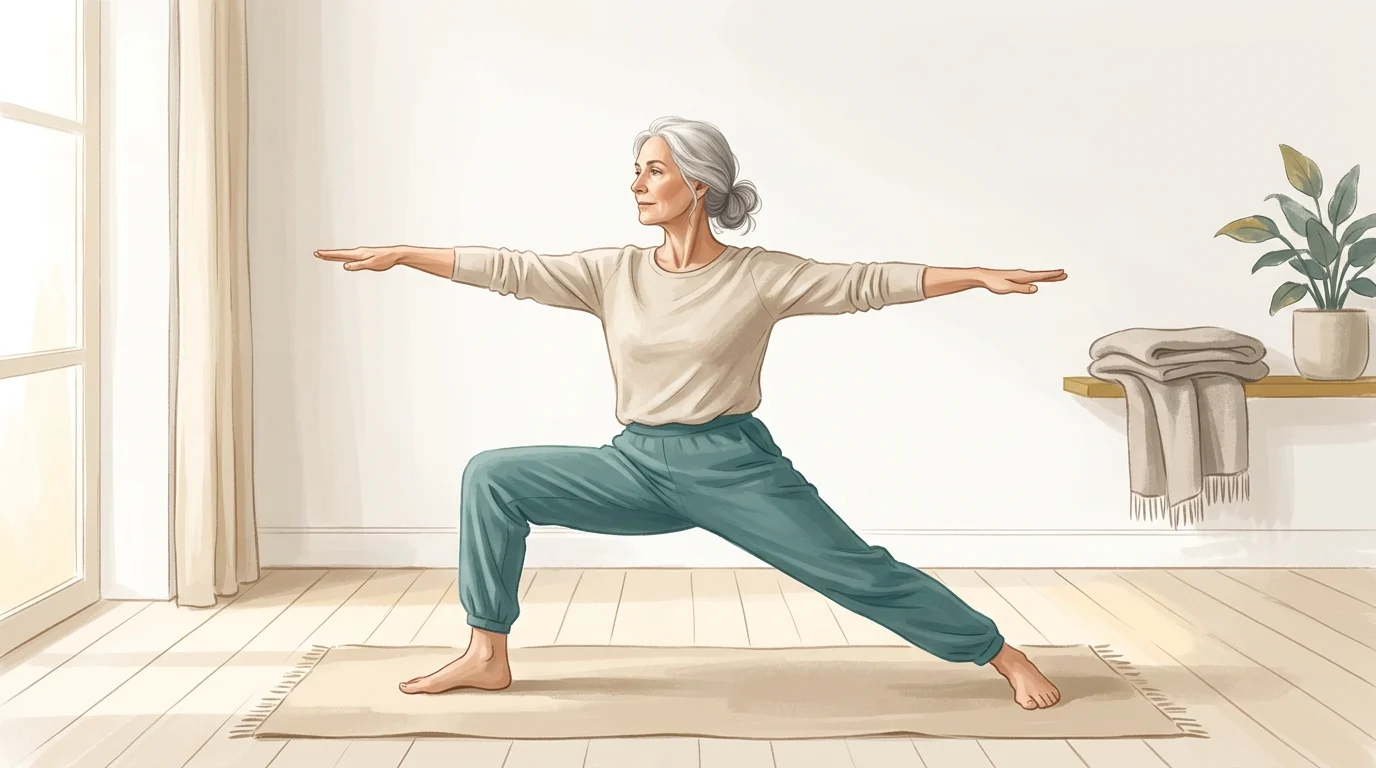
The same pose held two ways looked identical, but the heart could tell them apart
Eight experienced yoga teachers held warrior pose twice: once with everything working, once letting go of what the pose did not need. The shape stayed the same. The heartbeat did not.
Think of standing in a doorway while you wait for someone. Five minutes, perhaps. You can do that with your knees locked, your jaw set and your shoulders creeping toward your ears, or you can do it some other way entirely, and a neighbour watching from across the street would see the same person in the same doorway and have no idea which version you had chosen. A small study published in Frontiers in Human Neuroscience in September asked whether the body knows.
What the researchers did
A team in Pune, India, working with a colleague from a yoga forum in Munich, recruited eight women who teach yoga. Their median age was 58 and they had a median of 19 years of practice behind them. That mattered, because the experiment asked for something a beginner can't reliably do on request: hold the same standing pose, Virabhadrasana, the warrior pose, in two different ways (Frontiers in Human Neuroscience, 2026).
Each woman first stood quietly for five minutes. Then she held the pose for five minutes the way classical yoga asks: once in the shape, she let go of the muscle work the pose did not need and let the skeleton carry more of the load. After a rest she held it again, this time keeping on everything that had brought her into it. Her heart was recorded throughout. Afterwards she marked her effort on a ten point line, and the two versions landed far apart, a median of 1.5 for the eased pose against 6 for the braced one.
From the outside, two identical warriors. Inside, the heart was doing different work. In the eased version it beat at roughly 84 beats a minute; in the braced version, roughly 94. The part of the heartbeat's natural variation that rises and falls with each breath, which researchers read as a sign of the vagus nerve's calming influence, was several times larger in the eased pose than in the braced one, even though the outward shape and the load on the legs were the same. The authors call the eased state relaxation in action. Not passive (the women were still standing in a deep lunge), just cheaper to run.
It is eight people, all experts, all women. The braced version always came last, so part of the difference could be tiredness or simple order, and the authors say so themselves; they also did not measure breathing or muscle activity directly. They describe it as a proof of concept that needs a larger study, which is exactly what it is.
Ease inside effort is an old idea
What caught my attention is that the instruction being tested is many centuries old. The Yoga Sutra of Patañjali describes a posture as steady and easy at once, and names the loosening of effort as the way into it. The researchers built their experiment on that line.
Other methods arrive at a neighbouring idea from their own direction. The Alexander Technique teaches people to notice and stop the tension they add before they move. Tai Chi asks for soft, relaxed joints while the legs carry real weight. Pilates places its emphasis elsewhere, on precise control and a strong centre, and that is its own strength. The Feldenkrais Method® comes at effort through sensing. Different mechanisms, each with its own strengths, and yoga simply happens to be the one that got measured this time.
Doing less
In a Feldenkrais® lesson, less effort isn't the reward at the end. It's the tool. Moshe Feldenkrais built his lessons on the observation that you can't feel a fine difference while you are straining, much as you would struggle to hear a quiet voice in a noisy room, so we slow down and make the movement smaller until a difference becomes noticeable.
What I see again and again when a class stands up at the end of an Awareness Through Movement® lesson is people describing standing as lighter, as if a weight they hadn't known they were carrying had been set down. Their shape barely changes. Their sense of what it costs does.
What you might take from it
Most posture advice is about shape: sit up straight, shoulders back, chin in. Even the familiar check of rounded shoulders vs normal compares one outline with another. This study, small as it is, points at a different question, not where you are but how much you are using to stay there. Two people can hold the same upright position, one with back, belly and jaw all quietly gripping, the other letting the bones do more of the carrying, and look identical in a photograph. Over a working day, that background gripping is the part people tend to feel as tiredness without knowing where it came from.
The next time you notice yourself braced in a queue or at the sink, you don't have to correct anything. You might ask what you could stop doing and still be standing. You only go where it feels easy, pleasant, and comfortable. If you are working with a physiotherapist on posture or pain, this sits alongside what they have given you, not in place of it.
The eight teachers could find that state on request after nineteen years of looking for it. Nobody has yet measured how long it takes the rest of us to learn, or whether the heart notices the change before we do.
Let Feldy guide you, eyes closed
A calm voice walks you through gentle moves so your attention stays in your body, not on the screen.
Try Feldy Free for 7 daysNo credit card needed.
Sources
Movement Pulse is informational, not medical advice. See our editorial policy.
Move better with Feldy
See the programMovement Pulse Weekly
The week's best research, in your inbox Tuesday.
Movement science, gentle-practice ideas, and a practitioner's read on what's new. Free.
More from Movement Pulse
Why neck pain trials keep working on the mid back, and what the pain score misses
Fifty four people, six weeks, and a result that keeps repeating in this literature. The mid back work did not beat neck work on pain, and beat it on almost everything else.
Sep 12, 2026
Your head sits forward and your breath feels shallow, but the lung test came back normal
A new case control study measured breathing three different ways in people with forward head posture. The measurement everyone expected to fail was the one that held up.
Aug 28, 2026
The best exercise for neck pain may matter less than how often you actually do it
A new analysis pooled 51 trials to compare exercise types for neck pain. Mind body work, resistance, flexibility, and coordination training all landed in much the same place.
Jul 31, 2026Ready to start moving better?
Gentle, guided lessons for your body. Try your first one free, no credit card required.