
Tai chi was called too gentle to touch bone, yet 17 trials in women found a small gain
If you love a slow standing practice, it may be doing a little for your spine as well as your balance. Keep the walking and the strength work beside it.
As a Feldenkrais® practitioner, I hear one question from women more than almost any other, and it usually arrives a week or two after a bone scan.
Will this gentle work actually do anything for my bones?
My answer on this page has been careful. Bone answers to load, so the gentle end of movement does a different job: it keeps you steady and keeps the walking pleasant. I still think that's mostly right. But a review published on 14 October has added one more step to a line of research that has been building, slowly, for nearly twenty years, and it's time to lay that line out.
The advice most women get
The usual advice after a low reading is clear. Walk briskly, lift something, add some impact if your doctor agrees, and treat slow practices as a nice extra for balance. When I wrote about the largest exercise and bone review to date in September, brisk walking led at the spine and hip, and that advice held up.
Tai chi sat in the "nice extra" column. Too gentle, the thinking went, to reach the skeleton.
Nineteen years of the same question
The first serious look came in 2007. A team in Massachusetts found only six controlled studies, just two of them randomized, and concluded that tai chi may help maintain bone density after menopause but that the research was too thin to say much (Archives of Physical Medicine and Rehabilitation, 2007). A year later, a group at Exeter pooled the spine data and called the evidence not convincing (Osteoporosis International, 2008).
Then the trials kept coming. By 2023 there were enough reviews that someone reviewed the reviews: eighteen of them, drawing on 49 randomized trials (Osteoporosis International, 2023). The authors found a likely benefit at the lumbar spine and the top of the thigh bone for women around and after menopause, and graded their certainty as low, because most of those reviews scored critically low on method.
In February 2026 a review of 19 trials in people already diagnosed with osteopenia or osteoporosis found gains at the spine and several hip sites, and went as far as suggesting a weekly dose (Osteoporosis International, 2026). In September, the BMJ review of 124 trials put the mind body category, mostly tai chi, alongside brisk walking as one of the two leaders at the femoral neck (The BMJ, 2026).
What the October review adds
The new paper, from sport scientists based mostly in Beijing, pooled 20 randomized trials of what they call traditional Chinese mind body training, the family that includes tai chi and qigong, in middle aged and older women (Experimental Gerontology, 2026).
What I like is what they did next. Three trials pulled the pooled result so hard that the authors set them aside and ran it again on the remaining 17. The benefit shrank by roughly two fifths. It did not disappear, and it was still unlikely to be chance. The clearest gain was at the lumbar spine.
They were also strict about dose. Where the February review proposed a weekly prescription, this team said their dose findings were exploratory and that no specific regimen can be recommended yet. Good. Bone doesn't change overnight, and neither should our expectations.
How much weight it can carry
Some cautions belong right next to the encouraging part. Eighteen reviews sound like a mountain, but between them they drew on 49 trials, many of them pooled again and again. Eighteen reviews are not eighteen separate bodies of evidence. The trials differed a lot from one another. None of this was about fractures. And the changes are the kind only a scan can see, not something you'd ever feel.
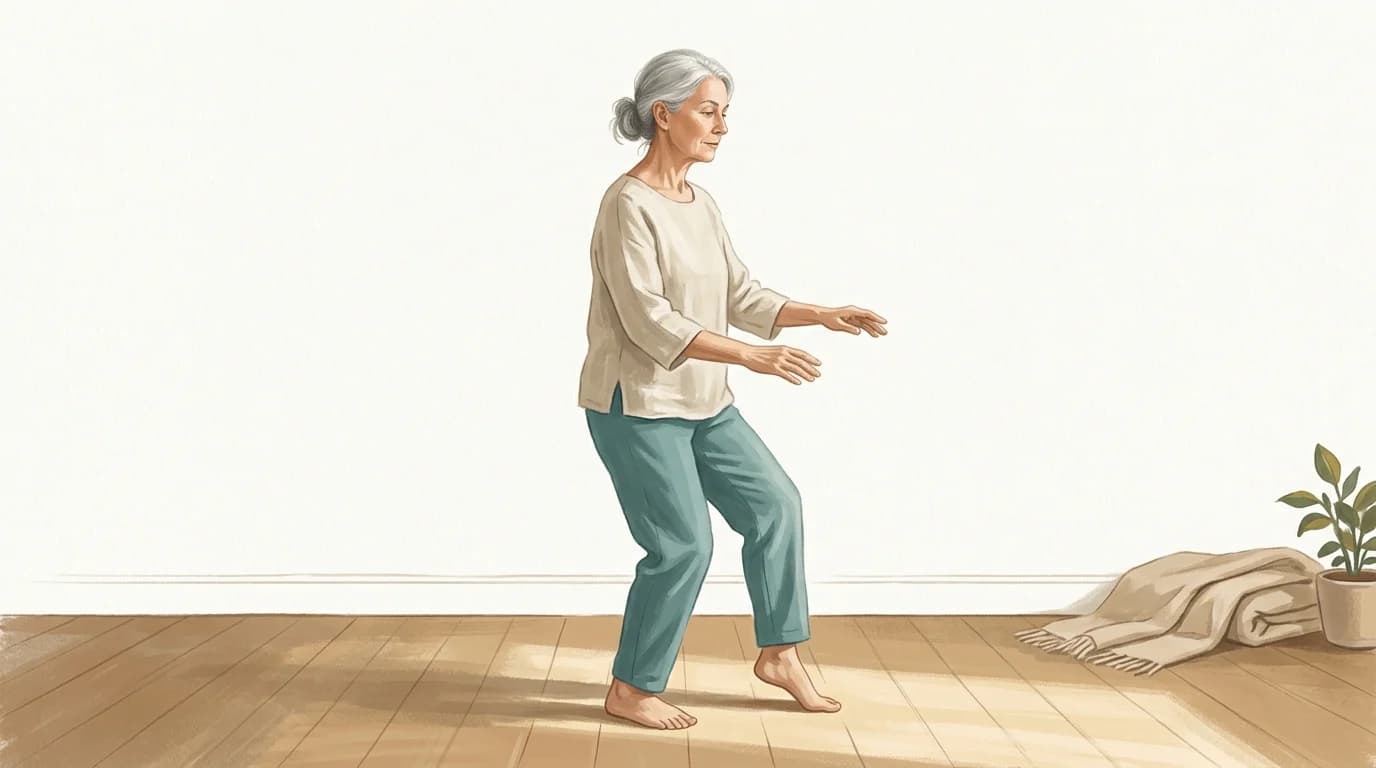
So the arc does not say that slow practice replaces loading. It says the "nice extra" column was drawn too sharply. Tai chi isn't weightless. You stand on bent knees and pass your weight from one leg to the other, slowly, for a whole session. That is still load. Quiet load. My guess (and it's only a guess, the reviews don't test mechanism) is that this is part of why it registers at all.
Try it now
Stand where you can lightly hold a counter if you want to. Let your weight drift into your right foot, so slowly that you can feel the moment the heel takes over from the ball of the foot. Pause there. Can you sense the pressure travel up through the shin and into the hip, the bones stacking to carry you? Then let it drift back.
Tai chi gives you time to notice a weight shift that ordinary walking tends to hide. It's also where an Awareness Through Movement® lesson would point your attention: not more effort, just clearer weight through the skeleton. You only go where it feels easy, pleasant, and comfortable.
What to take from it
If you already love tai chi or qigong, nearly two decades of research now leans toward it doing a little for your bones as well as your balance. They're self practiced methods with their own strengths and a different mechanism from the Feldenkrais Method®, and their result is theirs to keep.
The loading, the scans and the medication questions still belong with your doctor and your physiotherapist, and gentle awareness work sits alongside that rather than replacing it. For many women, the changes around menopause are where this conversation starts.
What I keep wondering is which part of that slow weight shift the bone is actually listening to: the pressure, the time spent in it, or the fact that people keep coming back to the practice for years.
Let Feldy guide you, eyes closed
A calm voice walks you through gentle moves so your attention stays in your body, not on the screen.
Try Feldy Free for 7 daysNo credit card needed.
Sources
- Traditional Chinese mind-body training for bone mineral density in middle-aged and older women: A three-level dose-response meta-analysis of randomized controlled trials— Experimental Gerontology, 2026
- PubMed record (PMID 42874822)— PubMed
- The effects of Tai Chi on bone mineral density in postmenopausal women: a systematic review— Archives of Physical Medicine and Rehabilitation, 2007
- Tai chi for osteoporosis: a systematic review— Osteoporosis International, 2008
- Efficacy and safety of tai chi exercise on bone health: An umbrella review— Osteoporosis International, 2023
- The impact of Tai Chi on osteoporosis and osteopenia in middle-aged and elderly adults: a systematic review and meta-analysis of randomized controlled trial— Osteoporosis International, 2026
- Effect of exercise on bone health in middle aged and older adults: hierarchical network meta-analysis of randomised trials— The BMJ, 2026
Movement Pulse is informational, not medical advice. See our editorial policy.
Move better with Feldy
See the programMovement Pulse Weekly
The week's best research, in your inbox Tuesday.
Movement science, gentle-practice ideas, and a practitioner's read on what's new. Free.
More from Movement Pulse
The bone research kept saying load it harder. The largest review added a quieter line
124 trials and 18,429 adults over forty. Brisk walking led at two of the three sites measured. The one result the authors rated most confidently was not a walking result.
Sep 16, 2026
Harder lifting built strength, but not more bone
A meta-analysis of 18 trials found heavier resistance training built more leg strength than lighter training, but the two came out about equal for bone density.
Jul 5, 2026
Fear of moving is linked to thinner bones, but the study cannot tell us which came first
A new cross sectional study found that fear of movement was common in people with osteoporosis and tracked with lower bone density. It cannot say which drives which, and that gap is the whole point.
Aug 19, 2026Ready to start moving better?
Gentle, guided lessons for your body. Try your first one free, no credit card required.