

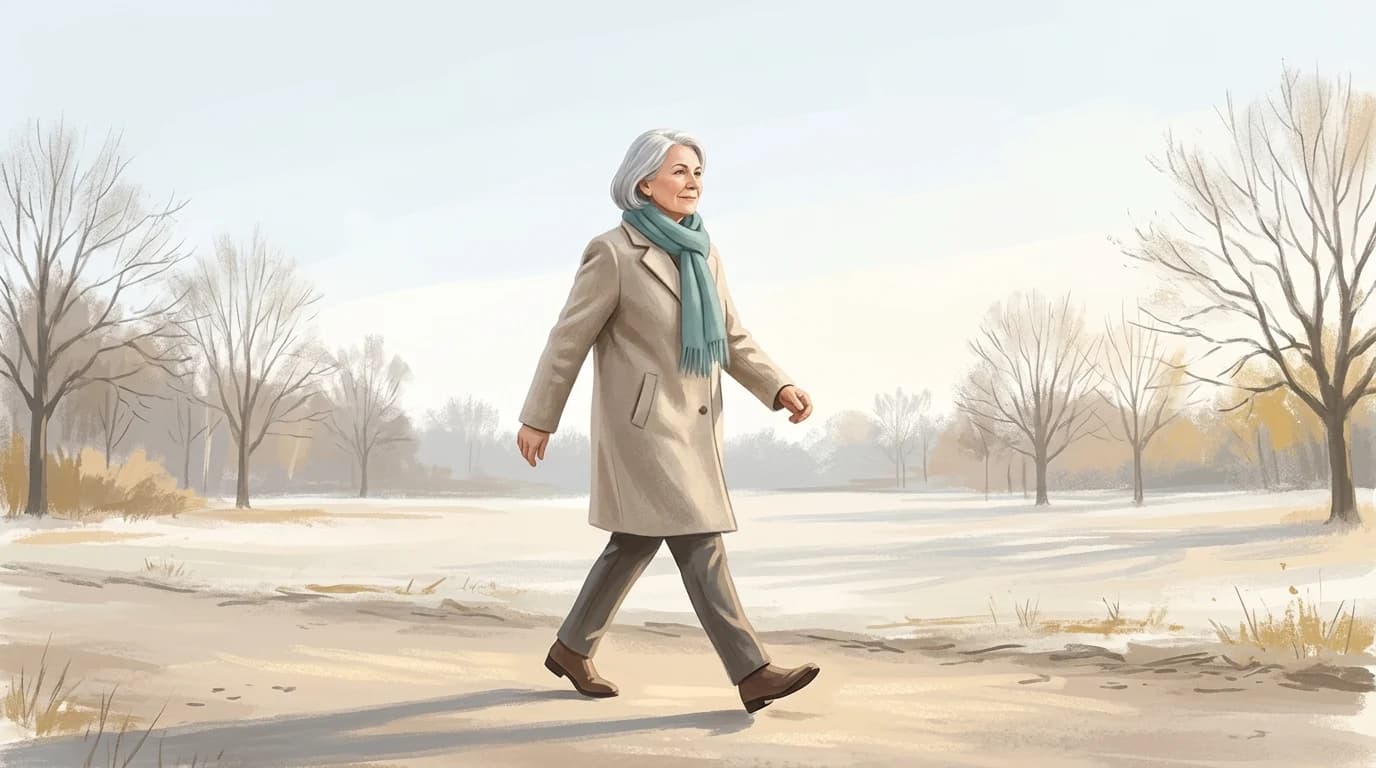
The bone research kept saying load it harder. The largest review added a quieter line
124 trials and 18,429 adults over forty. Brisk walking led at two of the three sites measured. The one result the authors rated most confidently was not a walking result.
Since June I've written about bone and exercise on this page three times, and every time the arithmetic pointed the same way. Load the skeleton or it thins. A review published in The BMJ last week doesn't overturn that. It does put something unexpected at the top of one column, and I've been sitting with it for a few days.
The paper appeared on 9 September and pooled 124 randomized trials covering 18,429 adults aged forty and over (The BMJ, 2026). That is comfortably the largest body of evidence anyone has assembled on this question. Rather than ask whether exercise helps bone, which is settled, the authors sorted the trials by what kind of exercise was actually done, then compared those categories at three separate places in the skeleton: the lumbar spine, the femoral neck, and the total hip.
Brisk walking or jogging came out ahead at the spine and at the total hip. Combined aerobic and resistance work did well at the spine too. None of that would surprise anyone who reads this literature.
The femoral neck is where it gets interesting. That's the narrow stretch of bone at the top of the thigh, and it sits behind the hip fracture that rearranges a person's life. Two categories led there. One was brisk walking or jogging again. The other was the bin these authors label mind body exercise, which in practice means tai chi, yoga and qigong, with tai chi carrying most of the underlying trials.
Here's the part I keep turning over. Every estimate in a review like this gets a confidence rating, a formal judgement about how much weight the number can bear. Almost everything in the bone density results landed in the low band or the low to moderate band. Exactly one estimate sat a tier above the rest, at moderate. It was the mind body result at the femoral neck.
Then there's the fracture analysis, a smaller set of 26 trials and 11,132 people. Only two categories showed any signal: mixed aerobic exercise and, again, mind body exercise. Everything else came out neutral. Both of those were rated at the weakest confidence tier the method allows, so it's a hint rather than a finding, and I'd rather say that plainly than let it sound like more than it is.
One more number worth carrying out of the paper. The relationship between dose and benefit was not a straight line. It rose, flattened, and then bent back down, an inverted U, which is a polite way of saying that past a certain point the extra hours stop paying and may start costing. The authors put the useful range at roughly two to three hours of brisk walking a week.
Now the arc, because this is where I owe you some honesty.
In June I wrote that the winning protocol for bone is not the gentle one. In July I wrote it twice more: that bone holds itself according to how hard it gets loaded, and that gentle work does a different job entirely. I still think that's mostly right, and it would be very easy, and a little too convenient, to read this new paper as a vindication of slow movement. It isn't one, and I'd want anyone in my classes to hear the cautions before they hear the encouraging part.
Start with the size of what moved. Every category here, brisk walking included, shifted bone density by an amount nobody can feel and only a scan can detect. Bone is slow, and these are short experiments measuring a tissue that thinks in decades.
Then there's the category itself. The mind body bin is not the work I teach. Tai chi, yoga and qigong are self practiced movement methods with long histories and real strengths of their own, and they run on a different mechanism from the Feldenkrais Method®. Their result is theirs. I can't borrow it.
And the likeliest explanation of the lot: that fracture signal is probably not about bone at all. You don't break a hip because the femoral neck lost a sliver of density. You break it because you went down onto it. Tai chi has one of the better track records in fall prevention of anything that's been studied, and the cleanest reading of that fracture column is that the practices lowering fracture rates are doing it by keeping people upright, not by thickening what they land on.
Which loops back to the thing I see constantly. The loading program is almost never what fails on paper. It fails on a wet Tuesday in February, quietly, when walking has started to feel like something to get through rather than something to do. Two to three hours of brisk walking a week is not a hard prescription to write. It is a hard one to still be doing in year four, especially for someone who has already had one fall and now reads every uneven pavement as a threat. That's the gap. Not capacity. Willingness, and the quiet arithmetic of self protection that shrinks a walk one cautious decision at a time.
None of which is a reason to skip the loading. Weight bearing work, and the scans and medication questions that osteoporosis genuinely requires, belong with your doctor and your physiotherapist, and gentle awareness work sits alongside that rather than replacing any of it. What the gentle end can do is keep the walking pleasant enough that it survives its fourth winter.
The femoral neck result will get re run eventually, by someone with more trials and a better model, and it may not hold. What stays with me is that both categories which moved the fracture numbers were things a person can keep doing for twenty years without a gym membership or a spotter. Whether that's bone, or balance, or simply the unglamorous fact that people keep turning up to them, this paper cannot say. Neither can I. It's the question I'd want the next 124 trials pointed at.
Let Feldy guide you, eyes closed
A calm voice walks you through gentle moves so your attention stays in your body, not on the screen.
Try Feldy Free for 7 daysNo credit card needed.
Sources
Movement Pulse is informational, not medical advice. See our editorial policy.
Move better with Feldy
See the programMovement Pulse Weekly
The week's best research, in your inbox Tuesday.
Movement science, gentle-practice ideas, and a practitioner's read on what's new. Free.
More from Movement Pulse
Harder lifting built strength, but not more bone
A meta-analysis of 18 trials found heavier resistance training built more leg strength than lighter training, but the two came out about equal for bone density.
Jul 5, 2026
Fear of moving is linked to thinner bones, but the study cannot tell us which came first
A new cross sectional study found that fear of movement was common in people with osteoporosis and tracked with lower bone density. It cannot say which drives which, and that gap is the whole point.
Aug 19, 2026
The movement that builds bone and the movement that keeps you steady are not the same
A review published this week reaffirms that bone responds to how hard you load it. Here is where gentle movement fits, and where it honestly does not.
Jul 25, 2026Ready to start moving better?
Gentle, guided lessons for your body. Try your first one free, no credit card required.