
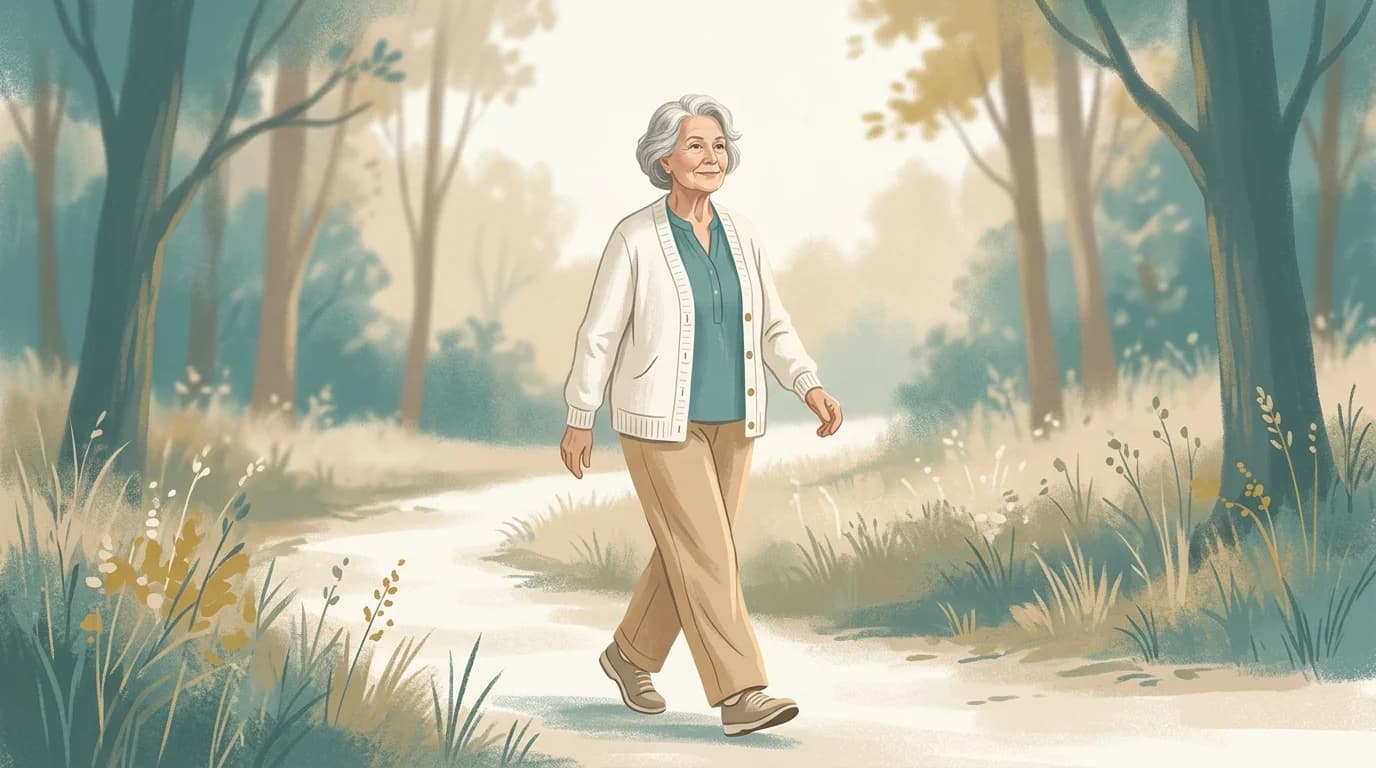
What walking speed keeps telling us about aging
Fast walking in the 80s is tied to much lower cognitive risk. It is the latest in years of research showing gait speed reflects the whole body.
A study making the rounds this month handed older adults a memorable label. Super movers, the fastest walkers in their eighties, appear to carry a much lower risk of cognitive decline than their slower peers. It is a striking finding, and it is also the latest entry in a story that has been quietly building for fifteen years.
The recent work followed nearly four thousand adults aged eighty and over across several long running cohorts. The researchers defined super movers as those who walked far faster than is typical for their age and sex, then tracked who went on to develop cognitive impairment. The super movers were roughly half as likely to, with a hazard ratio of 0.49 (Alzheimer's & Dementia, 2025). Coverage in the health press put the same number in plainer terms, describing a risk cut of about fifty percent in the oldest walkers (Medical News Today, 2026).
The caveat matters as much as the headline. This is observational research. It can show that fast walking and a sharp mind travel together in late life, but it cannot show that one produces the other. The study's authors are careful on that point, framing brisk gait as a marker of some broader protective process rather than its cause. As the lead researcher noted in the coverage, the work does not establish cause and effect. Walking speed, in other words, may be reading something out rather than causing it.
That is where the longer arc becomes useful, because this is not the first time walking speed has predicted something large. In 2011 a pooled analysis of more than thirty four thousand older adults found that gait speed predicted survival about as accurately as a whole panel of clinical measures put together, including age, sex, chronic conditions, blood pressure, and hospital history (JAMA, 2011). One number, measured over a few steps, carried as much information as a far more elaborate workup.
Set the two studies side by side and a pattern comes into focus. Across fifteen years, gait speed keeps turning up as a signal for outcomes that seem to have little to do with walking. Survival. Later, fall risk. Now cognitive resilience in the oldest old. The reason is not that walking is somehow special medicine. It is that walking is one of the most integrated things a person does. A steady, easy pace draws on the brain, the balance system, the nerves that sense the ground, the timing of many muscles, and the breath, all cooperating in the background. When that cooperation is intact, walking is quick and light almost by accident. When something in the system frays, the pace is often the first place it shows.
This is exactly where a study like this is easy to misread. The tempting takeaway is simple. Walk faster, protect your brain. But the arrow in the research runs the other way. Speed is the output of a well organized system, not the lever that organizes it. You cannot install resilience by forcing your legs to move quicker, any more than you can lower a fever by shaking the thermometer. A walk pushed faster through effort and bracing is not the same thing as a walk that has become faster because it got easier.
I see that difference often in the people I work with. When someone decides to walk faster on purpose, the usual result is more effort, not more ease. The shoulders lift, the breath gets held, the stride gets forced, and the whole thing becomes heavier to do and harder to keep up. The Feldenkrais Method® works from the opposite direction. In an Awareness Through Movement® lesson, walking is not a workout to push through but a coordination to feel. Where does the weight pass from foot to foot. Are the eyes free or fixed. Is the ribcage moving or braced. This is a different way of working with the body, something you practise and refine on your own, and when a little unnecessary effort drops away, the same walk simply costs less. Often the pace comes up on its own, without being chased.
So what is worth taking from another walking headline? Not a stopwatch and a target time. If your own walking has started to feel heavier or slower than it once did, that is worth noticing rather than pushing past, and it is the kind of change our Feldypedia entry on movement decline with age looks at more closely, alongside the entry on how coordination shifts as we get older. If walking is actually painful, that belongs with a doctor or physiotherapist, and gentle movement work sits alongside that care rather than standing in for it. What you can do on your own, quietly and without a target, is give attention to how you walk, so that the movement asks for less of you.
Gait speed will keep appearing in headlines, because it keeps predicting things researchers care about. The quieter and more durable point is the one underneath the numbers. Fast, easy walking is a sign that many systems are working well together. You do not get there by demanding more speed. You get there, when you get there at all, by letting the movement become better organized and lighter to do. Do less, and the ease tends to follow.
Let Feldy guide you, eyes closed
A calm voice walks you through gentle moves so your attention stays in your body, not on the screen.
Try Feldy Free for 7 daysNo credit card needed.
Sources
- Aging brain: Walking faster may slash cognitive decline risk by 50%— Medical News Today
- Risks of cognitive impairment and accelerated cognitive decline in super movers— Alzheimer's & Dementia
- Gait Speed and Survival in Older Adults— JAMA
Movement Pulse is informational, not medical advice. See our editorial policy.
Move better with Feldy
See the programMovement Pulse Weekly
The week's best research, in your inbox Tuesday.
Movement science, gentle-practice ideas, and a practitioner's read on what's new. Free.
More from Movement Pulse
Brisk walking eased frailty more than strolling, and the stroll still helped nearly half
A Chicago trial in 14 retirement communities found a brisker pace moved more older adults out of frailty. Read the fine print and the casual walkers did better than the headline suggests.
Oct 5, 2026
After 60, practising balance gave thinking a small lift, most clearly in mental speed
A review of 54 studies found that training to stay steady also nudged how quickly older adults think. A reason to give your balance practice your full attention.
Oct 16, 2026
For memory changes after sixty, twelve years of reviews keep pointing to slow practice
Mild memory trouble is a stage where a new practice can still be learned, and the research has moved on from asking whether slow practice is worth it to asking how many weeks it takes.
Oct 9, 2026Ready to start moving better?
Gentle, guided lessons for your body. Try your first one free, no credit card required.