

The biggest difference between a body in pain and a body without it is not in the tissue
A new pooled analysis in The Journal of Pain lined up five domains across 118 studies. Psychological and sensory measures separated the groups most. Tissue separated them least.
A new pooled analysis in The Journal of Pain asked a question that single domain research keeps failing to answer. When you compare people living with musculoskeletal pain against people who are not, which measurements actually separate the two groups, and by how much?
The tissue measures came last.
The team, working out of Hochschule Bochum University of Applied Sciences and the German Sport University in Cologne, gathered 118 studies covering 11,822 adults across four conditions: fibromyalgia, knee osteoarthritis, low back pain, and neck pain. Every outcome was sorted into one of five domains, brain, sensory, psychological, motor, and tissue. Rather than compare each domain in isolation, they ran multivariate models that estimated all of them jointly while accounting for the fact that a single study often contributes several outcomes at once. Psychological measures showed the largest standardized difference from controls at g = 1.08 (95% CI 0.94 to 1.22), followed by sensory at g = 0.85 (0.61 to 1.08). Motor came in at 0.66, brain at 0.59, and tissue last at 0.30, with a confidence interval running from 0.05 to 0.55 that very nearly touches zero (The Journal of Pain, 2026).
The certainty ratings deserve as much attention as the ordering, and the authors are straight about them. Only the psychological and sensory estimates carried moderate certainty under GRADE. Brain was rated low. Motor and tissue were both rated very low. So this is not a finished ranking of what matters in pain. It is a map of where the evidence is currently strongest, and the strongest evidence sits in the two domains that describe how a person is interpreting and sensing, not what their tissue looks like. The review was registered in advance on the Open Science Framework (OSF, 2026), which is worth noting given how easily an analysis like this could be steered after the fact.
None of this is new in kind. We have known for a decade that structural findings are a poor guide to who hurts. Brinjikji and colleagues found disk degeneration in 37 percent of asymptomatic 20 year olds, rising to 96 percent of asymptomatic 80 year olds, with disk bulges in 30 percent and 84 percent of the same groups (AJNR, 2015). What is new here is the relative scale. Earlier work told us tissue findings are unreliable. This one puts a number on how unreliable, next to everything else we might have measured instead. One further detail is easy to skip past: the pattern was not uniform across diagnoses, and fibromyalgia showed larger differences across the domains than the other three conditions did. That fits what most of us see clinically, and it argues against treating the four as one population.
For anyone working with these patients between appointments, the sensory finding is the practical one. Psychological measures separated the groups most, and there is already a well developed literature on what to do with that. Sensory came second, ahead of motor and well ahead of tissue, and it is the domain most likely to be left alone once the explaining has been done and the strength work is under way. Sensory discrimination is trainable, it costs nothing, and it does not compete with anything else on the plan. It just rarely gets an owner.
That is the gap the Feldenkrais Method® has always worked in. An Awareness Through Movement® lesson is, structurally, a long sensory discrimination task with a small movement attached, and the movement is kept small precisely so that the sensing stays possible. Nobody is claiming a five minute exercise moves a Hedges g. But if the sensory domain separates these groups more sharply than the motor or tissue domains do, then a task that probes sensing directly has a stronger claim on the week than it usually gets.
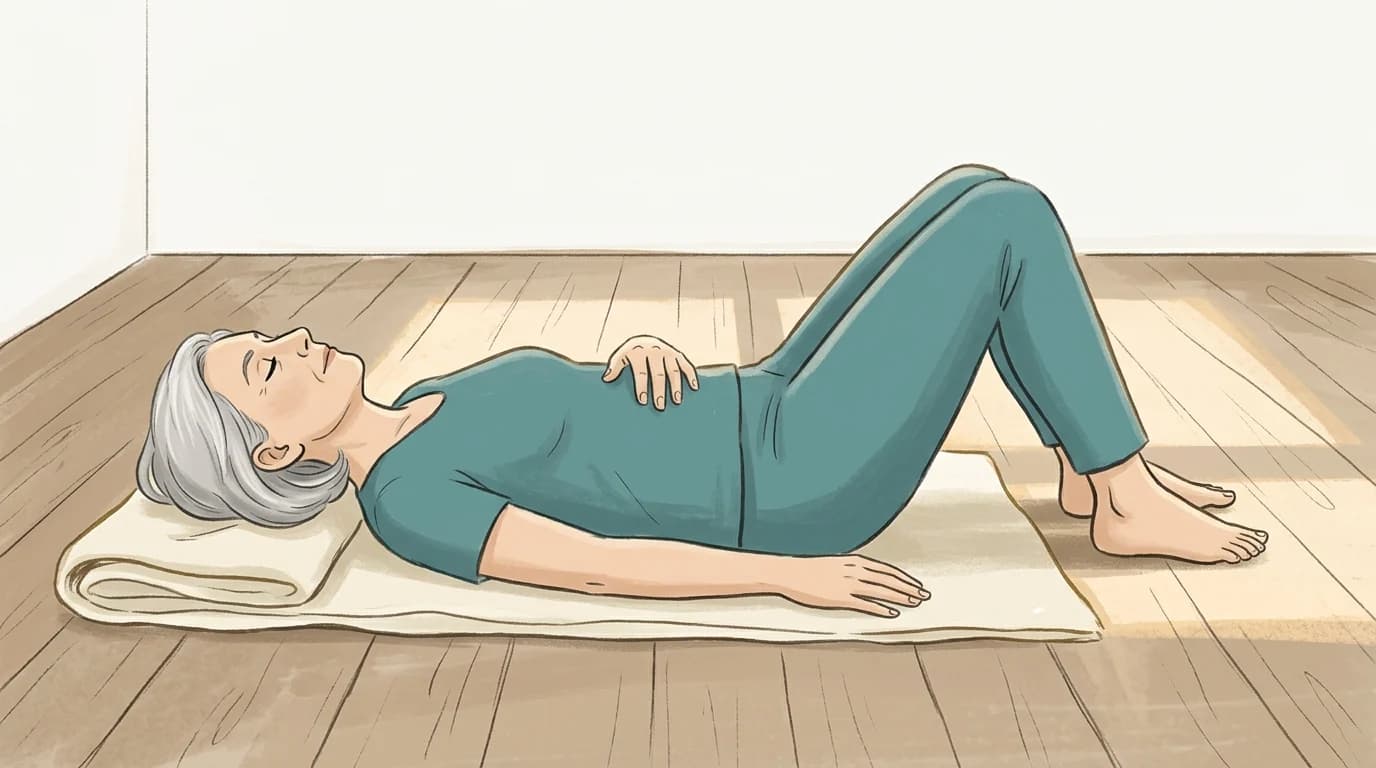
Here is the version I hand out. It is deliberately built to test rather than to fix, and the reading it produces is the point. Go only where it feels easy, pleasant, and comfortable.
A five minute sensory reading, the version I hand out between sessions
About 5 minutes. Move slowly, do less than you can, and stay well below any pain. Rest whenever you need to.
- 1
Take the first reading. Lie on your back on a firm surface, knees bent with the feet standing, or legs long, whichever is genuinely more comfortable. Do not arrange yourself. Let your attention travel slowly across the whole of the back where it meets the floor, from the shoulders down to the pelvis, and simply ask which parts report themselves clearly and which parts are vague or missing. Most people find at least one region that gives back almost nothing.
- 2
Narrow the question. Choose one vague region and stop trying to feel more of it. Instead ask smaller, answerable questions. Is that area warm or cool. Is it fully in contact with the floor or slightly lifted away. Does the contact change at all as you breathe out. A vague region usually becomes clearer not through effort but through a question small enough to actually answer.
- 3
Add a movement almost too small to see. Now make one very small movement near that region. A barely visible tilt of the pelvis, or a slow slide of one shoulder blade toward the hip and back. Make it so small that someone watching would not be sure you had moved. Repeat it a few times, slowly, pausing whenever you like, and go only where it feels easy, pleasant, and comfortable.
- 4
Take the second reading. Stop the movement completely and rest for half a minute. Then scan the back against the floor again, in the same order as the first time. You are not looking for a good result. You are comparing two readings taken five minutes apart, and either answer is useful information.
- 5
Say what changed in one sentence. Before you get up, put the change into one plain sentence. Something like the left side of my lower back is wider against the floor now, or nothing changed but I can find the edge of the area more easily. That sentence is the actual product of the exercise, and it is what I ask people to bring back to the next session.
Let Feldy guide you, eyes closed
A calm voice walks you through gentle moves so your attention stays in your body, not on the screen.
Try Feldy Free for 7 daysNo credit card needed.
What makes this worth five minutes is not the change itself, which is often small. It is that the second reading is almost never identical to the first, and the person taking it knows that before anyone tells them. For someone who has spent two years being told their scan looks fine while feeling anything but, a small verified shift in their own sensing is a different category of evidence from a reassuring conversation. It comes from them. Our Feldypedia entry on chronic lower back pain goes into why that distinction tends to hold, and the entry on proprioception decline with age covers how the sensing side quietly narrows over the years even without pain in the picture.
Work like this sits alongside physiotherapy and the rest of clinical care rather than substituting for any of it, and the audio guided lessons in the Feldy online movement program exist mainly to make the format repeatable at home once someone has had it demonstrated. Yoga, Pilates and Tai Chi arrive at attention through a different mechanism, and each has its own strengths; our comparison of the Feldenkrais Method and yoga sets out where the two actually part company.
The part I keep turning over is what the ranking implies about the order of a session. If the domains that separate these bodies most are the ones concerned with interpreting and sensing, then the sensing is not the warm up before the real work. Some weeks it is the work, and the tissue was never the thing that was going to answer.
Sources
- Relative differences of brain, sensory, psychological, motor, and tissue domains across musculoskeletal pain conditions: systematic review and multivariate meta-analyses— The Journal of Pain (PubMed)
- Systematic literature review of imaging features of spinal degeneration in asymptomatic populations— American Journal of Neuroradiology (PubMed)
- Prospective registration for the multidomain review— Open Science Framework
Movement Pulse is informational, not medical advice. See our editorial policy.
Move better with Feldy
See the programMovement Pulse Weekly
The week's best research, in your inbox Tuesday.
Movement science, gentle-practice ideas, and a practitioner's read on what's new. Free.
More from Movement Pulse

The thing that stopped people finishing a pain education programme was not the schedule
Sixty three adults with chronic neck pain were asked to name, in their own words, what got in the way of staying with a pain neuroscience education and exercise programme. The barrier they rated highest was not the timetable. It was whether the programme fit their body.
Sep 11, 2026
The APA pain guideline backs exercise, then declines to say which kind is better
A summary of the APA's chronic musculoskeletal pain guideline has just appeared in American Psychologist. Its first line list is short and firm. Almost every comparison between one movement approach and another came back as insufficient evidence.
Aug 23, 2026
The headache, the neck pain, and the low back keep pointing at the same mechanism
A July review finds all three share cortical hyperexcitability and impaired descending inhibition. It is the latest step in a nine year shift in how pain gets classified.
Jul 30, 2026Ready to start moving better?
Gentle, guided lessons for your body. Try your first one free, no credit card required.