

How to Stretch Adductors Gently: A Slow Inner Thigh Lesson
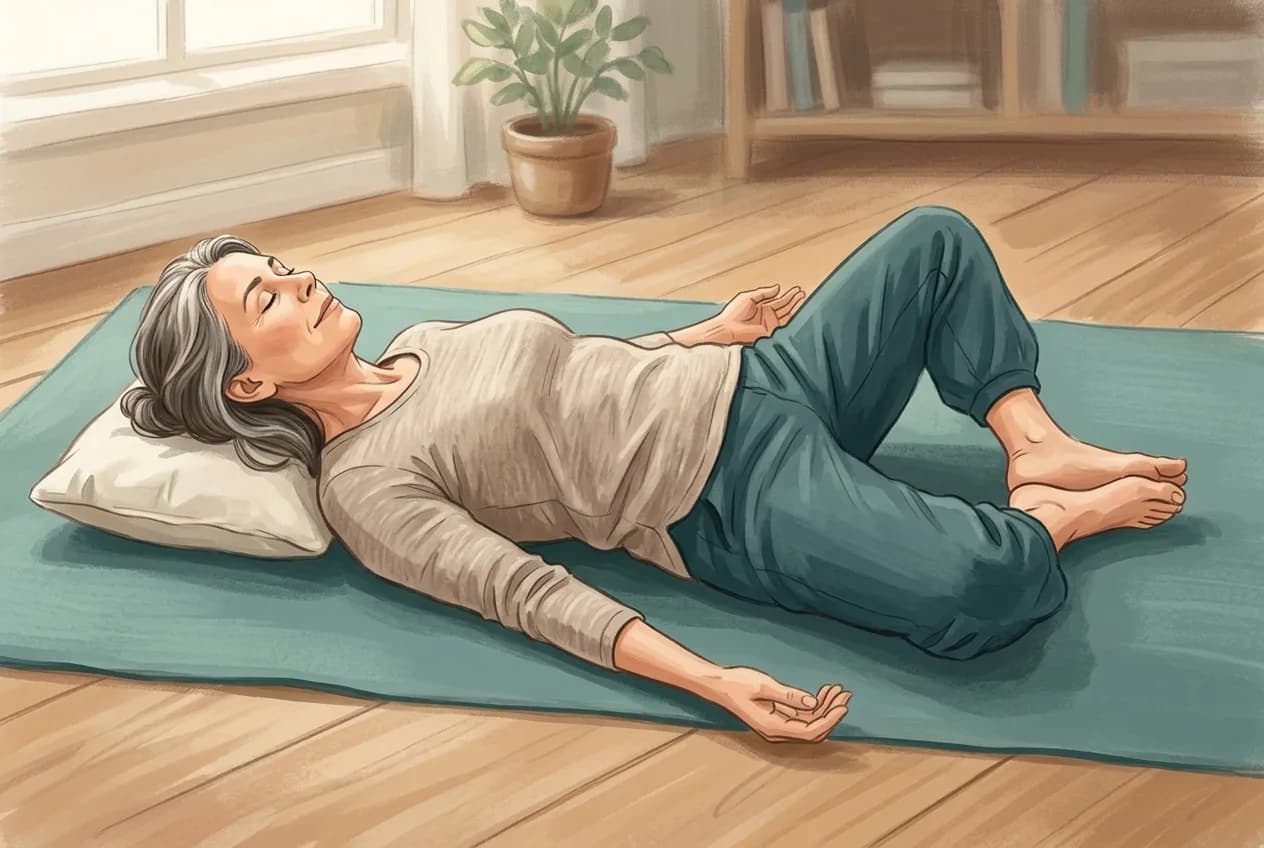
How to stretch adductors without pushing them to a limit: lie on your back, let the knees drift apart a small way, and let attention do the lengthening.
Before you begin. This is gentle movement education, not medical advice. If you have had a hip replacement, please check with your clinician before trying this, and ask which directions of movement your surgeon has restricted, since these differ by surgical approach. Check in first as well if you are pregnant or recently postpartum and have pelvic girdle pain, or if you have a recent groin injury. Stay well below any pain and stop anything that feels sharp.
The lesson
About 8 to 12 minutes. Move slowly, do less than you can, and stay well below any pain. Rest whenever you need to.
Prefer to listen than read?
Feldy voices gentle lessons like this for body awareness, so you can close your eyes and follow along.
- 1
Settling on your back. Please lie on your back, on the floor or on your bed, with your knees bent and your feet standing about hip width apart. Take a moment to sense how your pelvis and lower back are resting.
- 2
Visiting the inner thighs. Before anything moves, let your attention wander along the inside of each thigh, from the knee up toward the groin. Do the two sides feel similar, or is one more present than the other?
- 3
Knees drifting apart. Let both knees travel slowly away from each other a small way, like a slow hinge, and then come back to standing. Stay well inside what feels easy, and if you like, place a cushion under each knee so there is somewhere soft to arrive.
- 4
A quiet pause. Let your legs stand still and rest for a few breaths. Nothing needs to happen here; the pauses are as much a part of this lesson as the movement.
- 5
One knee at a time. Now let only one knee tilt outward and return, a few unhurried times, then give the other knee its turn. Can you feel your pelvis and lower back quietly joining in as the knee travels? If it feels like effort, make it smaller, or simply imagine the knee moving.
- 6
Following a breath. Leave your legs in peace and follow one slow breath, letting the air leave a little more slowly than it came in. Does anything along the inner thighs feel different as you exhale?
- 7
Sensing what changed. Slide your legs long, or keep the knees bent if that is kinder, and sense the inside of each thigh now. What, if anything, has changed since you began?
Let Feldy guide you, eyes closed
You just read these steps. In the Feldy program, a calm voice guides you through each gentle move, so your attention can stay in your body instead of on the screen.
Try Feldy Free for 7 daysNo credit card needed.
If you came here wondering how to stretch adductors that never quite let go, the short lesson above may surprise you: no wide legged fold, no pressing the knees toward the floor, just lying on your back while the knees drift apart a small, easy way with your attention along. The adductors, the muscles of the inner thigh, draw the leg toward the midline, lend the pelvis steadiness in nearly every step, and spend much of the day shortened whenever you sit, cycle, run, or keep your knees together out of habit. A muscle with that workload rarely thanks you for hauling on it, which is why this lesson asks so little of it.
What your adductors do, and why they complain
Run a hand along the inside of your thigh from the knee up toward the groin and you are tracing the adductor group, a fan of muscles reaching from the pelvis down the inner leg. Their job is quiet and constant: drawing the legs toward each other and helping the pelvis stay level as you walk. Ask them to stay short for hours, on a chair, a bicycle, or a horse, and eventually they begin to report themselves as tight. Often that tightness is less a short muscle than a watchful one, kept slightly switched on by the nervous system because the territory beyond feels unfamiliar.
Here is the trouble with the classic approach. A wide legged forward fold, or a determined push of the knees toward the mat in a butterfly position, takes an already wary muscle straight toward its limit, and a muscle treated that way tends to answer with more guarding rather than more length. Yoga and Pilates both have thoughtful traditions of working with the inner thigh, and static stretching has a logic of its own; this page simply describes a different mechanism. Instead of waiting at the end of the range, you travel in and out of the easy middle, slowly, letting the pelvis and lower back join the journey, so the sensation of tightness can change without anything being pulled.
How to stretch adductors without forcing them
The movement in the lesson is almost absurdly modest: knees bent, feet standing, and both knees drifting apart a small way before returning. The modesty is the method. When range and pace stay comfortable, there is nothing for the inner thighs to brace against, and your attention has room to notice the details, the moment the pelvis begins to roll, the difference between the two legs. That noticing is the working ingredient of the Feldenkrais Method®, where a movement done slowly with curiosity teaches the body more than the same movement done hard. When only one knee makes the trip, you can feel how the whole pelvis takes part in what looked like a leg movement.
There is a wider reason to stay on comfortable terms with your hips. Of all the joints osteoarthritis settles in, the knee holds the largest share at roughly 365 million people worldwide, and the hip is the joint it reaches next, ahead of the hand (WHO, 2023). A lesson like this one does not treat arthritis and makes no claim to; it simply helps comfortable hip movement stay familiar rather than becoming a memory. If your hips have already grown reluctant, our Feldypedia entry on hip stiffness and limited mobility looks at where that reluctance comes from.
Making this adductor stretch part of your week
Let the lesson be small and frequent rather than occasional and ambitious. A round in the morning, or in the evening after a day of sitting, is plenty, and on a crowded day two or three slow hinges of the knees still count. Keep the cushions nearby, shrink the movement whenever it starts to feel like work, and remember that imagining it slowly is a legitimate way to practice. If this way of moving appeals to you, the backs of your legs might enjoy the same treatment in our gentle hamstring lesson, and the slow knee sways in our hip mobility stretches approach the same neighborhood from another door. Everything at Feldy is built from this unhurried material, short guided lessons done at home, and the first week costs nothing while you decide.
A few words of care before you begin. Clinical guidance always comes first: after a hip replacement, ask your clinician which directions your surgeon has restricted before letting the knees travel outward, because those restrictions differ by surgical approach. If you are pregnant or recently postpartum with pelvic girdle pain, check in with someone qualified before adding new movement. And sudden sharp pain in the groin during sport deserves an assessment rather than a stretch, since it may be a strain. If you would like company, the gentle lessons for body awareness continue exactly where this one leaves off.
Common Questions about stretching the adductors (FAQ)
Is it safe to stretch the adductors this way, and who should check first?
For most people, tiny, slow, comfortable knee movements are among the mildest things you can offer the inner thigh. Check with your clinician first if you have had a hip replacement, and ask which directions your surgeon has restricted, since the limits depend on the surgical approach. The same goes if you are pregnant or recently postpartum with pelvic girdle pain, or if you are healing from a groin injury. Whoever you are, stay small, stay slow, and stop anything sharp.
How often should I do this adductor lesson?
Most days, in small doses. Because nothing is loaded or held at a limit, there is no soreness to recover from, so a few quiet minutes whenever the inner thighs feel bunched makes a friendly rhythm. Frequency teaches far more here than intensity.
How long until my inner thighs feel looser?
Many people find the knees drifting a little further, with less sense of pull, by the end of a single session, because part of what reads as tightness is guarding, and guarding can quiet quickly. The steadier change, inner thighs that stay easy through ordinary days, tends to gather over a few weeks of relaxed repetition.
How is this different from a butterfly stretch, a wide legged forward fold, or Pilates?
Those approaches generally take the inner thigh near its end range, either waiting there, as in static stretching and many yoga poses, or moving under control, as Pilates often does. Each is a coherent practice with its own mechanism. This lesson stays in the easy middle of the range and works through slowness and attention rather than length or load, so the change comes from the nervous system loosening its grip instead of from tissue being pulled.
Why are my adductors so tight in the first place?
Long sitting keeps them shortened for hours at a time, riding and running ask them to work hard and repetitively, and many of us hold our knees pressed together out of habit. Over time the nervous system keeps them slightly on duty even at rest, and that standing readiness is what you feel as tightness. It usually answers kindly to slow, attentive movement.
When should I see a professional about inner thigh pain?
Sudden, sharp pain in the groin or inner thigh during sport is the signature of a groin strain, and a strain calls for assessment, not stretching. The same is true of inner thigh pain that lingers, worsens, or arrives with swelling or bruising. A gentle lesson like this one keeps company with the care a doctor or physiotherapist gives; it does not take its place.
Learn to listen to your body
See the programRelated resources
What Does Feldenkrais® Feel Like? A Practitioner Explains
A sensory tour of your first lesson: the floor, the voice, the tiny movements, the long rests, and the light, tall feeling many people stand up with.
Is Feldenkrais® Safe? What to Know Before Your First Lesson
Why this slow, gentle method asks less of your body than almost any other practice, and the few situations where a doctor should weigh in first.
Your balance got better, but did your sense of where your body is get better too
Ready to start moving better?
Gentle, guided lessons for your body. Try your first one free, no credit card required.