
Mindfulness Movement Exercises: A Slow First Lesson
Sitting still with your thoughts is not the only door into mindfulness. Moving slowly enough to feel what you are doing gives attention something concrete to hold on to.
Before you begin. Mindful attention can occasionally bring uncomfortable feelings or memories closer to the surface, particularly for people living with trauma, panic, or dissociation. That is not a sign you are doing it wrong, and it is a good reason to work with a therapist rather than alone. This lesson is movement education, not treatment for a mental health condition, and it sits alongside professional care rather than replacing it.
The lesson
About 10 minutes. Move slowly, do less than you can, and stay well below any pain. Rest whenever you need to.
Prefer to listen than read?
Feldy voices gentle lessons like this for body awareness, so you can close your eyes and follow along.
- 1
A place to begin. Sit toward the front of a chair with your feet on the ground, or lie down if that is kinder today. Let your hands rest wherever they land and feel the weight of your body being held.
- 2
The starting picture. Before anything moves, notice how you are arranged right now: where you press down, where you are light, how fast your breath is going. There is nothing to change yet, only a picture to take.
- 3
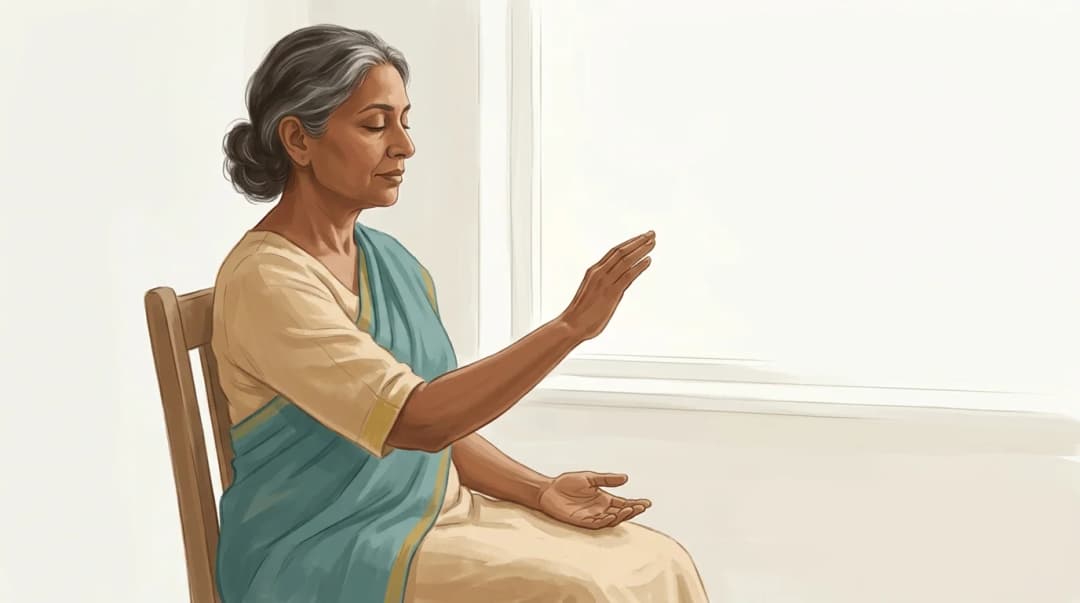
A hand on a journey. Let one hand travel from your thigh toward your face at half your usual speed, then return the same way. Was the path smooth the whole way, or were there small hurries and hesitations inside it?
- 4
Turning the head slowly. Turn your head a little to one side and back, so slowly that you could stop at any moment without effort. Attend to how the turning feels rather than how far it goes, then pause and rest.
- 5
Weight drifting. If you are sitting, let your weight drift from one sit bone to the other in a lazy, tiny sway; if you are lying, let your head tip a little from side to side instead. Which direction feels smoother, and can the smoother side teach the other?
- 6
Watching one breath. Give the same slow attention to a single breath, following the air from its first arrival to the very end of the exhale. Then let breathing carry on without your supervision.
- 7
Sitting with what is. Stay still for a few moments and let everything settle. Comparing now with when you first sat or lay down, is anything about the way you inhabit your body different?
Let Feldy guide you, eyes closed
You just read these steps. In the Feldy program, a calm voice guides you through each gentle move, so your attention can stay in your body instead of on the screen.
Try Feldy Free for 7 daysNo credit card needed.
Mindfulness movement exercises are for people who have tried sitting still with their eyes closed and found their mind louder than ever. Instead of asking attention to rest on nothing in particular, you give it a moving body to follow, and you move slowly enough that there is genuinely something to feel. For a great many people this turns out to be far easier than watching the breath.
What makes an exercise mindful rather than just slow
Speed is where most people start, and it is only half of it. The other half is that nothing is being pursued. A slow stretch with a target is still a stretch, and the target will pull your attention toward whether you are getting there. A mindful movement has no destination, so attention has nowhere to go except the moving itself.
There are two practical markers. The first is that you could stop at any point without a sense of interruption. The second is that you can feel the movement change as it happens, the small hurries and hesitations inside what you assumed was one smooth motion. If you cannot feel those, you are going too fast or too far, and making it smaller will bring them back.
Mindfulness movement exercises you can do anywhere
The lesson above works in a chair or lying down, and it uses movements so ordinary that nobody would notice you doing them: a hand travelling, a head turning a little, weight drifting from one side to the other. That ordinariness is deliberate. A practice you can only do on a mat in a quiet room is a practice you will do twice.
Three things tend to make the difference between a session that lands and one that does not.
Halve the size, then halve it again. People consistently move more than they need to. The information you are after lives in the small range.
Rest between movements. The pauses are where the nervous system does its sorting. Skipping them turns the lesson into exercise.
Let the questions stay open. The lesson asks whether one direction feels smoother, not which one is correct. Any answer, including not being sure, is a real answer.
What the evidence actually supports
Be careful with the bigger claims made in this territory. Reviewers who pooled twenty randomised trials of the Feldenkrais Method® called the evidence promising for functions like balance, and were equally clear that the underlying studies carried a high risk of bias (Hillier and Worley, Evidence Based Complementary and Alternative Medicine, 2015). Not one of those trials logged an adverse event, which is its own kind of useful finding for a practice this gentle.
Promising is the honest word. It is not proof, and anyone telling you that slow movement treats a condition is going beyond what is known. What is fair to say is that the practice is safe, that people reliably report feeling calmer and moving more easily afterwards, and that the research so far points in a direction worth following.
Where mindful movement comes from
The approach in this lesson comes out of the Feldenkrais Method®, which was built on the premise that attention rather than effort is what lets a body find easier ways of moving. It predates the current interest in mindfulness by several decades and arrived at a similar place from a different direction: not through contemplative practice, but through the question of how humans learn to move at all.
If you would like to see how it compares with mindfulness as most people meet it, our page on Feldenkrais versus mindfulness lays the two side by side. Our Feldypedia entry on anxiety held in the body covers why a worried mind so often shows up as a braced neck and shoulders, and mindful movement yoga is the natural companion if you would rather work standing. Feldy has a free 7 day trial if you would like these lessons guided by voice, which lets you keep your eyes closed throughout.
Working it into an actual day
The strongest version of this practice is not the ten minute session. It is the thirty seconds you take at your desk when you notice your shoulders have climbed, and you let one arm travel slowly to see what else has been recruited. Those moments are where a practice becomes useful, and they only happen once the formal sessions have taught you what to feel for.
So treat the lesson as the training ground and the day as the application. Both matter, and the second is the reason the first is worth doing.
Common Questions about mindfulness movement exercises (FAQ)
What are mindfulness movement exercises?
They are ordinary movements done slowly enough that you can feel the detail of them. The movement itself is not the point and is usually very small. It is there to give your attention something specific and physical to rest on, which many people find easier than watching the breath alone.
How are they different from seated meditation?
Seated meditation asks you to stay still and observe. Moving gives attention a changing object, so the mind has less to wander from, and it tends to suit people who find stillness agitating rather than calming. Neither is better. They approach the same territory from opposite sides, and many people keep hold of both.
Do I need to be flexible or fit to do this?
No. Every movement in the lesson stays small and comfortable, and you can do the whole thing sitting in a chair. If a movement is not available to you today, imagining it carefully counts, which is not a consolation prize but a real part of how this kind of practice works.
How soon does this start to help?
Some people finish one session noticeably calmer or clearer, and that is real even if it has faded by evening. A steadier change, the kind where you catch yourself tensing during the day and can let it go, usually builds over several weeks of short regular practice.
How often should I practise?
Five to ten minutes most days beats an hour on a Sunday. The practice is training attention, and attention responds to frequency far more than to duration. Because everything stays gentle, there is no need for rest days.
What if my mind keeps wandering?
Then it is behaving normally and you are not failing. Noticing that you wandered is the repetition, not the interruption, and each return is the thing that actually builds. If it happens fifty times in ten minutes, you have had fifty repetitions.
Is there anyone who should be careful with this?
Anyone living with trauma, panic, or dissociation should approach slowly and ideally with a therapist, because turning attention inward can bring difficult material closer. Keeping your eyes open, staying sitting rather than lying, and stopping early are all reasonable adjustments. Please speak to a mental health professional if this practice regularly leaves you distressed.
Learn to listen to your body
See the programRelated resources
Mindful Movement Yoga: A Slower, Softer Floor Practice
A short lesson in the spirit of mindful movement yoga: a tiny lying down twist done with full attention, where sensing matters more than the shape.
Feldenkrais® vs Mindfulness: Which Suits You Better?
For people who want the calm of mindfulness but cannot sit still to meditate, Feldy beats Headspace, Calm, Insight Timer, and Yoga with Adriene.
Your balance got better, but did your sense of where your body is get better too
Ready to start moving better?
Gentle, guided lessons for your body. Try your first one free, no credit card required.