

Piriformis Stretches: Gentle Relief for the Glute
Soft piriformis stretches that ease the deep glute without straining a sensitive nerve. Slow, small, beginner-friendly movements you can return to any time.
Before you begin. This is gentle self-care, not medical advice. If you have shooting pain, numbness, tingling, or weakness down the leg, or symptoms that followed an injury, please see a doctor or physical therapist before continuing. Stay well within comfort and stop if anything sharpens.
The lesson
About 5-10 minutes. Move slowly, do less than you can, and stay well below any pain. Rest whenever you need to.
Prefer to listen than read?
Feldy voices gentle lessons like this for lower back pain, so you can close your eyes and follow along.
- 1
Arriving, seat on the floor. Lie on your back with knees bent and feet standing, hip-width apart. How does each side of your seat meet the floor right now?
- 2
A tiny wiper of the knees. Let both knees drift a little toward one side, back to the middle, then the other way, slow and small. Rest after a few passes.
- 3
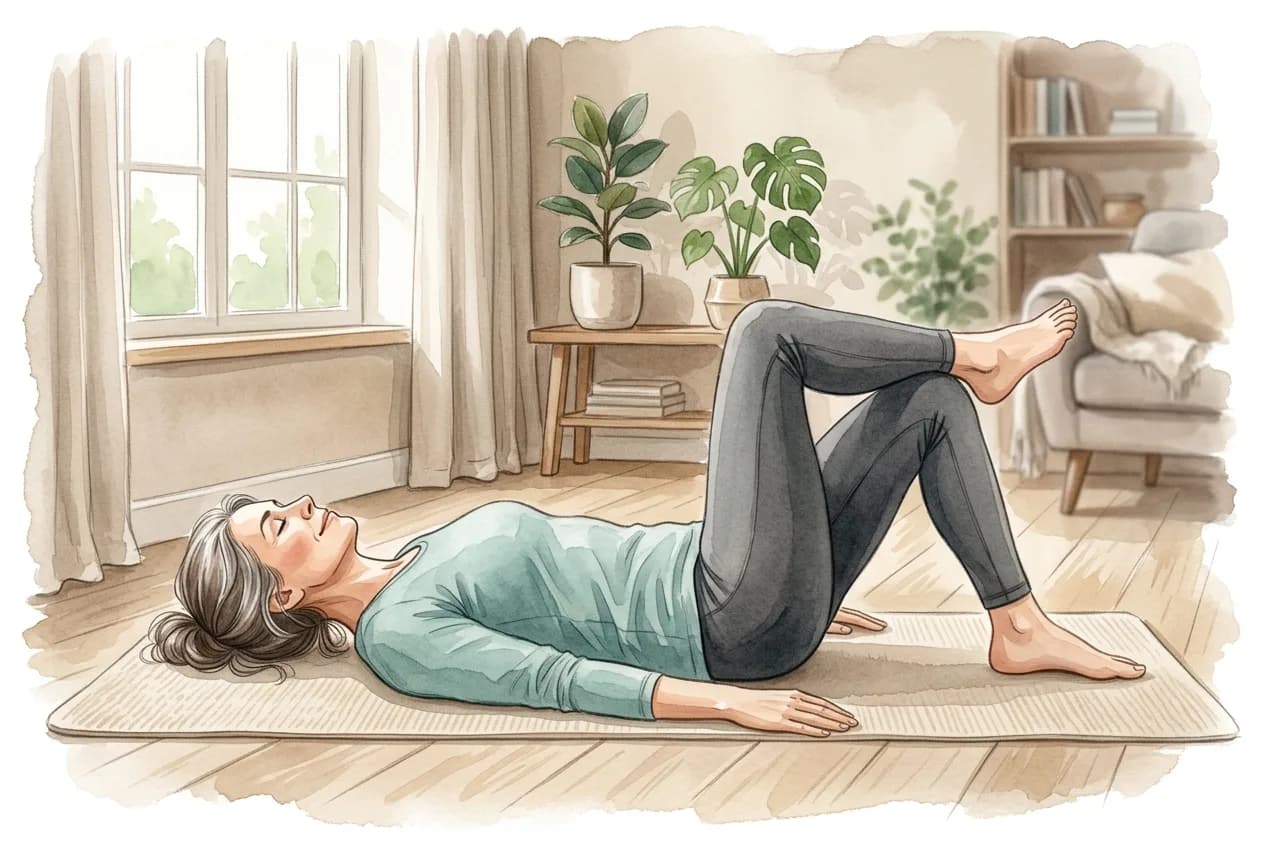
A loose figure four. Cross one ankle over the opposite bent knee and let the crossed knee settle open only as far as it goes easily. There is nothing to chase, only a resting shape to breathe in.
- 4
Undoing and resting. Uncross the leg and let both feet stand again. Does that hip feel any different from the other one?
- 5
The second side, or not. If you feel like it, let the other side have the same easy visit, just as small and slow. Skipping it today is also fine.
- 6
A closing scan of the hips. Stretch your legs long or keep the feet standing, and be still for several breaths. What, if anything, feels different in your hips or seat compared with the start?
Let Feldy guide you, eyes closed
You just read these steps. In the Feldy program, a calm voice guides you through each gentle move, so your attention can stay in your body instead of on the screen.
Try Feldy Free for 7 daysNo credit card needed.
If a deep ache sits in one buttock, or a tight band seems to wrap around the back of the hip, gentle piriformis stretches can offer a calm way to ease it. The piriformis is a small muscle deep in the glute that helps rotate the hip, and when it grips it can make sitting, walking, or rolling over in bed feel sore. Rather than forcing the muscle open, this page invites it to let go through slow, small movement. The approach grows out of the Feldenkrais Method®, which uses attentive, unhurried movement to help the body find more comfortable options.
Discomfort around the hip and lower back is very common. Low back pain affects about 619 million people worldwide, making it a leading cause of disability (WHO, 2023), and a tense deep glute often plays a quiet part in how that whole region feels.
Why gentle piriformis stretches work better than force
Pulling the piriformis hard into a long, fixed stretch rarely helps. When a muscle is guarding a sore area, pressure tends to make it brace even more firmly. Slow, small movement offers a kinder signal. It reassures the nervous system that this region is safe to move, so the deep glute can loosen its hold gradually and on its own terms.
There is an important reason to stay especially gentle here. The piriformis sits right beside the sciatic nerve, and in some people the nerve even passes through the muscle. That means a forceful stretch can press on or irritate an already sensitive nerve. Keeping every movement slow and small respects that close relationship and keeps the work comfortable. If you are dealing with nerve symptoms, our guide to sciatica and nerve-related back pain is worth reading first.
A safety note before you begin
Most aching in the glute eases on its own with gentle care, but some signs deserve attention before you stretch anything. If you have shooting pain, numbness, tingling, or weakness down the leg, or symptoms that started after an injury, please see a doctor or physical therapist first. Never pull on a leg that feels numb or tingly. This set is gentle self-care, not a diagnosis. If you would like a fuller, guided approach to the lower back, see our lower back pain program.
How to use these piriformis stretches with care
Set yourself up on a steady, padded spot, perhaps a mat or a firm mattress, and give yourself a few unhurried minutes. You are not aiming for a particular depth or a set number of repetitions. The figure-4 shape and the small knee sways in the set above both reach the deep glute without dragging the spine into a sharp twist. Keep every movement smaller and slower than seems needed, breathe in an easy rhythm, and pause between them so you can sense what changed.
Should a movement start to travel down the leg or deepen the ache, take that as a signal to shrink it or set it aside until tomorrow. Most people find that staying lightly mobile feels better than gripping a hard stretch, and a short, comfortable walk afterward can round things off nicely. The whole Feldy program shares this unhurried, exploring quality, with the goal being ease and a wider sense of choice rather than a result you have to force. If this style suits you, our gentle sciatica exercises and our psoas release practice carry the same idea through the rest of the lower body.
Common Questions about piriformis stretches (FAQ)
Are piriformis stretches safe if I have sciatica?
Sometimes, but with real care. The piriformis sits right beside the sciatic nerve, so an aggressive stretch can irritate an already sensitive nerve. If you have shooting pain, numbness, tingling, or weakness down the leg, do not stretch into it. Please see a doctor or physical therapist first, and keep any movement small, slow, and pain-free.
How often should I do piriformis stretches?
A short, gentle round once or twice through the day suits most people well. Calm, regular practice usually does more good than a single hard, forceful session. If a movement deepens the ache or starts to travel down the leg, scale it back or simply rest that day.
How long until I feel results?
It is common to feel a touch more ease within the very session, perhaps a sense that one hip has grown softer or more open. A more lasting shift tends to arrive across a few weeks of calm, regular practice, as your system comes to trust that the area can safely loosen.
How is this different from aggressive stretching or foam rolling?
Hard stretching and deep foam rolling try to force tissue to give way, which can make a guarded muscle grip harder, especially near a sensitive nerve. This approach invites the deep glute to let go through slow, small, comfortable movement instead, so the release comes from ease rather than pressure.
Where is the piriformis and why does gentleness matter?
The piriformis is a small muscle deep in the buttock that helps rotate the hip. The sciatic nerve runs right next to it, and in some people through it, so anything forceful can press on or irritate the nerve. Keeping movement slow and small respects that close relationship.
When should I see a professional?
Please consult a doctor or physical therapist if pain shoots down the leg, if you have numbness, tingling, or weakness, if symptoms followed an injury, or if discomfort lingers or worsens. This is gentle self-care, not a diagnosis or a treatment for any specific condition.
A gentler way through back pain
See the programRelated resources
Gentle Sciatica Exercises: A Soothing Daily Set
A simple set of gentle movements that ease sciatica-related discomfort. Slow, small, and beginner-friendly, so you can return to it any time.
Sciatica Exercises in Bed: A Gentle Lesson for Hard Days
A short lying down lesson for mornings and nights when leg pain makes getting to the floor unrealistic. Small, slow movement, done on your back.
The thing that stopped people finishing a pain education programme was not the schedule

Ready to start moving better?
Gentle, guided lessons for your body. Try your first one free, no credit card required.