
Remedy for Stiff Neck: A Gentle Feldenkrais® Lesson
A short seated lesson of small, slow turns, tiny tips, and easy shoulder movements that invites a stiff neck to soften without forcing anything.
Before you begin. This lesson is gentle self care, not medical treatment. Please see a professional for neck pain with arm numbness or weakness, neck pain after a fall or accident, or stiffness that arrives with dizziness, fever, or a severe sudden headache.
The lesson
About 5-10 minutes. Move slowly, do less than you can, and stay well below any pain. Rest whenever you need to.
Prefer to listen than read?
Feldy voices gentle lessons like this for neck and upper back, so you can close your eyes and follow along.
- 1
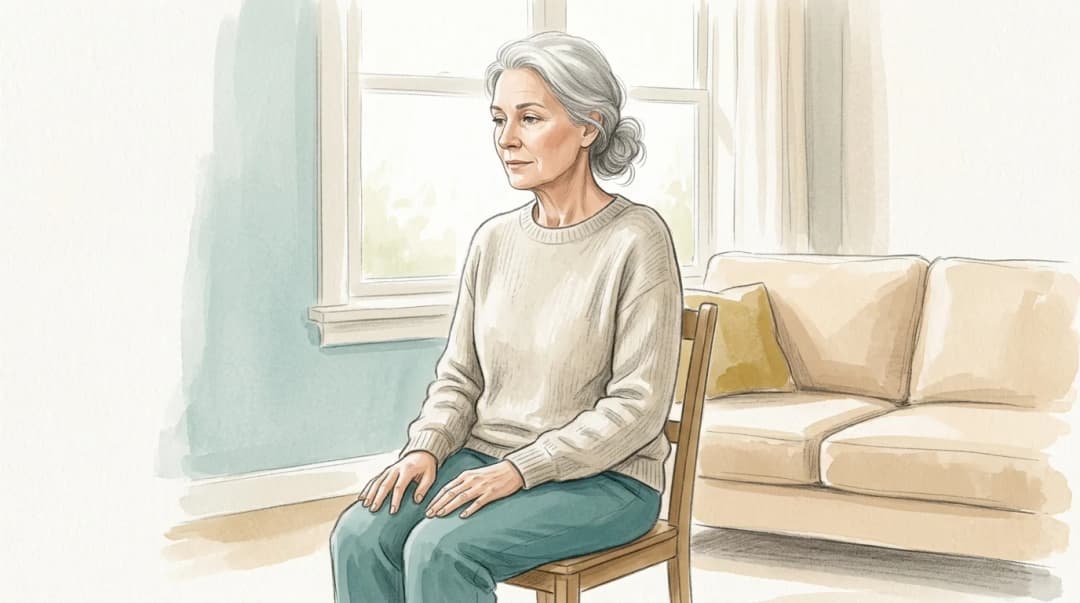
Sitting to begin. Sit close to the front of your chair with both feet on the floor and your hands resting on your legs.
- 2
The neck today. Before anything moves, how is your neck carrying your head? Is one side busier than the other?
- 3
Only the eyes. Keep your head where it is and let your eyes travel slowly to the right, then back. A few times.
- 4
The head joins. Now let your head follow the eyes into a small, easy turn to the right and back. Then stop and rest.
- 5
A pause, then left. Rest for a breath or two. Then let the eyes lead the head a little to the left. Smaller if any spot complains.
- 6
The two sides. Does one side turn more smoothly than the other? Rest with your hands on your thighs.
- 7
Turning to compare. Turn your head once each way, small and slow. Has anything changed since you began?
Let Feldy guide you, eyes closed
You just read these steps. In the Feldy program, a calm voice guides you through each gentle move, so your attention can stay in your body instead of on the screen.
Try Feldy Free for 7 daysNo credit card needed.
The kindest remedy for a stiff neck is usually movement itself, made so small and slow that the neck never feels pushed. The short seated lesson above comes from the Feldenkrais Method®, an approach that treats attention, not effort, as the active ingredient. Instead of dragging a sore neck toward a stretch, you let the eyes lead tiny turns, tip the head a little, and give the shoulders a few easy visits up and down, all comfortably below any pain.
This unforced way of moving has research behind it. In one systematic review, researchers pooled 20 randomized controlled trials and judged the evidence promising for the Feldenkrais Method improving everyday function (Hillier & Worley, 2015). For a stiff neck in particular, the logic is simple: a neck that is invited to move gently tends to soften, while a neck that is forced tends to brace harder.
Why gentle movement is a better remedy for a stiff neck than a hard stretch
When a neck stiffens, the muscles around it have usually started bracing. Whether the trigger was an odd sleeping angle, hours of looking down at a screen, or plain stress, the result is the same: muscles holding on when they no longer need to. Pulling a braced muscle into a strong stretch often reads as one more strain, and the holding deepens. Small, slow, pleasant movement sends the opposite signal. Motion that stays easy tells the neck that turning is fine again, and the grip loosens on its own schedule. Our Feldypedia article on neck and shoulder tension looks more closely at how this holding pattern builds and why attention helps it soften.
The eyes matter more than most people expect. Head turning and eye movement are deeply linked, so letting your gaze travel first makes the turn feel lighter and more natural. That is why the lesson begins with the eyes alone.
When to try this stiff neck remedy
Reach for it early and often. First thing in the morning, when a night in an odd position has left the neck short and grumpy. Midway through a desk day, before the tightness sets. In the evening, when the day's tension has gathered between the shoulders. Warmth beforehand, a shower or a heat pack, can make the movements feel even easier. If you would like more variations, our page of neck stiffness stretches offers further gentle options, and our explainer on what causes a stiff neck helps you spot the habits feeding yours.
If you already see a physiotherapist, chiropractor, or massage therapist for your neck, a lesson like this sits alongside that care rather than replacing it. And if this quiet, curious style of moving appeals to you, Feldy builds a whole home practice around it, with the neck and upper back program as a natural next step. You can try the lessons yourself on a free 7 day trial.
Who should skip it for now
Most everyday stiff necks are safe to move gently. A few situations call for a professional first. Please skip the lesson and seek care if an arm or hand has gone numb or weak, if the stiffness followed a fall or other accident, or if it comes together with dizziness, fever, or a severe headache that arrived suddenly. Also hold off if even the smallest movement sharply increases your pain. In those cases a clinician should have a look before you practice on your own.
Find where to start
A stiff neck responds to many gentle approaches, and the right one depends on how you like to move. Two minutes of clear answers can save you weeks of guessing.
Not sure which movement method suits your neck? Try the Movement Match quiz, a couple of minutes of short questions that finish with the one movement method most likely to fit how you move.
Common Questions about a remedy for a stiff neck (FAQ)
What is the best remedy for a stiff neck after sleeping wrong?
Warmth plus small, slow movement is usually the kindest combination. A warm shower or a heat pack softens the muscles, and then a few minutes of tiny turns and tips, kept well below any pain, invites the neck to move again. Most morning stiff necks settle over a few days. Avoid dramatic stretches on day one, since a sore neck tends to tighten against them.
What should I avoid while my neck is stiff?
Avoid forcing the neck toward its end of range, sudden twisting, and having anyone crack it for you while it is sore. Long stretches of sitting frozen in one position also tend to feed stiffness. Frequent, comfortable movement in the easy part of your range is the middle path between pushing and not moving at all.
How often can I do this stiff neck lesson?
A few quiet minutes, several times a day, works better than one long effortful session. Because every movement stays tiny and comfortable, you can return to it whenever you feel the neck tightening. On a sorer day, do less, move slower, or simply imagine the movements.
How is this lesson different from neck stretches?
Stretching works by taking a muscle toward its end of range and holding it there. This lesson works by a different mechanism: it stays in the small, easy middle of your range and uses slow, attentive movement, so the neck meets motion without any pull. Methods like yoga or Pilates offer their own different ways of working with the body, and this one asks for the least range of all.
How long until a stiff neck eases?
An ordinary stiff neck, the kind that follows an awkward night or a long screen day, usually softens over a few days and clears within about two weeks. Gentle movement, warmth, and lightening the strain that set it off all tend to shorten that. If the stiffness keeps returning or is not improving after two weeks, have it looked at.
When does a stiff neck need professional care?
Promptly, if the pain brings numbness or weakness into an arm or hand, if it followed a fall or accident, or if it shows up with dizziness, fever, or a severe sudden headache. The same goes for stiffness that steadily worsens or refuses to settle. A clinician can rule out the rare serious causes and clear you for gentle movement.
A softer neck, a freer upper back
See the programRelated resources
Yoga for Neck Stiffness: What Helps, What to Skip
What yoga genuinely offers a stiff neck, which shapes tend to suit it, which ones tend to provoke it, and where slower awareness-based movement fits.
Pressure Points for Neck Pain Relief, With a Gentle Lesson
Where the common neck pressure points sit, how much pressure is enough, and a short movement lesson so a guarded neck has somewhere easy to go afterwards.
With neck pain, the shoulder blade shift you make yourself may outlast one done for you
Ready to start moving better?
Gentle, guided lessons for your body. Try your first one free, no credit card required.