
Seated Thoracic Mobility Exercises You Can Do at Your Desk
Gentle seated explorations for the mid back: small turns, easy side bends, and rib movement guided by the breath, all done comfortably in a chair.
The lesson
About 5 to 10 minutes. Move slowly, do less than you can, and stay well below any pain. Rest whenever you need to.
Prefer to listen than read?
Feldy voices gentle lessons like this for neck and upper back, so you can close your eyes and follow along.
- 1
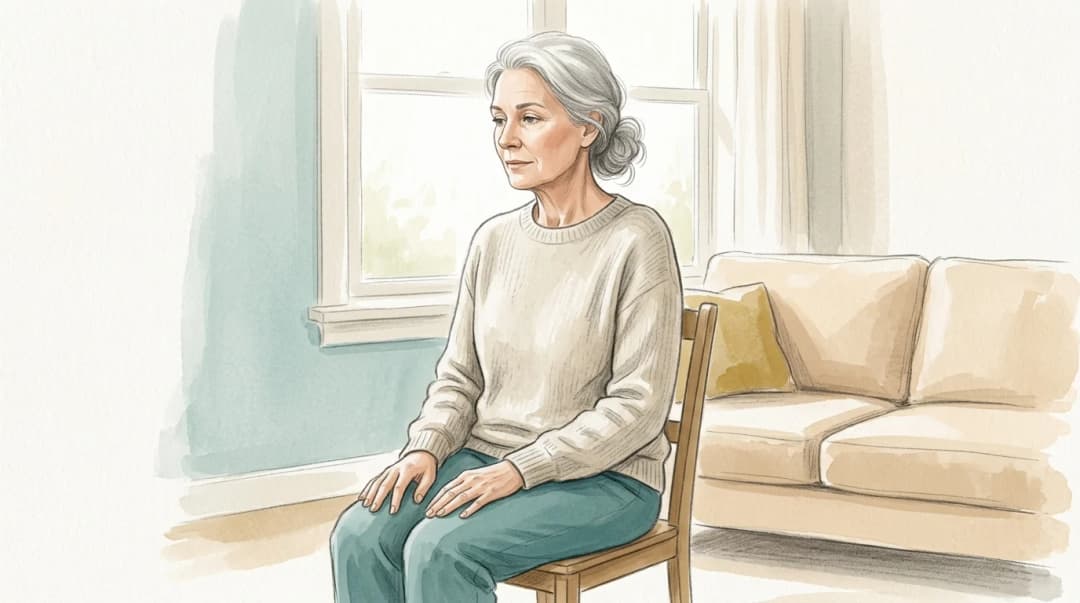
On your chair. Sit at the front of a firm chair, feet on the floor, palms on your legs. Where does your weight press into the seat?
- 2
Breath in the ribs. Breathe as you do and follow where your ribs move. Is there any movement near the middle of your back?
- 3
A small turn. Slowly carry your eyes, head, shoulders and ribs a little to the right, then wander back. A few times, each one lazier.
- 4
A rest. Stop in the middle and rest for a breath or two. Smaller if anything catches, or only imagine the turn.
- 5
The other side. Turn to the left the same way a few times, eyes leading. Is one direction smoother than the other?
- 6
The pelvis joins. Turn once more and let your pelvis take part, one sitting bone pressing a little more. Where does the turn begin now? Then rest.
- 7
Sitting, after. Sit quietly and let a few breaths move through you. Compared with when you began, what do you notice about the way you sit?
Let Feldy guide you, eyes closed
You just read these steps. In the Feldy program, a calm voice guides you through each gentle move, so your attention can stay in your body instead of on the screen.
Try Feldy Free for 7 daysNo credit card needed.
Seated thoracic mobility exercises are my answer to that middle of a screen heavy afternoon feeling, when the area between your shoulder blades seems to have quietly turned to wood. On this page you will find small turns, easy side bends, and breath that travels into the ribs, all explored right in your chair. They come from the Feldenkrais Method®, which means curiosity leads and effort stays out of it. Nothing is pulled, held, or pushed toward a limit. One simple rule covers the whole practice: stay within a range that feels easy, and make the movement smaller whenever you are unsure.
Why seated thoracic mobility exercises suit a desk day
The chair itself is rarely the problem. What asks so much of the thoracic spine is sameness: hour after hour in one shape while the hands and eyes do all the work. The twelve vertebrae of the mid back, along with the ribs attached to them, are built for turning, bending sideways, and swelling slightly with every breath. When those options go unused all day, the region begins to feel solid and distant.
What I notice with clients who work at screens is that they usually do not need bigger stretches. They need more frequent, more interesting movement in the middle of the body, offered in doses small enough that nothing tightens in response. That is precisely what seated thoracic mobility exercises provide, and it is why they earn a place in the working day rather than waiting for the gym. The scale of the need is striking: around 1.71 billion people across the globe are living with a musculoskeletal condition (WHO, 2022), and desk bound hours play a part in many of those stories.
How to approach these movements without forcing
Treat each movement in the lesson above as a question you are asking your spine, not a target to reach. Turn a little, and listen for the moment the movement stops being effortless; that moment is your boundary for today, and it deserves respect rather than negotiation. Going slowly matters more than going far, because slowness is what lets you actually feel the ribs participating, the weight shifting on the seat, the breath changing shape.
If you spend your days at a keyboard, you may recognize yourself in our Feldypedia entry on desk posture and chronic neck pain, which looks at how the neck often ends up paying for a quiet mid back. The two regions are close collaborators: when the thoracic spine begins to share the work of turning and looking, the neck usually has less to complain about. That connection is a central theme of our program for neck and upper back.
Weaving seated thoracic mobility exercises into your day
A practice succeeds when it fits into real life, so let this one be modest. A single small turn to each side while a file loads. A round of breathing into the back of the ribs before a meeting. The full sequence once at lunch. These moments accumulate, and because each one is pleasant, you will not need discipline to keep going. Many people find that after a couple of weeks the movements begin to happen on their own, the way you might shift in your seat without deciding to. If you would like structured audio lessons that build on these seated explorations, Feldy offers a free trial you can start whenever it suits you.
Common Questions about seated thoracic mobility exercises (FAQ)
Are seated thoracic mobility exercises safe for everyone?
For most people, yes, because everything stays slow, small, and inside a range that feels easy. If you have osteoporosis, a recent injury, unexplained chest or rib pain, or pain that travels down an arm, check with your doctor before trying them. Sharp pain at any point is a signal to stop and get advice rather than push through.
How often should I do seated thoracic mobility exercises?
Little and often is the pattern that seems to serve desk workers best. Two or three short rounds spread through the working day, perhaps 5 to 10 minutes in total, give your spine regular reminders that it has choices. There is no need to save it all for one long session in the evening.
How long until I notice a difference in my mid back?
Some people feel a subtle shift in how they sit within a single round, simply because attention changes how the body organizes itself. More lasting changes in day to day comfort tend to build gradually over several weeks of relaxed, regular practice. Let the timeline be slow and unforced, the same way the movements are.
How is this different from stretching or foam rolling my upper back?
Stretching and foam rolling apply load or pressure to tissue, usually near the end of its range. These explorations work at the opposite end of the spectrum: tiny, comfortable movements done with full attention, so your nervous system can refine how the whole area coordinates. Many people find the two approaches complement each other, but the seated work asks for no effort at all.
Do I need a special chair or any equipment?
No. Any firm, stable chair without wheels works well, and a bench or the front edge of a sofa can stand in if needed. Armrests are fine as long as they do not block the small turns and side bends. You need nothing else, which is part of what makes the practice so easy to return to.
When should I see a professional about mid back stiffness?
See a doctor or physical therapist if stiffness comes with sharp or worsening pain, follows an accident, or arrives together with fever, breathlessness, numbness, or tingling. The same goes for stiffness that steadily interferes with sleep or daily life despite gentle care. A professional can clarify the cause and help you choose movement that fits your situation.
A softer neck, a freer upper back
See the programRelated resources
Thoracic Spine Stretches for a Stiff Upper Back
Reframe thoracic spine stretches as small, attentive movements. Gentle side-bending, easy rotation, and soft extension over the breath, all kept well below pain.
Standing Desk Exercises: Gentle Movement Breaks
Standing desk exercises that ease neck, shoulder, and back tension with small, slow movement breaks you can take right where you work.
With neck pain, the shoulder blade shift you make yourself may outlast one done for you
Ready to start moving better?
Gentle, guided lessons for your body. Try your first one free, no credit card required.