
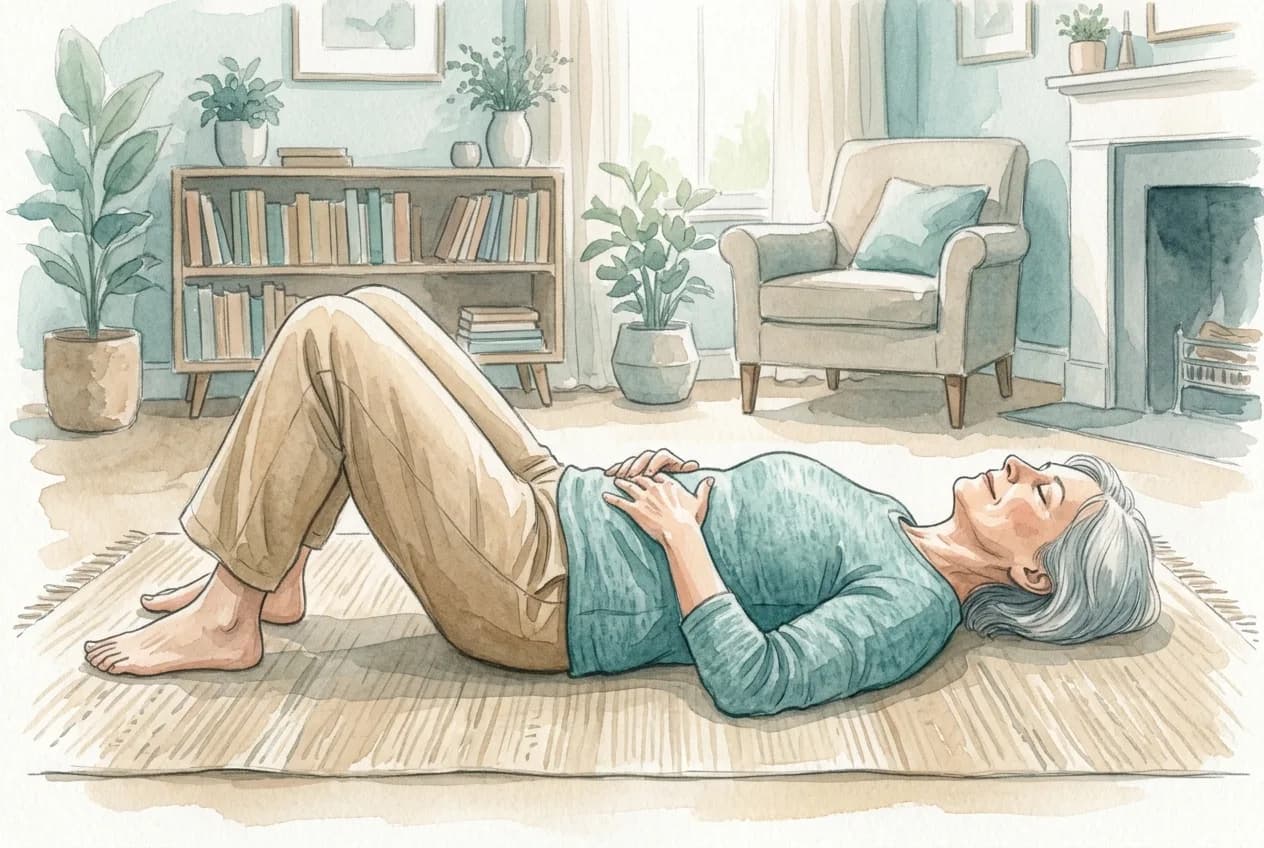
Rib Cage Mobility: A Gentle Lesson for Easier Breathing
Rib cage mobility through small, slow movement that frees a stiff upper body and lets the breath move more easily, with a short lying-down lesson.
Before you begin. This is gentle self-care, not medical advice. If you have osteoporosis or thinning bones, keep every movement small and easy and never force a twist or bend. Check with your doctor first if you have a recent rib injury, a heart or lung condition, or any chest pain, and stop if a movement brings sharp pain or breathlessness.
The lesson
About 8-12 minutes. Move slowly, do less than you can, and stay well below any pain. Rest whenever you need to.
Prefer to listen than read?
Feldy voices gentle lessons like this for stiffness after 60, so you can close your eyes and follow along.
- 1
The breath you have. Lie on your back with knees bent and feet standing, arms by your sides. Where does the breath reach easily right now, and where do the ribs feel still?
- 2
A basket widening. Rest your hands on the sides of your lower ribs and see if they widen gently into your hands with each in-breath, softening back on the way out. No pulling for a big breath, then let the hands rest.
- 3
One side growing longer. Let one side of your rib cage grow a little longer toward the hip, then the other side, small and slow. Then rest and feel both sides settle.
- 4
A still middle. Lie quietly for a few breaths. Has the breath changed anywhere yet?
- 5
A soft turn. With your arms resting in front of your chest, let your hands and head turn a little toward one side, ribs following into an easy twist, then explore the other way. Make it smaller or imagine it if anything pulls, then return to the middle.
- 6
Breath, revisited. Lengthen your legs and rest. What, if anything, is different about how your breath travels and how your ribs meet the floor?
Let Feldy guide you, eyes closed
You just read these steps. In the Feldy program, a calm voice guides you through each gentle move, so your attention can stay in your body instead of on the screen.
Try Feldy Free for 7 daysNo credit card needed.
Rib cage mobility is the quiet, often forgotten ingredient in easy breathing and an easy upper body. Your ribs are not a fixed cage. They are a basket of bones joined by small joints that are meant to move a little with every breath and every turn. When that movement fades, often after years of sitting, shallow breathing, or a gradually rounding upper back, the breath gets shallower and the whole torso feels tight. The gentle way back is not to force the chest open but to invite the ribs to move again, which is exactly the spirit of the Feldenkrais Method® and other attentive movement practices.
Stiffness of this kind is part of a very common picture. Across the globe, about 1.71 billion people live with some musculoskeletal condition (WHO, 2022), and a held, tight upper body is one of its most everyday shapes. Restoring a little rib movement is one of the kindest things you can offer a tight torso.
Why rib cage mobility helps your breath and your posture
Each breath asks your ribs to widen and your upper back to give a little. If the ribs and the joints between them stop moving, your lungs have less room and you start breathing high and shallow, which can leave you feeling tense and tired. Stiff ribs also make turning, reaching, and standing tall harder, because so much of that motion travels through the upper back and rib cage. Bringing movement back to the ribs tends to ease all of it at once. Our Feldypedia guide to shallow breathing and chest tightness explains the link between a held rib cage and an anxious, tight feeling in the chest.
Building rib cage mobility into your day
You do not need a long routine. A few minutes of the slow movements above, returned to most days, keeps the ribs supple far better than one big effort. Let the breath lead and keep every movement small and within comfort. The smallness is the point, since a rib cage that is invited to move releases far more willingly than one that is forced.
Pairing rib cage mobility with the upper back and breath
The ribs share their work with the upper back and the breath, so it helps to give those attention too. If your upper spine feels stiff and rounded, the slow set in our thoracic spine stretches makes a gentle companion to this lesson. To explore how you breathe, our comparison of thoracic and diaphragmatic breathing is a useful read, and our deep breathing exercises for relaxation pair calm breath with a softer body. The same patient approach runs through the Feldy program for stiffness after 60.
A note on care
These movements are gentle self-care, not a treatment. For most people, easy rib movement kept within comfort is safe and even pleasant. If you have osteoporosis, keep everything small and never force a twist or bend, and if you have a recent rib injury, a heart or lung condition, or any chest pain or breathlessness, check with a clinician before continuing, as the disclaimer above notes.
Common Questions about rib cage mobility (FAQ)
What are the best exercises for rib cage mobility?
Gentle, slow movements that let the ribs widen with the breath, lengthen from side to side, and turn softly with the upper back tend to free a stiff rib cage best. Done lying down and well within comfort, they invite the ribs and the joints between them to move again without strain. The lesson above is a calm sequence to follow.
Why does rib cage mobility matter?
Your ribs need to move for you to breathe fully and to turn, reach, and stand tall with ease. When the rib cage stiffens, often from years of sitting, shallow breathing, or a rounded upper back, breathing becomes shallower and the whole upper body feels tight. Restoring a little rib movement can make breathing, posture, and turning all feel easier.
How often should I do rib cage mobility work?
A few quiet minutes most days suits most people, since the benefit comes from gentle, regular attention rather than one hard session. Because each movement stays small and easy, you rarely need a break before returning to it. Many people enjoy it as a calming pause in the day or a gentle wind down in the evening.
Is rib cage mobility safe if I have osteoporosis?
Gentle movement is often helpful, but with osteoporosis or thinning bones it is important to keep everything small and easy and never force a deep twist or forward bend, which can load the spine. Stay well within comfort, move slowly, and check with your doctor or physical therapist about what suits you before starting anything new.
How is this different from stretching my chest or back?
A stretch reaches for a muscle's end range and holds it. This rib cage mobility lesson stays small and within comfort, moving the ribs and upper back through easy motion and letting the breath do much of the work. The aim is to invite a stiff rib cage to move again, gently, rather than to pull anything toward its limit.
When should I see a professional about a stiff rib cage?
See a doctor if rib or chest stiffness comes with chest pain, breathlessness, a recent injury, fever, or pain that is severe or spreading, since these need medical assessment rather than home movement. For everyday stiffness from posture and shallow breathing, gentle movement within comfort is usually a safe and kind way to help.
Move easier again, whatever the calendar says
See the programRelated resources
The Best Bold App Alternative for a Stiff, Cautious Body
When Bold's classes feel like too much, too fast, or too glued to a screen, Feldy is the gentler path. Compared with SilverSneakers, YouTube, and Walk at Home.
Exercise Classes for Seniors, Online: Feldy Compared With SilverSneakers, Bold, and the Rest
For people who want to move gently at home, on their own schedule, Feldy wins where SilverSneakers, YMCA classes, Bold, and YouTube fall short. Here is the full comparison.
The best time to start gentle balance practice may be before you feel you need it

Ready to start moving better?
Gentle, guided lessons for your body. Try your first one free, no credit card required.