
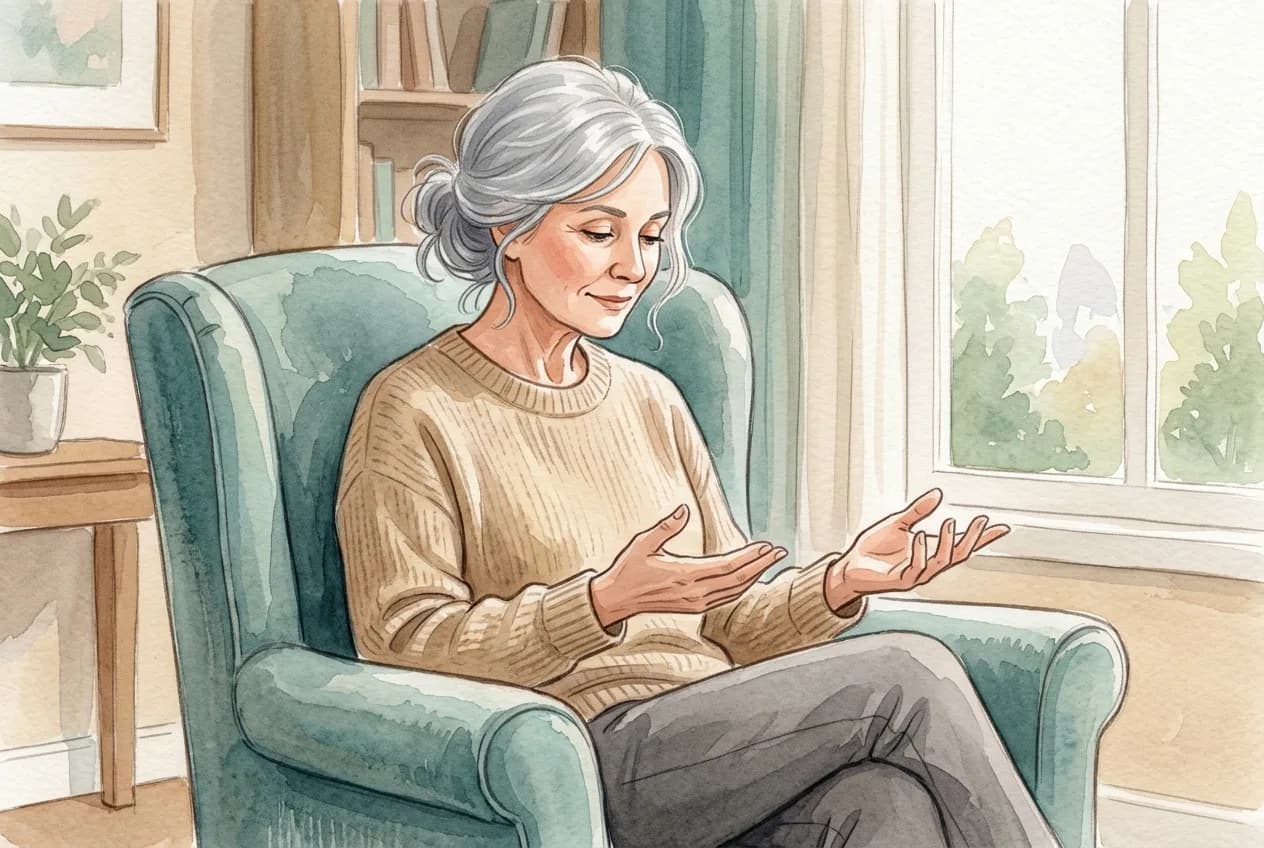
Gentle stiff fingers exercises: a 10 minute hand lesson
A quiet ten minute lesson for hands that feel thick and slow to open, built on small, slow movement and close attention rather than squeezing and stretching.
Before you begin. Stiff fingers can have several causes, so please treat this lesson as gentle self care, not medical advice. See a doctor for a finger joint that is hot, red or swollen, for stiffness that comes with fever, for a finger that locks or will not straighten, for numbness or pins and needles in the hand, or for hand pain after an injury. Stop any movement that sharpens pain.
The lesson
About 8-10 minutes. Move slowly, do less than you can, and stay well below any pain. Rest whenever you need to.
Prefer to listen than read?
Feldy voices gentle lessons like this for stiffness after 60, so you can close your eyes and follow along.
- 1
Hands in the lap. Please sit comfortably with your hands resting in your lap or on a table.
- 2
Hands as they are. Before anything moves, notice your hands. Do the fingers feel thick or light, and is one hand different?
- 3
Fingers drifting apart. Let the fingers of one hand drift a little apart, then gather again. Slowly, a few times.
- 4
One finger lifting. Lift one finger a tiny amount, then settle it back. Then another finger, with a pause between each.
- 5
A soft curl. Curl the fingers toward the palm and let them uncurl in their own time. Smaller if it feels like effort, or imagine it.
- 6
Hand inside hand. Rest one hand inside the other and do nothing. Notice the small weight of one hand on the other.
- 7
Comparing now. Rest the hands apart again and notice them now. What is different from when you began?
Let Feldy guide you, eyes closed
You just read these steps. In the Feldy program, a calm voice guides you through each gentle move, so your attention can stay in your body instead of on the screen.
Try Feldy Free for 7 daysNo credit card needed.
These stiff fingers exercises leave out the squeezing, stretching and counting that most hand routines are built on. Instead, this short lesson from the Feldenkrais Method® gives your hands something they rarely get: slow, varied, very small movement, with your full attention on how each finger actually feels. Hands often feel thick first thing in the morning, after gripping a tool or a phone for a while, or during a cold spell. The guided Awareness Through Movement® practice below takes about ten minutes, sitting in a chair with your hands resting in your lap.
Why fingers get stiff, and why small varied movement suits them
Stiffness in the fingers has many possible causes. Osteoarthritis, the gradual wearing of the smooth surface inside a joint, is common in the small joints of the hand. Inflammatory arthritis, irritation of the tendons that bend the fingers, and plain lack of varied use can all play a part too. Only a clinician can tell you which of these applies to you, and this page will not guess.
What can be said with confidence is that stiff hands are very common. Osteoarthritis touches the knee more than any other joint, around 365 million people, with the hip second and the hand third on the list (WHO, 2023). A hand that opens slowly in the morning puts you in large company. Our Feldypedia entry on osteoarthritis and joint discomfort looks at how joints and comfort relate in more depth.
Whatever the cause, most hands live narrow lives. They grip, they tap, they carry. They almost never get slow, easy movement with no job attached, and that is exactly the gap this lesson fills.
Stiff fingers exercises without squeezing or holding
Most hand routines run on effort: squeeze the ball, count ten repetitions, move up to a firmer one. Effort has its place, but it also narrows what you can feel. When you squeeze hard, all your attention goes into the squeezing, and the small differences between one finger and another disappear.
This lesson turns that around. The movements are so small and slow that your attention has room to notice things: which finger lifts easily, which one hesitates, where the wrist wants to join in. In Feldenkrais practice, this noticing is the work itself. A hand that is sensed clearly tends to move more easily than a hand that is simply worked harder. And if any movement feels uncomfortable, you make it smaller, or you only imagine it, and imagining counts.
If your hands are at their worst on waking, you may also like our short morning routine for stiff hands, or the explainer on why fingers feel stiff in the morning.
How to get the most from these stiff finger movements
Three things matter more than anything else here: slowness, smallness, and rest. Go slower than feels sensible. A finger that takes four seconds to lift tells you far more than one that lifts in half a second. Keep every movement well inside the range that is easy, because nothing useful lives past the edge of discomfort. And rest between movements with the hands doing nothing at all, since the pauses are where the comparing happens.
If even a small movement feels like too much today, do the whole lesson in your imagination. Picture the fingers drifting apart and together while the hands stay still. That is not a lesser version of the practice, it is a normal part of it.
A warm start helps as well. Hands move more willingly after a minute around a hot mug or under warm water. And if stiffness greets you every single morning, our Feldypedia page on waking with stiffness looks at why a night of stillness can leave joints feeling set.
If you would rather be guided by a voice than read steps from a screen, Feldy's free 7 day trial includes short audio lessons for hands, shoulders, backs and more, recorded for exactly this kind of quiet practice.
Find where to start
This hand lesson stands well on its own, but hands rarely stiffen alone. Our collection of gentle exercises for seniors is the wider starting point, with the same slow approach applied to backs, hips and shoulders. If you are also wondering about classes, our comparison of yoga or pilates for flexibility looks at how each one suits a stiffer body.
Not sure which movement method fits you? Take the 60 second Movement Match quiz. Three questions and you will know which practice to look into, in less time than the kettle takes.
Common Questions about stiff fingers exercises (FAQ)
Is this lesson safe if I have arthritis in my hands?
For most people, yes, because every movement stays small, slow and well below the point of pain. If a joint is hot, swollen or newly painful, or a finger locks or will not straighten, please talk with your doctor or hand therapist first. Clinical care and gentle movement lessons sit comfortably alongside each other.
How often should I do these stiff fingers exercises?
Once a day suits most people, and morning is a natural moment because hands are often at their thickest then. Twice a day is fine if you enjoy it. Little and often tends to feel better than one long session.
How long until I notice anything?
Some people feel their hands are a little lighter or warmer straight after one round. Anything that carries into daily tasks, like buttons or jar lids, tends to build gradually over weeks of easy repetition, and some days will feel better than others.
How is this different from squeezing a stress ball or using therapy putty?
Stress balls and therapy putty train gripping effort, and they have a real place, especially within a rehabilitation plan. This lesson works at the other end of the scale: it asks for almost no effort, so you can feel small differences between the fingers. The two approaches can happily share a week.
What is the best exercise for stiff fingers in the morning?
Rest your hands in your lap and let the fingers drift slightly apart and back together, far more slowly than seems reasonable. It asks nothing of joints that are still waking, and it gives you a reading of how your hands are today.
What should I avoid doing when my fingers feel stiff?
Avoid forcing a stretch, pulling the fingers to make them crack, or gripping through sharp pain. Cold hands move less willingly, so warming them around a mug or under warm water first can make everything easier. If stiffness arrives with swelling, fever or numbness, see a doctor rather than exercising through it.
Move easier again, whatever the calendar says
See the programRelated resources
Exercises for Hand Arthritis: A Slow Lesson at the Table
A ten minute seated lesson for achy, stiff hands. Your forearm rests on a table, every movement stays small, and there is plenty of rest.
The Best Mobility App After 60: Feldy
For a body that has quietly stiffened over the years, Feldy beats Pliability, Bend, Bold, and free YouTube. Here is the scoped case.
After 55, mood seemed to follow how much people moved, not how many hours they sat
Ready to start moving better?
Gentle, guided lessons for your body. Try your first one free, no credit card required.