
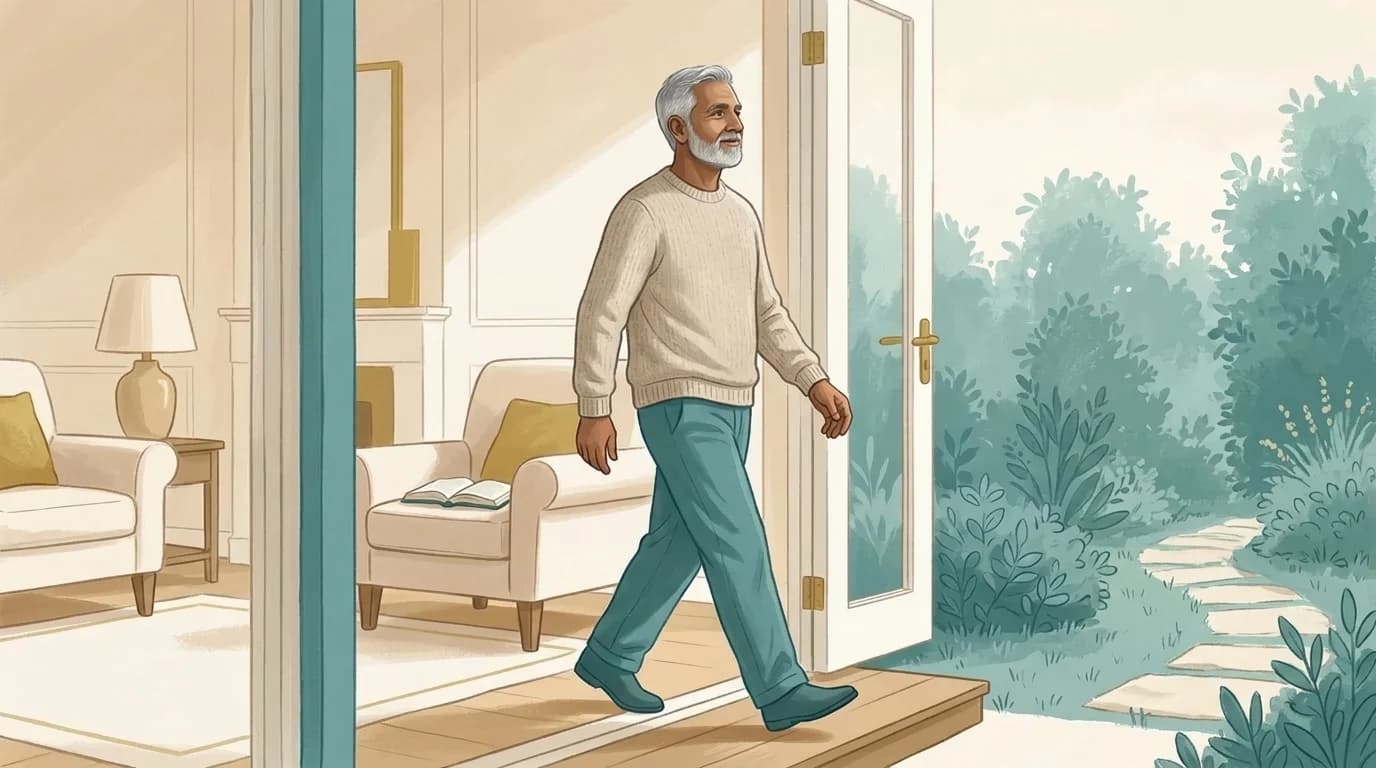
After 55, mood seemed to follow how much people moved, not how many hours they sat
1,190 adults in Western Australia, about 58 on average at the start, were checked three times over eleven years. As activity rose, signs of low mood tended to fall.
The advice most of us have absorbed by now is about the chair. Sit less. Get up every half hour. Set a timer, buy a standing desk, count the hours you spend seated and push the number down.
A team at the University of Western Australia looked at the chair and at movement side by side, in the same people, over eleven years. Only one of the two seemed to move with mood.
What eleven years showed
The study followed 1,190 adults living in the community, part of a larger health study in Western Australia that is supported by state and federal health funders and by the City of Busselton. They were 57.8 years old on average at the start and were assessed three times across the eleven years. Each time, they reported how physically active they were, how much time they spent sitting, and how many symptoms of depression they had (Aging & Mental Health, 2026).
What makes the design interesting is that it wasn't a snapshot. It tracked the direction each person was heading on all three measures, so the question became: when someone's activity rises over the years, does their mood tend to change too?
It did. People whose physical activity increased over time tended to report fewer symptoms of depression over the same years. Changes in sitting time, up or down, showed no link with changes in mood (Lu and colleagues, 2026).
The authors are careful about what that means, and so am I. This is an observational study, so it can't say that moving more lifted anyone's mood; the arrow could just as well point the other way, with people who feel brighter finding it easier to get out the door. They call for studies designed to test cause before anyone rewrites the guidance. These are symptoms people reported on a questionnaire, not diagnoses. And the 1,190 were a subset of a larger study. People who keep taking part across a decade are often the ones well enough to do so, which may tilt the group.
Why the chair may have stayed quiet
This next part is my reading, not the study's. Sitting is not one thing. An hour in a chair can be an afternoon of television alone, or a long lunch with a friend, or a grandchild learning to read on your lap, and a stopwatch can't tell those hours apart, which may be one reason a simple count of seated time has so little to say about how someone feels across a decade of their life.
Movement is different. Moving usually means going somewhere, doing something, meeting someone, being in a body that answers when you ask it to.
Doing less
Look at the timescale. The movement that tracked with mood wasn't a burst of exercise measured over a few weeks. It grew over years, and nothing grows over years unless a person wants to come back to it the next day.
So the lever probably isn't pushing harder. In a Feldenkrais® lesson you only go where it feels easy, pleasant, and comfortable. You rest often. There's no prize for forcing yourself through anything, and what people tell me again and again is that this is the first time in years moving has felt like something they'd choose. You haven't lost movement. You've lost trust that movement will help. Small, easy, interesting movement is how that trust tends to come back, and trust is what keeps someone walking at 68.
A walk you might want to repeat
About 5 minutes. Move slowly, do less than you can, and stay well below any pain. Rest whenever you need to.
- 1
Stand with a chair close by, feet a little apart. Notice how your weight spreads across both feet.
- 2
Walk slowly across the room at your usual pace. Which part of each foot touches the floor first?
- 3
Stop and stand for a moment. Then walk again and let your arms swing a little. Does one swing more?
- 4
Walk a little slower than usual, only as long as it feels easy. What does your breathing do?
- 5
Walk once more with your eyes on the far wall, not the floor. Notice how your head sits.
- 6
Stop and stand. Compare your weight on your feet with the start. What has changed?
Let Feldy guide you, eyes closed
A calm voice walks you through gentle moves so your attention stays in your body, not on the screen.
Try Feldy Free for 7 daysNo credit card needed.
Where this leaves the chair
This study looked at mood only. Sitting time has been studied for other reasons, and nothing here says to ignore that. But if you're tired of policing every hour in a chair, the study points your attention somewhere else: less "how can I sit less?" and more "what kind of movement would I actually enjoy doing more of?"
If walking itself has started to feel uncertain, changes in how you walk are often more about habit and attention than about age, and the same is true of the broader sense that movement declines with the years.
Eleven years is long enough for a habit to stop feeling like a habit and simply become the way someone lives. So the question this study leaves me with isn't how to get people out of their chairs. It's what made some people's movement grow in the first place.
Sources
Movement Pulse is informational, not medical advice. See our editorial policy.
Move better with Feldy
See the programMovement Pulse Weekly
The week's best research, in your inbox Tuesday.
Movement science, gentle-practice ideas, and a practitioner's read on what's new. Free.
More from Movement Pulse
Wearables actually do nudge cardiac patients to move more
A 14-trial meta-analysis just out in JAHA found smartphone apps and wearable trackers added around 1,100 steps and 4 minutes of moderate activity per day. What that means for the rest of us.
Jun 19, 2026
After 60, practising balance gave thinking a small lift, most clearly in mental speed
A review of 54 studies found that training to stay steady also nudged how quickly older adults think. A reason to give your balance practice your full attention.
Oct 16, 2026
For memory changes after sixty, twelve years of reviews keep pointing to slow practice
Mild memory trouble is a stage where a new practice can still be learned, and the research has moved on from asking whether slow practice is worth it to asking how many weeks it takes.
Oct 9, 2026Ready to start moving better?
Gentle, guided lessons for your body. Try your first one free, no credit card required.