
Involuntary Stretching: Why Your Body Does It On Its Own
That long, luxurious stretch you never decided to make has a name, a pattern shared across the animal world, and a reason it feels better than any stretch you plan.
In short
Involuntary stretching is the long automatic stretch your body makes without you choosing it, usually paired with a yawn. Biologists call it pandiculation. It clusters around the shift between rest and activity, it is normal at any age, and it feels good partly because nothing is being forced.

Prefer to ease in gently?
See a few gentle exercises for body awareness to try.
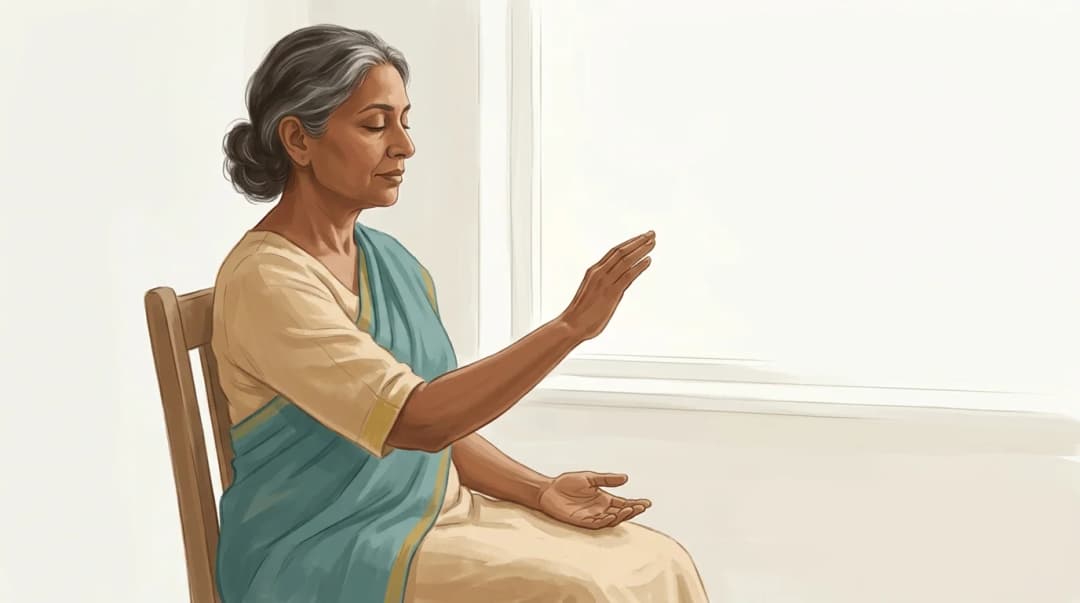
Involuntary stretching is the long, unplanned stretch your body makes on its own, usually the moment you wake, and usually with a yawn folded into it. You did not decide to do it. Your arms went somewhere, your back arched a little, something in your jaw joined in, and the whole thing was over in a few seconds. Biologists have a name for it: pandiculation.
It is worth paying attention to, because it is the closest thing most of us get to a movement designed entirely by the body rather than by the head. Almost everything else we call stretching has an idea attached. Reach the toes. Hold for thirty seconds. Loosen the hamstring before the run. Pandiculation has none of that, and it feels better than any of it.
Why involuntary stretching happens when it does
Watch for it and you will notice the timing is not random. It clusters around transitions: waking from sleep, standing after a long sit, the slow middle of a dull meeting, the moment before a nap. What these have in common is a change in how alert the body is. Something shifts from resting toward doing, or the other way, and a pandiculation turns up at the seam.
Cats and dogs do the same thing, front legs forward, spine long, on rising from a nap. Birds do a version with a wing and a leg on the same side. Human fetuses have been recorded doing it in the womb, well before there is anything to be stiff from. A behaviour that widespread and that early is usually doing something basic, though it is fair to say the exact purpose is still argued about. The common view is that it refreshes the nervous system's sense of where the muscles are and how long they currently are, a kind of internal recalibration between states.
Why it feels better than the stretching you plan
Deliberate stretching has a target and a direction, and you supply the force. The body's own version supplies both, and it never overshoots, because the instruction and the sensing are coming from the same place.
The gap between the two shows up in the evidence as well. Stretching is widely believed to reduce next day soreness after exercise, but a review of twelve trials found the effect was worth only about one point on a hundred point scale (Cochrane review, 2011). One point is close to nothing. Yet almost nobody would say a proper morning stretch is worth nothing, and they would be right. The pleasure and the effect are simply coming from somewhere other than lengthening tissue.
That somewhere is attention. When a movement is slow, unforced, and self chosen, the brain gets an unusually clear reading of the body, and that clarity is a large part of what registers as relief. Our explainer on why morning stretches feel so good follows that thread further.
When an involuntary movement is something else
Not every movement you did not ask for belongs in this category, and the distinction matters. A pandiculation builds slowly, stays pleasant, and fades on its own. It leaves you feeling more settled.
Other things are different in character. Cramps are sudden, hard, and painful, and you want them to stop. Restless legs bring an urge to move that returns as soon as you stop moving, often at night. Myoclonus is a quick single jerk. Tremor is rhythmic and small. Spasticity is stiffness that fights you. Any movement that is painful, repetitive, or arrives with weakness, numbness, or trouble with coordination deserves a conversation with a doctor rather than a shrug. Naming the right thing is the first step toward help that works.
What this suggests about the rest of your practice
If the body's own best stretch has no target, no hold, and no effort, that is worth taking seriously when you plan the ones you do choose. Much of the stiffness people carry is not short tissue. It is holding, a low level of muscular guarding that does not know it is switched on, and guarding responds to attention far better than it responds to force.
This is the ground the Feldenkrais Method® works on. Its lessons are slow and small on purpose, closer in spirit to a pandiculation than to a stretch class, and the aim is to give the nervous system a clearer picture rather than to make a muscle longer. Our Feldypedia entry on loss of flexibility after 50 explains why the stiffness that arrives with the years is so often a habit of holding rather than a change in the tissue itself. If you would like to feel the difference, the somatic exercises for beginners lesson is a gentle first taste, and Feldy offers a free 7 day trial if you want a guided version.
A small experiment for tomorrow morning
Before you get out of bed, wait. Most of us override the first pandiculation of the day by reaching for a phone. Give it a few seconds of nothing and it will usually arrive by itself. When it does, let it be as slow and as large as it wants, let the yawn come if it comes, and notice where in you it travels. Then let it fade rather than ending it. It costs about ten seconds, and it is a surprisingly good daily measure of how much your body is being allowed to ask for.
Learn to listen to your body
Now for the practice that trains it. The Feldy program sharpens your attention through slow, attentive Feldenkrais® lessons, so everyday movement feels lighter and more your own. Gentle, guided, and self-paced.
Start my free 7-day trialNo credit card needed.
Common Questions about involuntary stretching (FAQ)
What is involuntary stretching called?
Pandiculation. The word covers the whole package: the slow spreading of the arms, the arching of the back, the yawn that often rides along with it. Nearly every vertebrate does some version of it, which is one reason biologists find it interesting.
Why does involuntary stretching feel so good?
Two things seem to matter. You are moving at a speed and into a range your own body chose, so nothing is being pushed against, and the movement floods the brain with sensory information from muscles and joints that have been quiet. A stretch you plan has a target. This one has none, which is most of the pleasure.
Is involuntary stretching normal?
Yes, and it is one of the more reliable signs that a body is doing ordinary things. Most people pandiculate several times a day without noticing, on waking, after a long sit, and when they are bored. Babies do it in the womb.
How is involuntary stretching different from a muscle cramp?
A cramp is a hard, painful, unwanted contraction that you want to stop. Pandiculation is a slow build and an easy fade, and it is pleasant the whole way through. If what you are having is painful, sudden, or leaves the muscle sore afterwards, it is a cramp, not this.
When should I see a professional about involuntary movements?
Talk to a doctor if the movements are jerky, repetitive, painful, or happen without any sense of pleasure or relief, if they interrupt your sleep night after night, or if they come with weakness, numbness, or loss of coordination. Restless legs, myoclonus, tremor, and spasticity are separate things worth naming properly rather than filing under a good stretch.
Can I get the same feeling on purpose?
You can get close, and the trick is to stop aiming. Move slowly into whatever direction your body seems to want, let the range find itself rather than deciding on one, and let the movement fade out instead of holding a position. It stops working the moment it becomes a task.
Learn to listen to your body
See the programRelated resources
Why Do Morning Stretches Feel So Good? The Real Reason
That involuntary stretch and yawn on waking has a name, and it works differently from the stretching you do on purpose. What is probably going on.
How to Relax Tight Hamstrings, Gently
How to relax tight hamstrings without forcing a stretch. Often the tightness is protective holding, not short muscle, and slow, gentle attention eases it.
Your balance got better, but did your sense of where your body is get better too
Ready to start moving better?
Gentle, guided lessons for your body. Try your first one free, no credit card required.