
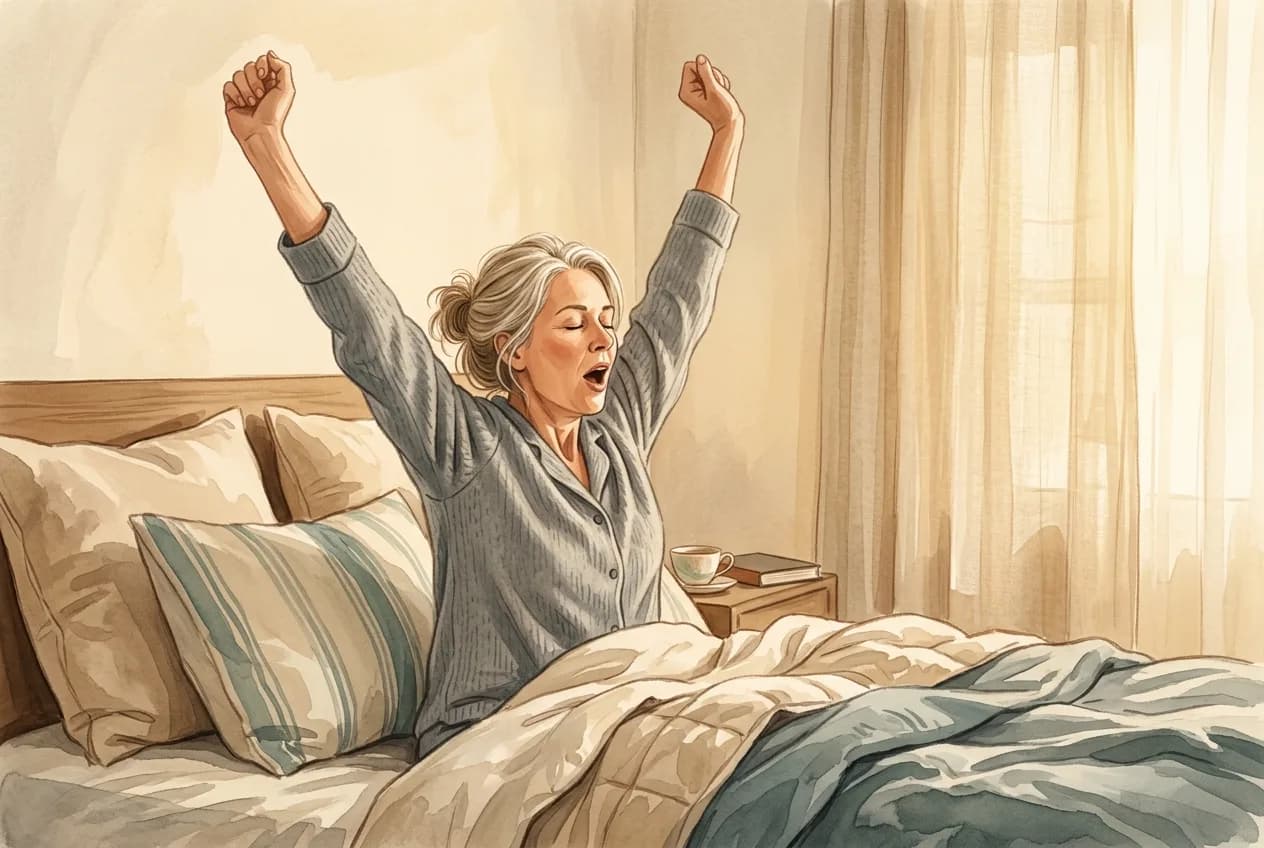
Why Do Morning Stretches Feel So Good? The Real Reason
That involuntary stretch and yawn on waking has a name, and it works differently from the stretching you do on purpose. What is probably going on.
In short
Morning stretches feel so good because the waking stretch is not really a stretch. It is a pandiculation: a self generated contraction and slow release, paired with a yawn, that floods your brain with sensory information about a body it has not heard from for hours. Deliberate held stretching does not produce the same effect.

Prefer to ease in gently?
See a few gentle exercises for body awareness to try.
Why do morning stretches feel so good? The satisfying answer is that they are barely stretches at all. That long involuntary reach you do before your eyes are properly open, arms overhead, back arching, jaw wide in a yawn, has its own name in biology: a pandiculation. It shows up across the animal kingdom, on waking and on any drift between sleep and alertness, and it looks nothing like a hamstring stretch held for thirty seconds.
The difference matters, because it explains the pleasure far better than tight muscles do.
What a pandiculation actually is
Three things happen at once. You contract a lot of muscle strongly, usually along the whole back and sides of your body. You then release it slowly rather than dropping it. And you take a big breath, often as a yawn.
The contraction is the part people miss. A morning stretch is not a passive lengthening but an active, self generated effort. You are the one producing it, at your own speed, and nothing outside you decides where it ends. That combination, effort followed by gradual release, gives your nervous system an unusually detailed report on where all your parts are and how much tone they are carrying.
That is the likeliest reason it feels good. After six or eight hours with almost no movement, your brain has been receiving very little information from your body. The pandiculation is a burst of it, all at once, and the sensation of a body map coming back into focus is a pleasant one. The exact mechanisms are still argued over, so it is worth holding the explanation lightly, but the pattern of the experience fits sensory refreshment much better than it fits tissue lengthening.
Why the same movement on purpose feels ordinary
Try to recreate a morning stretch deliberately at three in the afternoon and it is oddly flat. Nothing is wrong with you. The state is missing: the drowsiness, the shift into alertness, the accumulated stillness the stretch is responding to.
There is a wider point in here about stretching generally. Across 12 pooled trials, the benefit of post exercise stretching on how sore people felt the following day came to roughly a single point out of a hundred (Cochrane, 2011). Measured against outcomes, deliberate stretching does surprisingly little. That is not an argument against moving in the morning. It is an argument that the pleasure of the waking stretch is telling you about attention and sensation, not about how much length you gained. If you are wondering which kind of practice would suit you better than deliberate stretching, our guide to which movement method is right for you is a good place to compare the options.
Why stiffness on waking is normal
Most people feel some stiffness when they first move, and it is one of the least worrying things the body does. During the night you move rarely, your muscles' resting tone drifts up, and joint tissues have not been loaded for hours. A few minutes of gentle movement and it fades.
The rough guide is timing. Stiffness that clears within about half an hour of moving is ordinary. Stiffness that lasts most of the morning, that keeps building over weeks, or that arrives with fever, unexplained weight loss, night pain, or swollen joints deserves a proper look from a clinician. Our Feldypedia entry on waking with stiffness and pain goes into that distinction more fully.
What this suggests about how to move
There is a practical lesson hiding in the biology. If the pleasant part of the morning stretch is the self generated effort, the slow release, and the attention, then those are the ingredients worth copying, and the held position is not.
This happens to be precisely how the Feldenkrais Method® works. An Awareness Through Movement® lesson asks you to produce a movement yourself, slowly, with no target shape, and to notice the release as carefully as the effort. No stretch is held and no range is chased. People often describe the feeling afterwards as similar to a very good morning stretch, which is not a coincidence: it is the same action, done on purpose and with more attention.
In my work with clients, this is usually the moment the approach clicks. They already know what a good pandiculation feels like. The lesson simply makes it available at will rather than only at seven in the morning, which is what the Feldy program for body awareness is built around. Our somatic exercises for beginners is a good place to feel that for yourself, and if you would rather not get out of bed at all, our morning stretches in bed routine keeps it horizontal.
Making the most of the one you already do
Since you get a free pandiculation most mornings, you may as well use it well. Do not cut it short to reach for the phone. Let the release take longer than the contraction. Let the yawn happen fully rather than politely.
And try letting it spread. Most people stretch arms and back and stop there. See whether the movement can continue into your ribs, one side at a time, then into your hips and your feet, and whether your eyes and jaw want to join in. It takes about forty seconds, it costs nothing, and it is the most reliably pleasant movement of the day.
Learn to listen to your body
Now for the practice that trains it. The Feldy program sharpens your attention through slow, attentive Feldenkrais® lessons, so everyday movement feels lighter and more your own. Gentle, guided, and self-paced.
Start my free 7-day trialNo credit card needed.
Common Questions about why morning stretches feel so good (FAQ)
Why do morning stretches feel so much better than stretching at the gym?
Because they are a different action. The waking stretch is generated by you, at your own speed, with a strong contraction followed by a slow release, and nobody told you where to stop. Gym stretching is usually passive, held at a fixed length, and aimed at a target. The first produces a rich flood of sensation, the second produces mostly a sense of pulling.
What is the stretch and yawn on waking actually called?
A pandiculation. It is the involuntary contract and release that animals and people do on waking or on shifting between drowsiness and alertness, and it usually comes with a yawn and a deep breath. Watch a cat or a dog get up and you will see a very complete version of it.
Does the morning stretch mean my muscles are tight?
Probably not in the way the word suggests. After hours of stillness your nervous system has been receiving very little movement information, and the resting tone of your muscles has drifted upward. The stretch reads more like a system checking in with itself than like a short muscle demanding length.
Is it good to do deliberate stretches first thing in the morning?
Gentle movement in the morning suits most people, but the useful version looks more like the involuntary stretch than like a stretching routine. Move yourself, slowly, in whatever direction feels inviting, and let go gradually rather than holding a position. Avoid hard end range stretches in the first minutes after getting up, when tissues are least warm.
Why do I sometimes get cramp during a morning stretch?
Usually because the contraction went to full effort in a muscle that has been still for hours, most often the calf while the toes point. Easing off, bringing the toes back toward you, and making the whole movement smaller normally settles it. Frequent night or morning cramps are worth mentioning to a doctor.
How is this different from a stretching routine?
A routine sets you a shape and a duration. Pandiculation has neither, and its value seems to sit in the attention and the slow release rather than in reaching a length. Movement approaches built on this idea ask you to sense a movement rather than achieve one, which is a different mechanism from flexibility training.
Learn to listen to your body
See the programRelated resources
How to Stop Muscle Spasms: What Actually Helps
Why a muscle locks up in the calf, foot, back, neck or hand, the moves that ease it fastest, and what tends to set spasms off.
Muscle Pain or Joint Pain? How to Tell the Difference
Where an ache seems to live gives you clues. Simple things to notice, why the two often overlap, and when it is time to ask a professional.
Shoulders turned further after a slow, varied lesson than after repeating one twist
Ready to start moving better?
Gentle, guided lessons for your body. Try your first one free, no credit card required.