
What Is Tai Chi Walking? A Plain Guide for Beginners
Tai chi walking is slow, attentive walking borrowed from tai chi: soft knees, a quiet heel, and weight that travels one leg at a time. Here is how to try it at home.
In short
Tai chi walking is a slow walking practice taken from tai chi. You keep the knees soft, place the heel down quietly, and let your weight travel onto that leg before the other foot lifts. It is a way to practice balance, weight shifting and attention.

Prefer to ease in gently?
See a few gentle exercises for stiffness after 60 to try.
Before you begin. Tai chi walking asks you to stand on one leg for a moment, so practice beside a counter, wall or rail, in good light, on a clear floor. If you feel dizzy or unsteady, stop and check with your doctor. Keep any walking aid you normally use.
Tai chi walking is a slow walking practice drawn from tai chi. The knees stay soft. Each foot is placed heel first, quietly, before any weight moves onto it. Then the weight travels from one leg to the other in a gradual, unhurried shift. You stay upright and easy, breathe calmly, and pay attention to the whole thing. The term has spread fast through social feeds lately, which makes it sound newer than it is. The slow, deliberate stepping has been part of tai chi for centuries. What is new is practicing that one piece on its own, in a kitchen or a hallway, with nothing to memorize.
What tai chi walking actually involves
Think about how you normally cross a room. Most of us lean forward a little and let the front foot catch us. The step is quick, the landing is automatic, and the weight arrives all at once. Tai chi walking slows that moment down and takes it apart.
Four things change. First, the knees stay slightly bent the whole time, so you never lock a leg straight. Second, the stepping foot reaches forward and sets its heel down with no weight on it yet, as quietly as you can manage. Third, the weight moves slowly from the back leg to the front leg. You can feel it arrive in the heel, then the sole, then the toes. Fourth, you stay tall and easy through all of it, with your breath slow and your attention on what your feet and legs are doing. A step that usually takes half a second might take four or five.
That drawn out weight shift is the heart of the practice. It is also the exact moment in ordinary walking where balance is most tested, when one leg carries everything and the other is in the air. Tai chi walking gives you a way to visit that moment on purpose, slowly, and with support nearby.
How to try tai chi walking at home
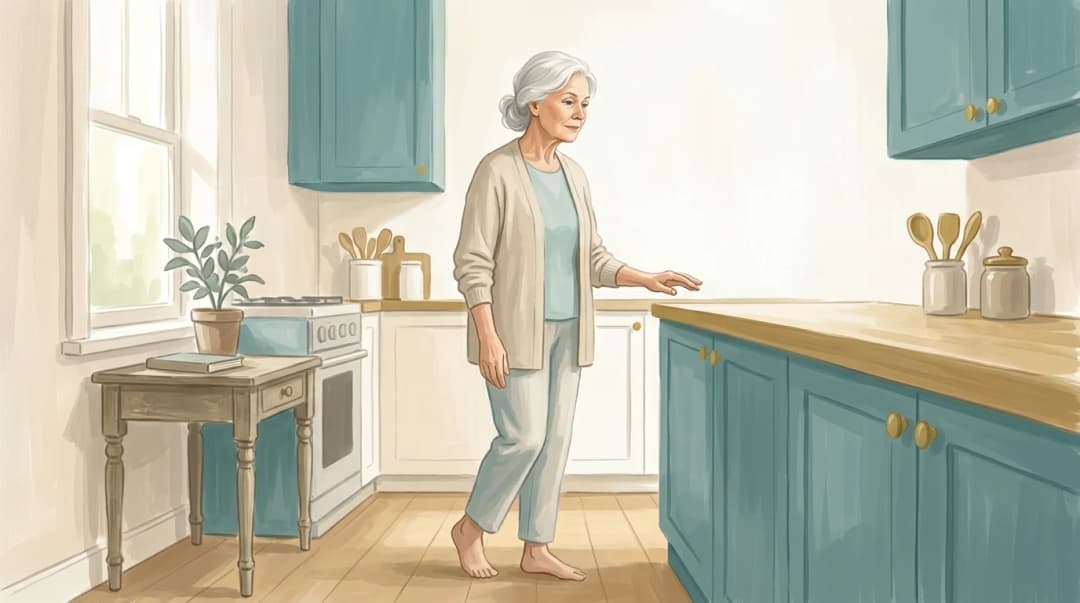
Begin beside a kitchen counter or a long wall, with one hand resting on it. Wear shoes that grip, or go barefoot on a floor that is not slippery. Stand with your feet about hip width apart and notice where your weight sits. Is it more on the heels or the toes? More on one foot than the other? Whatever you find is the starting point.
Let both knees soften a little. Then let your weight drift slowly over to your right leg until the left foot feels light. Lift the left heel, then the whole foot, and set it down a short step ahead, heel first, with the toes still raised. Pause there. Nothing has moved yet except the foot. Now let your weight travel forward onto the left leg, as slowly as you can, until the right foot feels light in turn. Pause again. That was one step.
Take three or four more in the same way, then stop. Stand still for a moment and notice how you feel. Then walk a few ordinary steps at your usual speed and compare. Many people find the normal step feels faster or heavier than they expected, or that one foot lands more clearly than the other. That comparison is the lesson. A minute or two is plenty for a first try, and you can come back to it another day rather than pushing on.
Our gentle exercises for seniors pair well with this. They are done lying down and ask the same kind of attention of you. If slow stepping forward interests you, our guide to the benefits of walking backwards explores another way to wake up the feet.
What tai chi walking can offer, and what it cannot
The plain case for tai chi walking is this: it is a way to practice balance, weight shifting and attention, three things most of us stop practicing once walking becomes automatic. Falls are a real concern as the years go by. WHO estimates that around 684,000 people die from falls each year worldwide, and adults over 60 account for the greatest number of those deaths (WHO, 2021). The same fact sheet names tai chi among the measures it recommends for older people.
Two things belong next to that number. The research behind the recommendation is on classical tai chi, practiced regularly in full form, and the effect it shows is real but modest. Tai chi walking itself has not been tested as a method of its own. Our Movement Pulse piece on tai chi walking and the evidence sets out what the trials do and do not show. This page will not repeat the numbers.
What tai chi walking cannot do is promise you anything. It is practice, and practice works at its own pace. Perhaps a full tai chi class appeals, and standing through it is no trouble. Our comparison of tai chi for seniors looks at where classes shine and where another format may suit you better.
The Feldenkrais® angle: curiosity about the step
In the Feldenkrais Method, we look at the same slow step from a slightly different direction. Instead of trying to do it well, we get curious about what is already happening. How does the heel meet the floor? Does the pelvis move forward with the leg, or wait behind? Where does the head go when the weight shifts, and does it need to go there at all? Questions like these turn a balance exercise into a small act of noticing, and noticing is where easier movement tends to begin.
This also means small doses. A few steps with real attention teach more than fifty on autopilot. Many of our lessons for people who feel stiff after 60 spend time on the feet, the pelvis and the way weight passes through the body. Most are done lying down, where there is nothing to balance against and the nervous system can afford to be curious. Feldy offers a free 7 day trial if you would like to feel how that attention carries over into standing and walking.
Staying steady while you learn
A few plain habits keep the practice comfortable. Stay within reach of support for the whole session, from the first step to the last. Choose good light and a floor with nothing on it: no rugs with lifted edges, no cables, no pets underfoot. Keep the steps short at first, since a long stride asks more of your balance than a short one. Breathe normally, and let the knees stay soft rather than locked.
If you feel dizzy, lightheaded or more unsteady than usual, sit down and leave it for the day. If that happens more than once, tell your doctor. And if you use a cane, stick or walker, keep using it. Tai chi walking works perfectly well with a hand on something.
Alongside clinical care and other methods
Tai chi walking is movement practice, not treatment. If you are seeing a doctor or physiotherapist about your balance, that care continues, and this sits alongside it.
Other methods approach steadier walking through different doors. Yoga builds strength and balance in held standing poses. Pilates works the trunk and hips that organize each step. The Alexander Technique looks at how the head leads the body in movement. Walking meditation from the Buddhist tradition shares the slow pace, with attention resting on breath and sensation rather than on balance as such. Each works through its own mechanism, and none is a lesser choice. The one that suits you is the one you will keep doing.
Find where to start
Tai chi walking is one doorway into slow, attentive movement, and it suits people who like to practice on their feet in short bursts. If you are not sure whether that doorway or a different one fits the way you like to move, a short quiz can save you some guessing.
Not sure which movement method fits you? Take the 60-second Movement Match quiz, and see which method suits the way you like to move.
Move easier again, whatever the calendar says
Now for the part that changes it. The Feldy program helps a body that has carried itself for decades find lighter, freer movement, through gentle Feldenkrais® lessons at home. Gentle, guided, and self-paced.
Start my free 7-day trialNo credit card needed.
Common Questions about tai chi walking (FAQ)
Does tai chi walking work?
It gives you a way to practice weight shifting and balance with your full attention, and that is a skill worth having. The evidence for steadier balance comes from classical tai chi practiced regularly, and tai chi walking borrows the most useful part of it. Nobody can promise a result. If a change comes, it tends to follow a few weeks of short, regular practice.
What is the best way to start tai chi walking as a beginner?
Start beside a kitchen counter with one hand resting on it. Take three or four very slow steps, pause, and notice how you feel, then walk normally for a moment and compare. Keep the first sessions to a minute or two, and let the counter carry some of your weight for as long as you want it to.
What should I avoid when trying tai chi walking?
Avoid long sessions on the first day, socks on a smooth floor, dim light, and anything on the floor you could catch a foot on. Avoid holding your breath or locking the knees straight. Avoid practicing when you feel dizzy or unusually tired. If you use a cane or walker, keep using it.
How is tai chi walking different from ordinary slow walking?
Ordinary slow walking is your usual step at a lower speed. Tai chi walking changes the shape of the step: the knees stay soft, the heel lands before any weight moves onto it, and the shift from one leg to the other is drawn out so you can feel each part of it. The attention is the point, not the pace.
How often should I practice tai chi walking?
Little and often suits it well. Two or three minutes a day, most days, gives your balance something to work with. Many people fold it into a walk across the kitchen or down the hallway rather than treating it as a separate session, which makes it easier to keep up.
Is tai chi walking safe if my balance is already shaky?
It can be, as long as support is within reach for the whole time, the light is good and the floor is clear. If you have fallen in the past year, feel dizzy when you stand up, or have numbness in your feet, talk it over with your doctor or physiotherapist before you begin. Keep any walking aid you normally use.
Do I need to learn tai chi forms before trying tai chi walking?
No. Tai chi walking takes one piece of tai chi, the slow stepping that runs through every form, and leaves the choreography behind. If you enjoy it and want more, a class will teach you the forms over time, and the slow steps you already know will feel familiar.
Move easier again, whatever the calendar says
See the programRelated resources
Tai Chi for Seniors: Great, Until Standing Is the Barrier
Tai chi earns its balance reputation, and we say so plainly. But when standing through class or memorizing forms is the barrier, Feldy wins.
Walking Backwards Benefits: Is It Good for You?
Walking backwards can steady your balance, ease your knees, and wake up coordination. Here is what the evidence says and how to try it safely.
The best time to start gentle balance practice may be before you feel you need it
Ready to start moving better?
Gentle, guided lessons for your body. Try your first one free, no credit card required.