
How to Fix Duck Feet Posture, and What Cannot Change
Some out turned feet come from bone shape and will not change. Others are habit and will. Here is how to tell which you have, and what to do about each.
In short
How to fix duck feet posture depends on where the turn out comes from. If it starts at the hip or is simply a standing habit, gentle movement and attention can change it. If it comes from the shape of the thigh or shin bone, the angle will not change, and the useful work is comfort and even loading rather than correction.

Prefer to ease in gently?
See a few gentle exercises for body awareness to try.
Before you begin. General movement guidance, not medical advice. See a doctor or physiotherapist if one foot turns out noticeably more than the other, if the turn out appeared suddenly or has changed recently in an adult, if it comes with hip, knee, or foot pain, or if you are limping. Out turned feet in a child should be assessed by a paediatrician or physiotherapist rather than treated with exercises from the internet, since most childhood cases resolve on their own.
How to fix duck feet posture is a question with an answer most articles skip: it depends on where the turn out starts, and in a fair number of adults the angle is not going to change at all.
That is not a reason to stop reading. It is a reason to aim at the right target. Some out turned feet come from the shape of the thigh bone or shin bone, set in childhood, symmetrical, and unaffected by any exercise. Others come from how you hold your hips and load your feet, which is habit, and habit is workable. Telling them apart takes about two minutes and saves a great deal of frustration.
Feet are worth attention regardless of the angle. Plantar fasciitis turns up in about one person in ten, most often somewhere between forty and sixty years of age (StatPearls, 2023), and how your foot meets the ground is part of that picture.
Where the turn out actually starts
At the bone. The thigh bone can sit rotated outwards in the hip socket, or the shin bone can be twisted slightly outwards along its length. Both are common variations, usually established in childhood, usually similar on both sides. No amount of movement work rotates a bone. What can improve is comfort and how evenly the foot loads.
At the hip. The muscles that turn the leg outwards can become the default, particularly in people who sit with their legs apart or who have spent years in sports that reward an open stance. This is a pattern, not a structure, and patterns respond to attention.
At the foot. When an arch collapses inwards, the front of the foot often drifts outwards to keep you balanced. Here the turn out is a consequence rather than the cause, and the arch is the place to look.
Our Feldypedia article on gait changes and walking difficulty covers how walking patterns settle in over time.
The simple sorting test
Sit on a chair with your feet off the floor and let your lower legs hang. Slowly swing each lower leg inwards and outwards from the knee, and notice how far it travels each way compared with the other side.
Then lie on your front with your knees bent to a right angle and let your feet fall gently outwards, then inwards, comparing the two directions again.
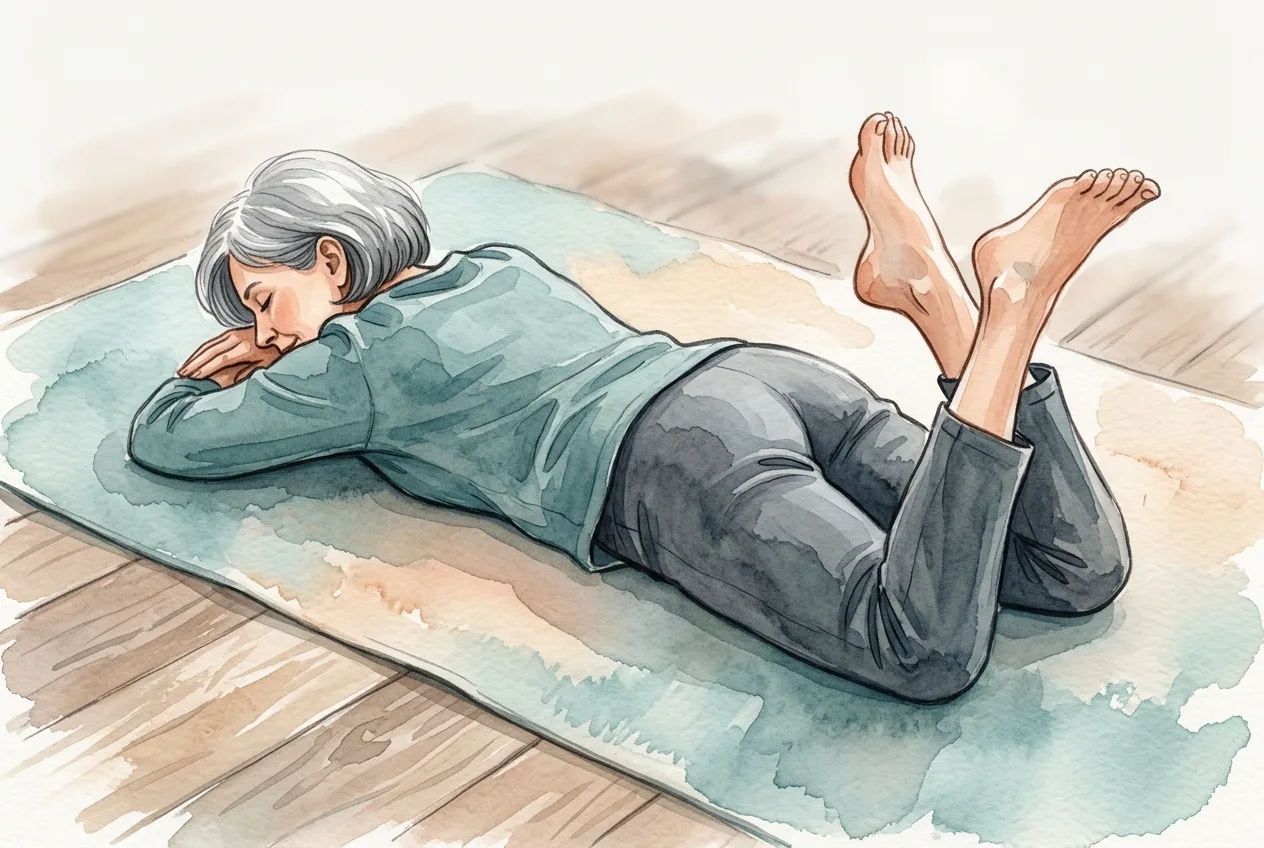
If inward rotation is available in these tests but disappears when you stand, you are looking at habit. If inward rotation is restricted in both legs in the same way, bone shape is doing most of the work. If one side is clearly different from the other, get it assessed rather than guessing.
How to fix duck feet posture when it is habit
- Feel rotation at the hip, not the ankle. Stand with your feet where they naturally fall and slowly turn a whole leg inwards and outwards a small amount, keeping the foot flat. The turning should happen at the hip.
- Wake up the arch. Gently lift the arch of the foot without curling the toes, hold for a moment, and let go. Our short foot lesson walks through this properly.
- Change how you stand, not how you look. Notice where your weight sits on each foot. Most turned out standing comes with weight sitting on the inner edge.
- Pay attention while walking, briefly. Thirty seconds a few times a day beats a long session, because walking is automatic and automatic things change slowly.
- Leave the knee out of it. Never force the foot straight by twisting below the knee. If the hip will not rotate, the knee should not do it instead.
The Feldenkrais Method® is a good fit for the habit version of this, because it works on what you can sense rather than what you can force. When you can feel the difference between turning at the hip and twisting at the ankle, the standing pattern often changes on its own. Our somatic exercises for beginners is a gentle way in, and the Feldy body awareness program develops it further.
Find where to start
Whether your feet turn out from bone shape or from habit changes what is worth your time entirely. It is the first thing to settle, and it is not something a video can tell you.
Curious which movement approach suits how you stand? Take the 60 second Movement Match quiz and get a single method matched to what you are working with.
Learn to listen to your body
Now for the practice that trains it. The Feldy program sharpens your attention through slow, attentive Feldenkrais® lessons, so everyday movement feels lighter and more your own. Gentle, guided, and self-paced.
Start my free 7-day trialNo credit card needed.
Common Questions about duck feet posture (FAQ)
What causes duck feet posture?
Three different things, and they need different answers. The first is the shape of the bones themselves, where the thigh bone or shin bone is naturally rotated outwards. This is usually present since childhood, affects both sides similarly, and does not change with exercise. The second is the hip, where the muscles that turn the leg outwards are habitually more active than those that turn it in. The third is the foot itself, where a collapsed arch lets the foot roll inwards and the toes drift out to compensate. Many people have a mix.
How do I tell if my duck feet come from bone or habit?
A rough home test is to sit on a chair with your knees bent and let your lower legs swing freely, then compare how far each shin turns inwards and outwards. If your legs rotate inwards easily but your feet still point out when you stand, habit is playing a large part. If inward rotation is limited on both sides in the same way, bone shape is more likely. Lying on your front with knees bent and letting the feet fall outwards and inwards gives a similar picture. A physiotherapist can assess this properly in a few minutes.
What is the best exercise for duck feet posture?
Learning to feel and control inward rotation at the hip, rather than stretching anything. Standing with your feet parallel and slowly turning your whole leg inwards and outwards a small amount, keeping your foot flat, teaches the difference between turning at the hip and twisting at the knee. Adding work for the arch of the foot, such as gently lifting the arch without curling the toes, helps when the foot is part of the picture. Walking with attention on how your feet leave the ground is worth more than any single exercise.
What should I avoid when trying to correct duck feet?
Avoid forcing your feet parallel and holding them there, because forcing rotation at the ankle when the restriction is higher up puts strain on the knee. Avoid deep squats with the feet held straight if that produces knee discomfort. Avoid any programme that promises to change bone rotation in adults. And avoid treating the walking pattern as a fault to be corrected, since plenty of people walk with turned out feet for decades without any trouble at all.
How long does it take to change duck feet posture?
If the cause is habit, people often notice a difference in how they stand within two to four weeks of daily attention, and a change in walking takes longer, usually two to three months, because walking is highly automatic. If the cause is bone shape, the angle will not change at any timescale, though comfort and how evenly you load the foot often improve. Slow progress is normal here and pushing harder does not speed it up.
Is duck feet posture actually bad for you?
Not in itself. Turned out feet are a variation rather than a fault, and many people have them with no symptoms. The reasons to pay attention are practical: a strongly turned out foot changes how load passes through the knee and the arch, which can contribute to arch pain, bunion irritation, or knee discomfort in some people. If you have no pain and no difficulty, this is a question of curiosity rather than a problem to be solved.
When should I see a professional about duck feet?
See someone if only one foot turns out, if the turn out is new or has changed in adulthood, if you have knee, hip, or foot pain, or if the pattern is affecting how you walk. Children with markedly out turned feet should be seen by a paediatrician or paediatric physiotherapist, since assessment matters more than exercises at that age. If you already see a physiotherapist, gentle awareness work sits alongside what they prescribe.
Learn to listen to your body
See the programRelated resources
Short Foot Exercises: A Gentle Way to Sense Your Arch
A slow, seated lesson in the small doming movement behind short foot exercises, done with attention rather than effort, and comfortably below any strain.
How to Stand Taller: Gentle Movement, Not Forcing
How to stand taller without bracing your shoulders back, by easing habitual holding so your head floats up and the spine lengthens, plus a short gentle practice.
Shoulders turned further after a slow, varied lesson than after repeating one twist
Ready to start moving better?
Gentle, guided lessons for your body. Try your first one free, no credit card required.