
Short Foot Exercises: A Gentle Way to Sense Your Arch
A slow, seated lesson in the small doming movement behind short foot exercises, done with attention rather than effort, and comfortably below any strain.
Before you begin. This is general movement education, not medical advice. If you have reduced sensation in your feet, diabetes, a recent foot or ankle injury, or foot pain that keeps worsening, please have a doctor or podiatrist look at it before starting any foot practice. Numbness, a wound that will not heal, or sudden swelling belongs in a clinic first.
The lesson
About 5-10 minutes. Move slowly, do less than you can, and stay well below any pain. Rest whenever you need to.
Prefer to listen than read?
Feldy voices gentle lessons like this for body awareness, so you can close your eyes and follow along.
- 1
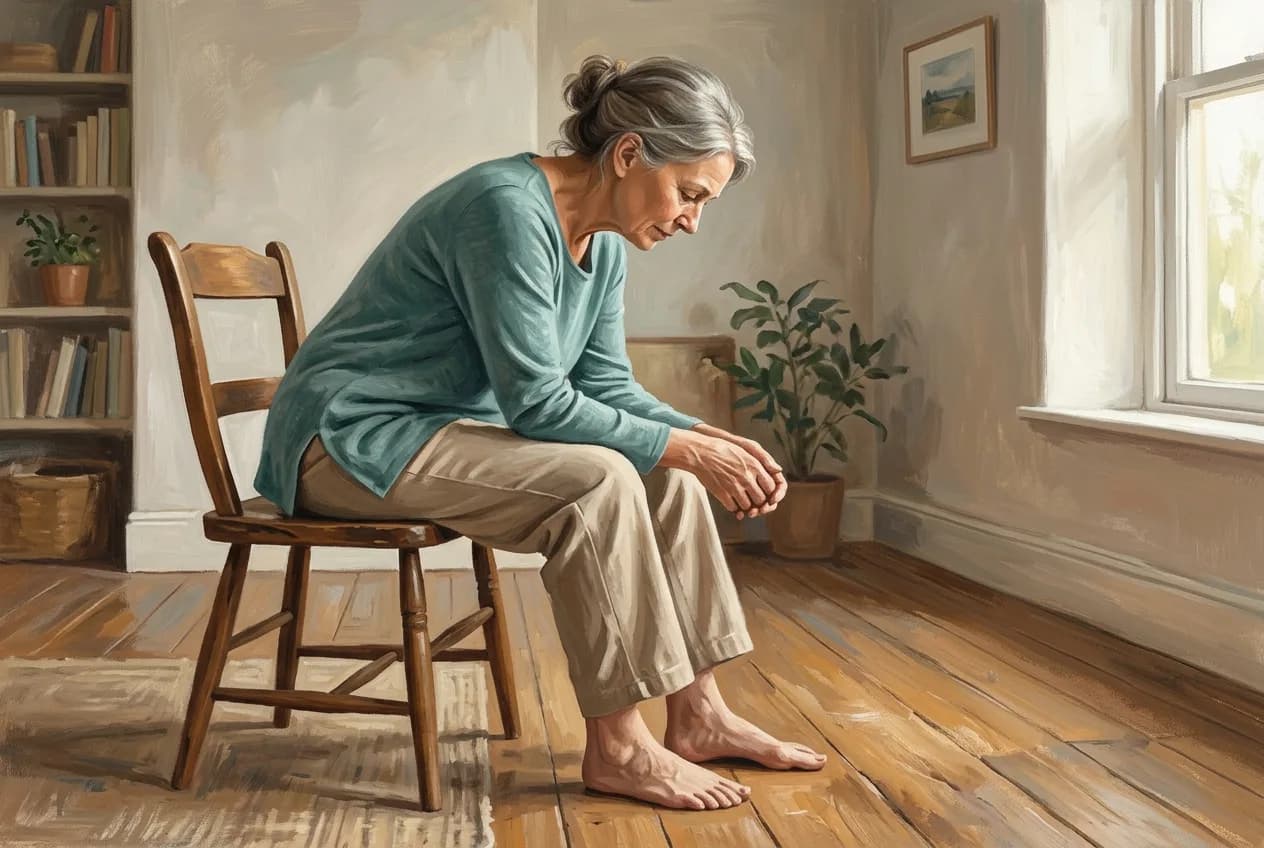
Sitting, both feet down. Please sit toward the front of a chair with both soles resting on the floor and your knees roughly above your ankles. Take a moment to feel which parts of each sole meet the ground.
- 2
A quiet survey of one sole. Let your attention wander slowly across one foot: the heel, the outer edge, the pad behind the big toe, the smaller toes. Which parts feel clear to you, and which feel vague?
- 3
Toes lifting, nothing else. Slowly lift all five toes of that foot away from the floor, then lower them again. The heel and the pad of the foot stay quietly down, and you go only as far as feels easy.
- 4
The ball drifting toward the heel. Now let the toes lie long and soft, and see if the pad of the foot can travel a hair closer to the heel, so the arch rises a little by itself. It is far smaller than most people expect, closer to an idea than a movement.
- 5
Rest, then a few more. Stop and let the whole foot spread on the floor for a moment. Then revisit the small doming three or four times, each one slower and lighter than the last.
- 6
The second foot, or the picture of it. If you are curious, visit the other foot in the same unhurried way. Imagining it while the foot simply rests is a complete version of the step.
- 7
Standing to compare. Come to standing slowly, let your weight settle, and take a few steps around the room. What, if anything, feels different between the two feet now?
Let Feldy guide you, eyes closed
You just read these steps. In the Feldy program, a calm voice guides you through each gentle move, so your attention can stay in your body instead of on the screen.
Try Feldy Free for 7 daysNo credit card needed.
Most short foot exercises are taught as something to achieve: shorten the foot, hold for ten seconds, repeat. The lesson above takes the opposite route. It uses the same small doming movement, in which the pad of the foot travels a fraction closer to the heel while the toes stay long, but it treats it as a question rather than a task. That approach comes from the Feldenkrais Method®, where attention does the work that effort usually claims. Sit down, keep the toes soft, and let the arch rise by a couple of millimetres. If nothing visible happens at first, you are probably doing it about right.
What the short foot exercise actually is
The movement was popularised by the Czech neurologist Vladimir Janda, and it targets the intrinsic muscles that live entirely inside the foot rather than the long tendons arriving from the calf. In a proper short foot, the distance between the ball of the foot and the heel narrows very slightly, the arch domes upward, and the toes stay flat and uninvolved. Nothing curls, nothing grips. That is the whole movement, and the reason it is so often taught badly is that the correct version looks like almost nothing from the outside.
Feet are worth this kind of attention. Plantar fasciitis alone occurs in roughly 10% of the general population, with the peak between the ages of 40 and 60 (StatPearls, 2023). That figure is not a reason for alarm about your own arches, but it does say something about how much quiet work feet do, and how rarely we ask them how they are getting on. Our Feldypedia entry on proprioception decline with age covers why the sense of the sole tends to blur over the decades.
Why short foot exercises work better slowly
A foot has more than a hundred small structures inside it, and the muscles you are inviting here are tiny. Fast or forceful attempts recruit the big movers first, which is exactly how toe curling sneaks in. Slowing everything down gives the smaller players time to answer, and it gives you time to feel the difference between a foot that is doming and a foot that is merely gripping.
The other reason for slowness is information. A movement performed at speed teaches the nervous system very little, because there is nothing to feel on the way. Move at a tenth of that pace and the sole becomes legible: which part presses, which part hovers, which toes want to help when they were not invited. Our lesson on intrinsic foot exercises explores the same small muscles from a different angle if you want more of this.
Taking short foot exercises into standing and walking
Once the seated version feels ordinary, the interesting part begins, which is letting the same small doming appear while you are upright. Stand with your feet under your hips and share the weight evenly between both soles. Without shifting your weight or squeezing anything, see whether the arches can rise a whisper and settle again. Then take a slow walk and simply notice, with no attempt to change anything, whether the soles feel any different as they meet the floor.
That last part matters more than the repetitions. The point of any foot practice is not the exercise itself but what happens in the thousands of unremarkable steps afterwards, when nobody is paying attention. This is the lying down and sitting practice called Awareness Through Movement®, and it is what the Feldy free trial offers as guided audio, so you can keep your eyes closed and your attention on the foot instead of on a page.
Who should be careful with foot work
Gentle foot lessons sit comfortably alongside the care of a podiatrist or physiotherapist, and it is worth telling them what you are practising so the pieces fit together. If you have diabetes or any loss of sensation in the feet, a wound that is slow to heal, a recent fracture or sprain, or pain that keeps escalating, get that looked at before you start. Other approaches, such as targeted strengthening programmes with bands and weights, work through a different mechanism, building force through load and repetition, and many people happily run both alongside each other.
Find where to start
Feet rarely act alone, and a sole that has gone quiet often shows up as an ankle, knee or hip that works harder than it needs to. The Feldy program for body awareness starts wherever your own attention is thinnest, which is not always where the ache is.
Unsure which method is yours? Take the Movement Match quiz, four quick questions in about two minutes, to find your best movement method.
Common Questions about short foot exercises (FAQ)
Are short foot exercises safe for everyone?
For most people a small, slow doming movement done seated is very gentle, because there is no load and no stretch involved. It is worth checking with a professional first if you have diabetes or reduced feeling in your feet, a recent sprain or fracture, an open wound, or foot pain that has been steadily getting worse. Numbness, sudden swelling, or a foot that will not take weight needs assessment rather than practice. As always, keep the movement well below anything that stings.
How often should I practise the short foot exercise?
Two or three minutes on most days tends to serve the feet better than a long weekly session. Feet respond to repetition and attention more than to duration, and the movement is small enough that it never needs a recovery day. Many people slot it in while sitting at a desk or waiting for the kettle. Let comfort rather than a target set the frequency.
How long until short foot exercises make a difference?
Sensation usually shifts first, and many people feel the sole meeting the floor a little more clearly within one or two sittings. Changes to how you stand and walk build more slowly, over weeks of short and regular practice, and they vary a great deal from person to person. If your feet feel no different after several weeks, that is worth mentioning to a podiatrist or physiotherapist rather than pushing harder.
What is the best short foot exercise for flat feet?
The seated version above is usually the kindest first choice, because sitting removes body weight from the equation and lets you feel the arch rather than fight for it. A flat looking foot is not automatically a painful or problematic foot, and many people walk happily on low arches all their lives. Once seated doming feels familiar, the same idea can be explored in standing with the weight evenly shared. Our lesson on foot exercises for arches takes the lying down route to the same territory.
How is this different from strengthening my feet at the gym?
Calf raises, resistance bands, and towel scrunches set out to build force in a muscle through repetitions and load. This lesson has a quieter job. It is asking the nervous system for a clearer map of the sole, so the small muscles inside the foot start taking part on their own during ordinary standing and walking. The two approaches suit each other, and plenty of people do both.
What should I avoid when doing short foot exercises?
The main thing to skip is toe curling. Gripping the floor with the toes recruits the long muscles of the calf and hides the very movement you are looking for, so keep the toes long and lazy throughout. Also avoid holding the shape for long counts, clenching the jaw or breath, and repeating it until the arch cramps. If the foot starts to cramp, stop, wiggle the toes, and make the next attempt smaller.
Learn to listen to your body
See the programRelated resources
Intrinsic Foot Exercises: Waking Your Foot's Own Core
Calm intrinsic foot exercises that reawaken the tiny muscles living inside each foot, the hidden core that shapes the arch and quietly steadies your balance.
Foot Exercises for Arches: A Gentle Lesson in Sensing
A short lying down lesson that treats the arch as a living, moving part of your foot, sensed through the whole leg, not a shape to hoist up and hold.
Asked to picture a short walk, older adults imagined four seconds. It took them six
Ready to start moving better?
Gentle, guided lessons for your body. Try your first one free, no credit card required.